
Nepal Through A Lens: A Pictorial Adventure - Part I
Nestled in the high Himalayas is the picturesque nation, Nepal. A country like no other with great diversity in ethnicity, climate, wildlife and flora. A photographic journey through these lands is a breath-taking experience. Something that has never been done in a paramount scale.
Over time, photography has developed as a sub-genre in travel. It has grown from just instilling the moment onto film or paper and evolved into a multi-faceted experience. People today travel to photograph and through this process indulge in the beauty and elements of the destinations.
I remember stumbling upon images of Nepal taken before we instituted an open door policy(1950AD). These travellers, some inconspicuously took great photographs to preserve the tranquil beauty of Nepal in film. Revisiting them in the 21st century, much has changed. Taking a time composite shows the gravity of how Nepal has deeply absorbed the facets of modernization. In this urban chaos, still lies the old world preserved in a unique amalgam.
Nepal has much to offer in photography which can lure many to this beautiful country. Photography has also grown in both technological and cultural aspects: it has also evolved into a glorious art form.
If one reviews most of my articles, I never fail to mention how Nepal has good diversity. It offers something for every genre of travellers and all age groups. When it comes to pictorial adventures as well, we have a diverse range for all photographers.
Exploring Nepal, little by little, it always dawns on me how beautiful it truly is. I haven’t travelled much of this nation: but in my adventures, I find peculiarities, beauty and tranquillity. The never-ending savanna of the terai, the layered hills and jagged north is an adventure beyond imagination for a curious mind. The terraces of the eastern region, urban chaos of central and the untainted beauty of the far-west is far too alluring as well.
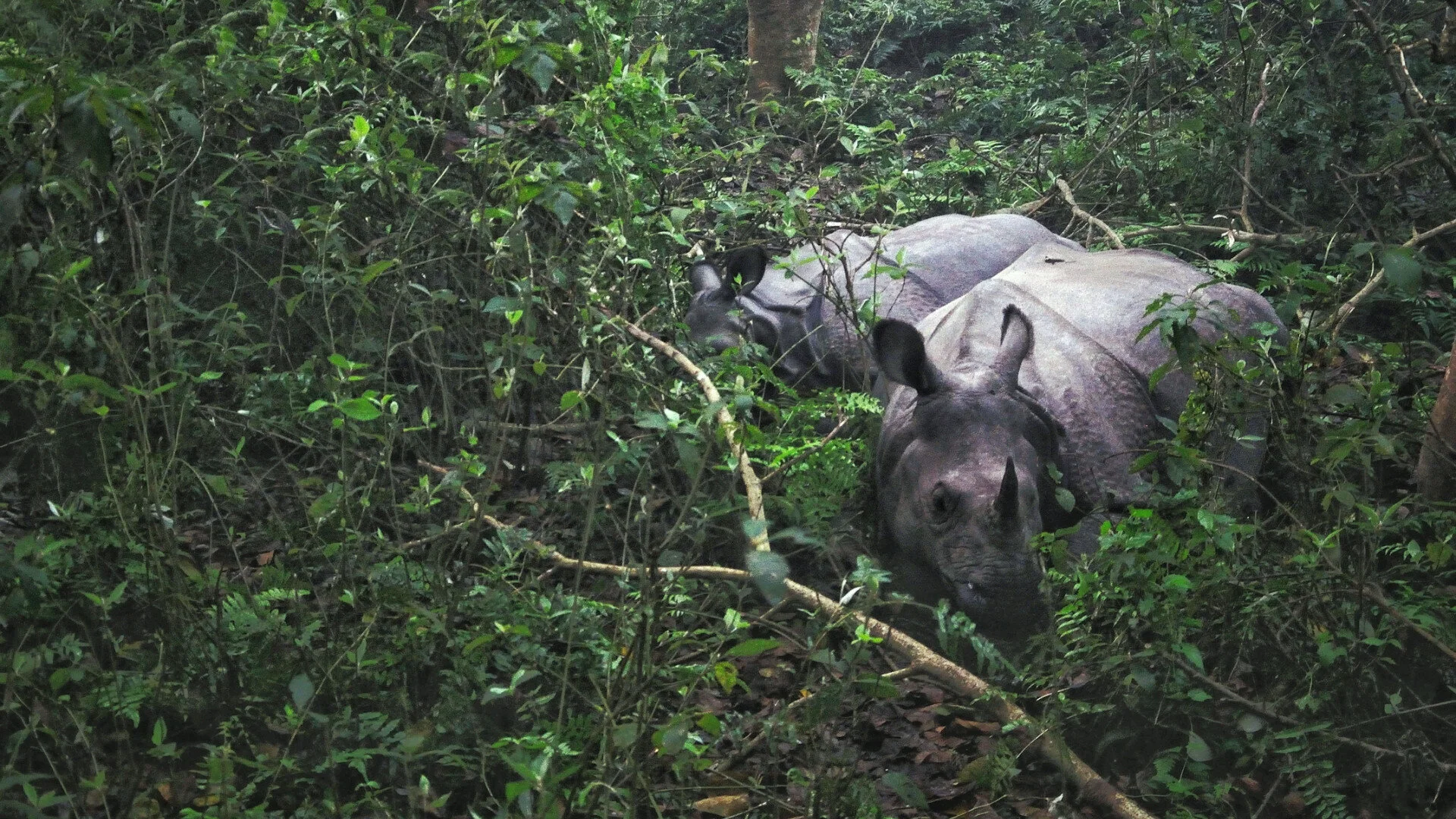
Venturing these lands with the intent of photography is an experience like no other; chasing the Bengal Tiger in the savanna to stumbling upon the Red Panda in the eastern hills, watching a flock of blue sheep attempt an impossible climb and daring the arctic to photograph the snow leopard.
The cultural discovery is also paramount, landscapes straight out of heaven and architecture of a bygone era. All of this and much more awaits a photographer in Nepal. We explore below in segments the dimensions of possibilities.
Wildlife Photography
Nepal’s geographical vastness needs no introduction. It has over time helped develop the biological diversity of Nepal. The variance in climatic conditions beginning from tropical in the south to reaching arctic in the north has made Nepal, “ Truly Natural”.
Nepal’s biodiversity is comprised into two main regions:
1. Mountainous ecoregion
2. Savanna and Grasslands ecoregion
Nepal is proudly called home by 208 mammal species and different reptiles, some of which are native. As of data collected in 2012 AD, we have more than 900 species of birds with the spiny babbler which is endemic (native) to Nepal. Underwater, we have a great diversity of catfishes spread out all over the country and also the Nepalese snowtrout.
Amongst this diverse selection the elusive snow leopard (Found North), Bengal Tiger (Found South), Red Panda (North Eastern), Blue Sheep (North West), One-horned Rhinoceros (South) are the creatures that have ringed many bells and marked ample expeditions to Nepal. Avifauna photography has also been a call to the wild for many adventures.
These faunas are protected under, National Parks and Wildlife Conservation Act 2029 BS. The 4 “classes” of protection are as follows:
1. National Parks (9)
2. Wildlife Reserves (3)
3. Conservation Areas (3)
4. Hunting Reserve (1)
Along with which we proudly hosts multiples Ramsar sites (Wetlands). The enlistment of Sagarmatha National Park and Chitwan National Park as world heritage was a notable achievement.
Flora Photography
As per the documented data of the 1970s and early 1980s, Nepal is home to 5067 species of flora. Amongst which 5041 were angiosperms and the remaining 26 species were gymnosperms. The ICOMOS checklist (as of 2006) presents 2,532 species of vascular plants under 1034 genera and 199 families in the protected sites.
Out of these species, 400 vascular plants are endemic (native) to Nepal. We have two endemic orchids Pleione coronaria, Oreocrchis porphyranthes and the most popular endemic plant is the rhododendron (arboreum).
A pictorial adventure through the lush foothills and the mountainous eco-system discovering Nepal’s flora, wouldn’t just be an experience but will also contribute to Nepal and the world. It is a segment unexplored in Nepal and lack interest in multiple dimensions (Research, Documentation and Photography) as left a gap in understanding flora and its potential.
POPULAR ITINERARIES
SIMILAR POSTS

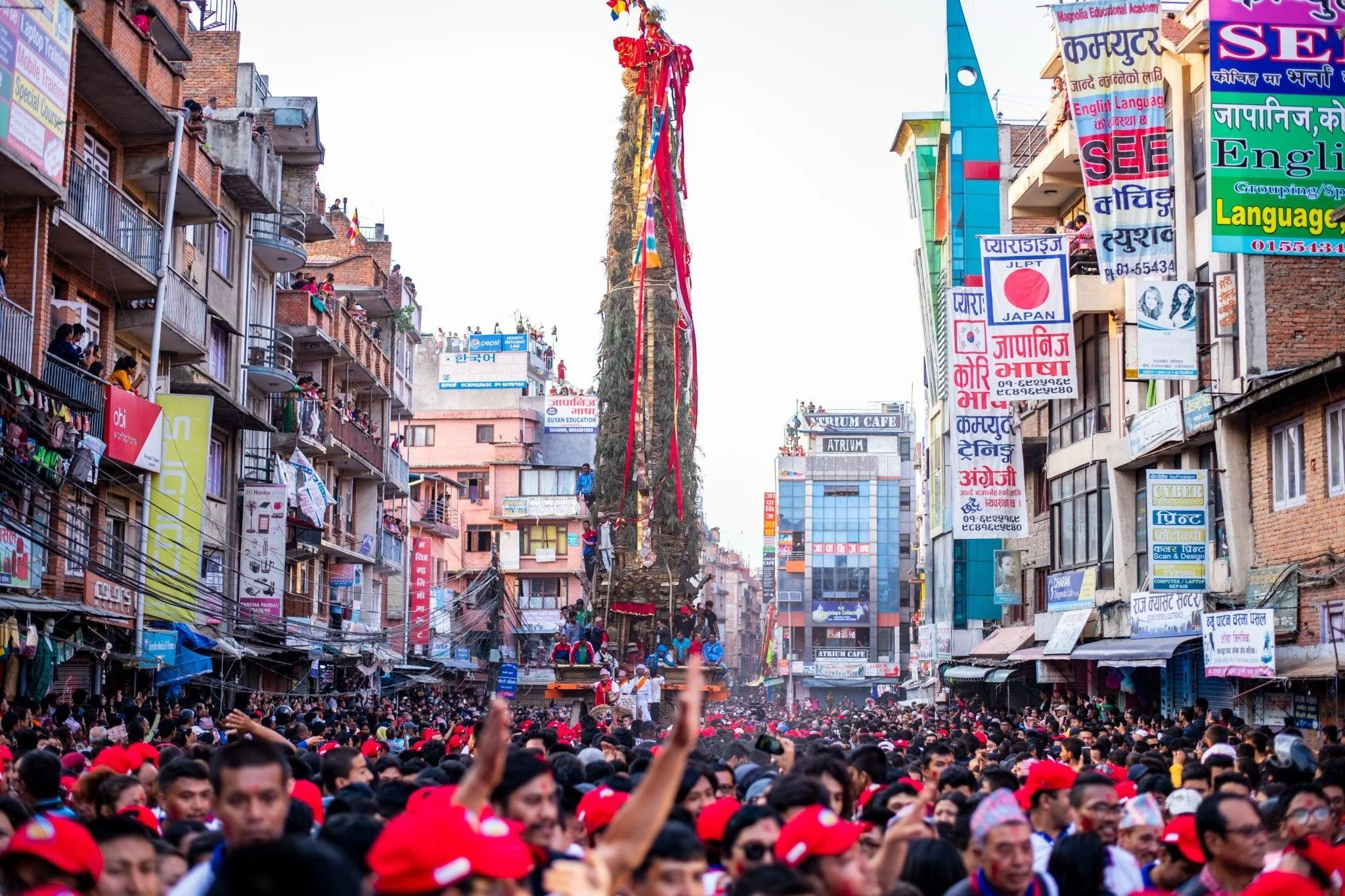
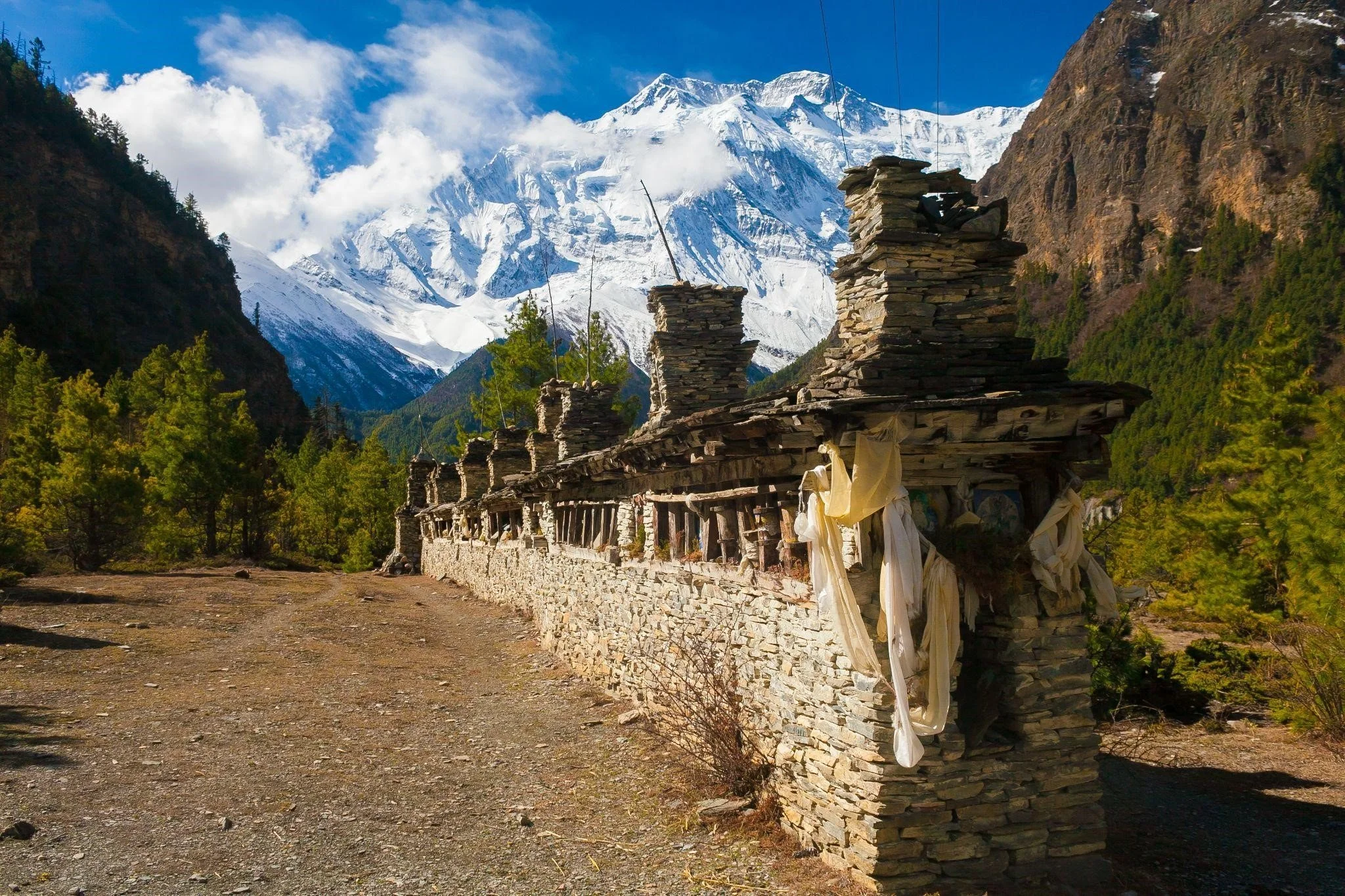
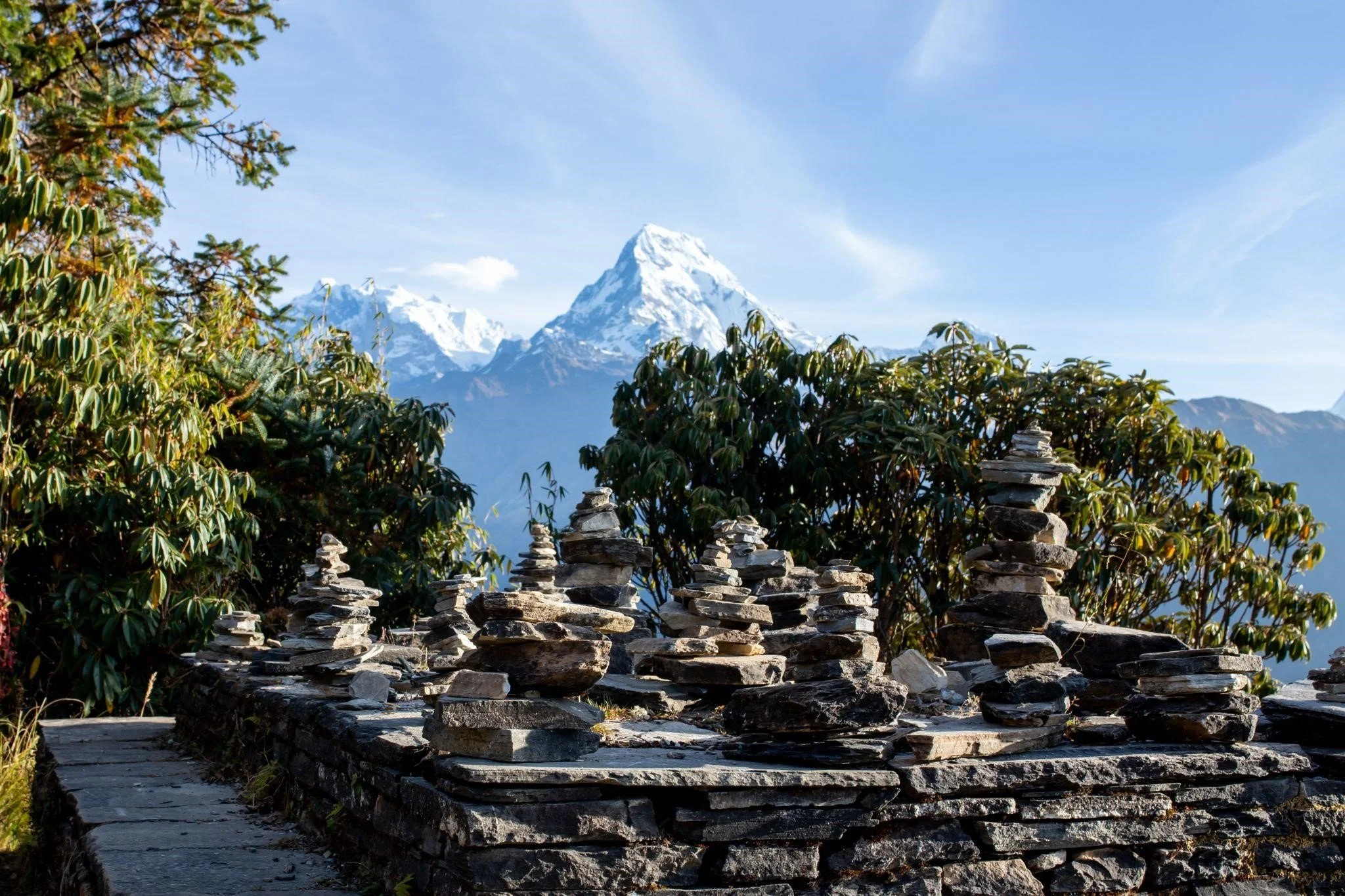
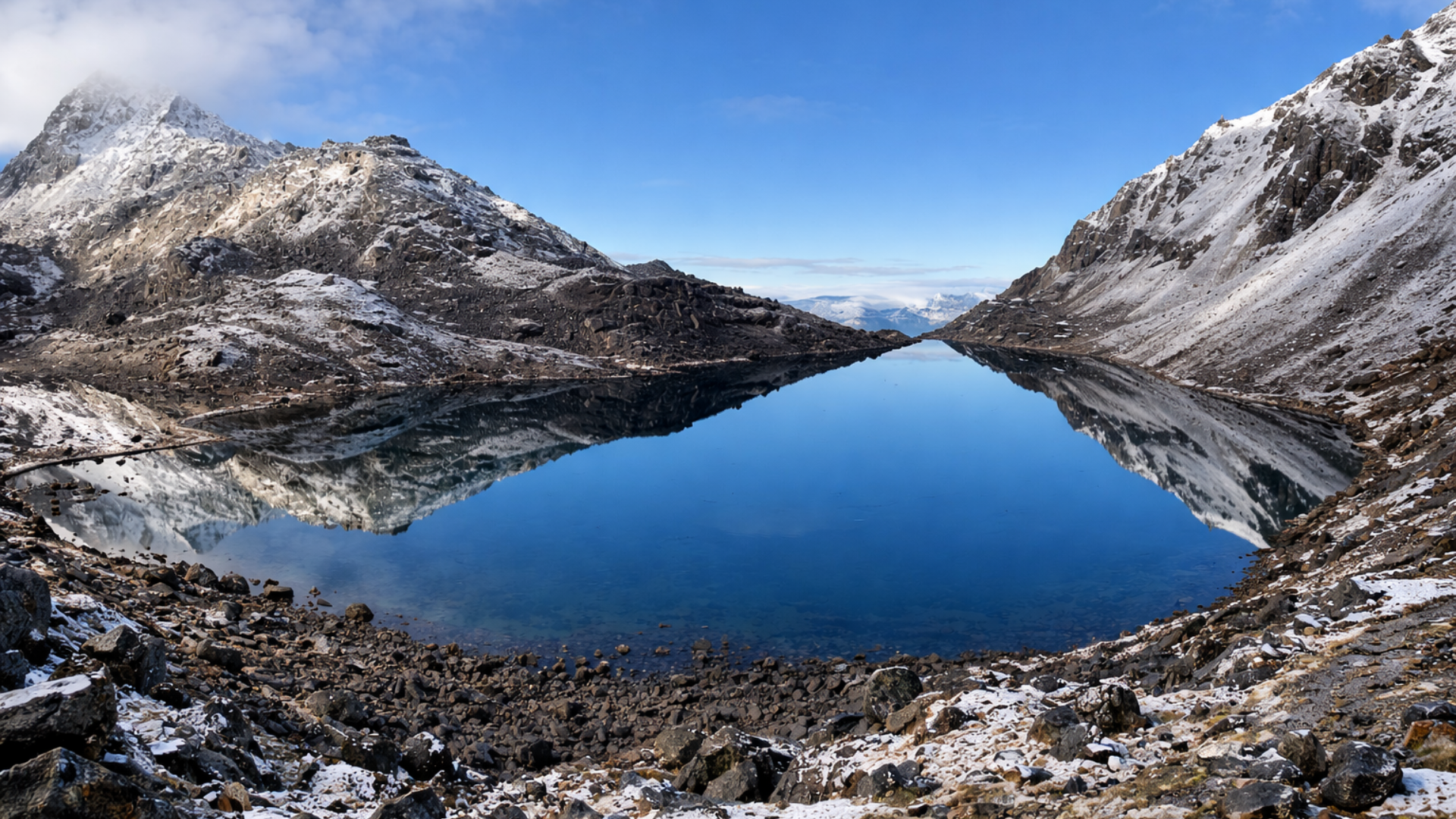
A Call To Nepalese: Travel Nepal This Decade
A Crisis is an opportunity for the brave. It is a chance to redefine dynamics, rhetoric and make history. We all faced a terrible crisis. Its impacts still loom like a sword hanging from a thread. In these troubled time, especially for the tourism industry, let us all travel Nepal this decade and breath back life to it.
In tourism statistics, we have always aimed to increase the inflow of tourists from foreign nations. But, what gets lost in the struggle to grow that number is the potential of domestic/ internal tourism. The pandemic has taught us a valuable lesson: globalization isn’t always the road to success. It is high time the tourism industry focuses on creating internal mechanisms, and revitalize Nepalese tourism.
When Visit Nepal Year 2020 was announced, it featured an ambitious goal of bringing in 2 million travelers to Nepal. The pandemic derailed the campaign. It stunned the industry, which for years was a great contributor to GDP and foreign currency reserves. A year went by in the blink of an eye, and much was lost during this storm.
The interconnected tourism industry felt the economic shock waves of the pandemic. It spread like an uncontrollable wildfire, bringing down shutters and closing gates. Businesses did their best to cope with the ricochet effect and survive together.
A peculiarity occurred once the lock down ended. People were restless, battered by a year-long violent storm that physically and mentally drained them. Thus, they began to travel!
They collected the little they had and exercised precautions to escape the brute reality. They indulged in the scenic Himalayan outbacks, the medley of hills and Terai’s vastness. They took in a fresh breath of air; for some, it felt like Moksha.
When it comes to traveling, what is the most important thing? Most always say money, but it is time. The combination of free time and disposable income creates a delightful mixture of travel. For what is the point of money if you don’t have time?
It was something that even the state agencies noticed, and announced a beta plan to provision a month-long travel leave. It also got lost in the storm.
Nepal has a multitude of destinations which are great for all ages. The public and private industry can endeavor into making regions more accessible as well, but without disrupting the natural essence. Sites can be promoted for domestic tourists by the local level utilizing catalysts such as religious, cultural, historical, urban and lifestyle tourism.
Wouldn’t you like to experience what was once Baise and Chaubise Rajya (Kingdoms before the unification of Nepal)? Traverse the trails of Bodhistava Majushree around Kathmandu Valley?
Indulge yourself watching the sunrise from Shree Antu with a sip of warm tea? Be awed by the pure spectacle from Mardi Viewpoint? Experience neo-classical luxury in Kathmandu?
The possibilities are endless, and with a good understanding of the audience; the sky is the limit.
One cannot understand the magnitude of depth Nepal offers without traveling. At times it seems like the concept of travel is reserved only for foreigners and expats in Nepal. This call is for those seekers who wish to unburden themselves from their routine life and harsh realities. Experience Nepal and rejoice in this natural treasure. Instead of celebrating occasions at exotic international destinations, do it in Nepal.
Experience indulgence
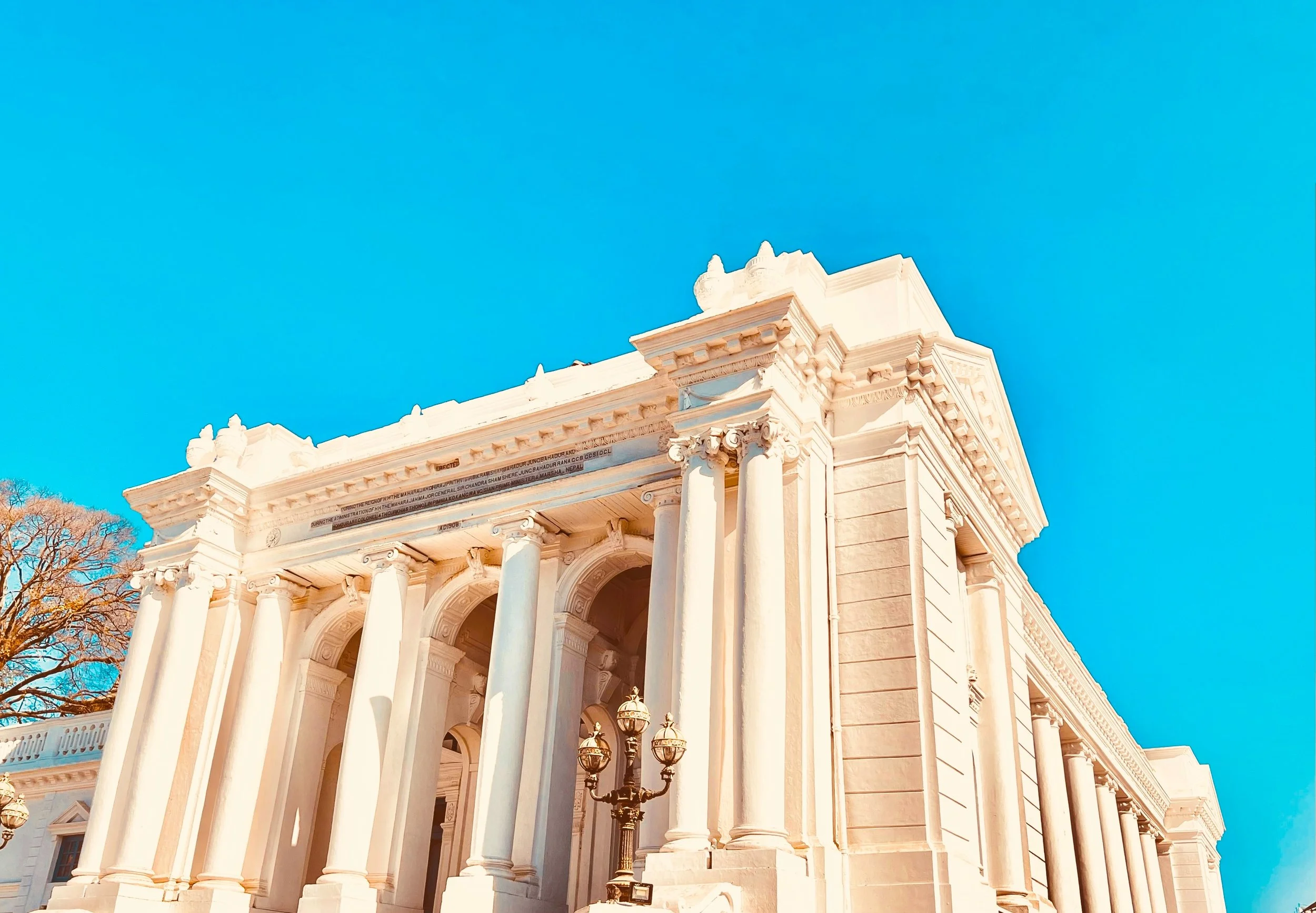
Luxury does not always mean Santorini, Bali or the Bahamas. It can be experiencing Kathmandu’s facets and indulging in a luxurious stay. Shanker hotel offers the best in class, wrapped in the beautiful baroque architecture. The neo-classical build infused with elements of fine wooden craft and masonry enables you to experience luxury at the finest.
When asked, “What defines a luxurious trip for you?”. I picture a beautiful rendezvous at Shey Poksundo Lake, via a beautiful helicopter flight. Indulge in the serenity, and head back to Kathmandu and detoxify stress at the spa and indulge in the finest cuisine.
Experience awakening
The segment of spiritual tourism is slowly but steadily gaining pace. Individuals from all walks of life, wish to understand and experience spiritual healing, practices such as yoga, music therapy, and meditation are slowly garnering the interest of all age groups. These can act as a great driver to promote domestic movement. Once can experience traditional Newar spiritual healing in Kathmandu. The mystic art of Shamanism in the Himalayas and unearth mystic secrets with stoic sages.
These are quite frankly just a few means to boost internal movement. The possibilities are endless, and it shall take a collective effort from all sectors to rekindle the industry. Thus, let us all make an effort to travel Nepal this decade.
POPULAR ITINERARIES
SIMILAR POSTS
The Magic of Nepal - Part II
Nepal is the ideal destination for every genre of travelers from all over the world. From the magnificent highlands in the North to the diverse hills and lowlands in the South, historical heritage to rich cultures and ethnic diversity, Nepal has several different environments to explore for every traveler from every corner of the globe.
Exploring this small but humble nation, the gravity of this macrocosm hits all your senses; from the magnificent highlands to the diverse hills and lowland. Nepal has something to offer for every genre of travellers. We explore further the magic of Nepal and what makes it truly a lifetime experience.
Natures Grandeur
The most inviting element of Nepal is its glorious natural diversity. As one climbs up from the lowland s/he gets to experience the environments of the world. It is rare to find a nation which begins close to sea level and reaches for the stars. Over the years some sites have become Nepal’s marquee such as Mt. Everest and Sagarmatha National Park; Chitwan National Park; Shey Phoksundo National Park; Koshi Tappu Wildlife Reserve; The Annapurna Circuit and Kanchenjunga Conservation Area. These are just a highlight of what Nepal has to offer in terms of nature tourism.
Over the years, national and international interests have enabled Nepal to become successful in environmental conservation. It has allowed populations of endangered species to climb up, forests to rekindle and wetlands to expand.
This grandeur makes Nepal enticing for all the right reasons; from bird watching and sightseeing, trekking and ultra running; landscape photography to adventure sports. Nepal still has not been able to tap its full potential in this regard, but its evident possibilities are endless.
The majority of tourists that flock to Nepal every year are mostly trekkers and backpackers. They indulge in the charming mountains and enchanting hills, breathing in clean mountain air and experience awe at every step. Coupled with great hospitality, they leave with not just glorious tales; a calmer mind and gallery full of pictures but also with an unforgettable experience.
Culinary Delights
Time and again debates on Nepal’s potential to become a culinary destination are raised. The ethnic diversity of this nation is indigenous and migratory. Over the years, it has created a diverse culture and also a delightful spread of cuisines.
From the influence of the Trans-Himalaya, multifariousness of Newari cuisine to the delicious flavours of Tharu in the south, Nepal's potential to become a culinary destination is endless. The flavours of Thak Khola (Thakali) has become a much-loved symbol of Nepal's taste. These are quite frankly just a few cuisines which have garnered spotlight, many lie in the shadows. A detailed study spanning the entirety of Nepal led by culinary masters would help bring them to light.
A dish is not just a combination of ingredients but also a symbol of one’s culture. Each region has its native ingredients, methods and utensils; this helps create the unique symphony of flavours. If not recorded in time, they shall fade away like everything else and just be tales.
An Appreciation of Hospitality
The hospitality industry experienced a boom after 1950 AD; especially in the Kathmandu valley, which had a strong foundation. A general typology to understand Nepal is to divide it into Ancient, Medieval and Modern. Ancient and Medieval Nepal did not span more than this valley. Thus it was called the valley kingdom of Nepal. Much of its development occurred during the Lichhavi Era and second Malla Dynasty. The Gurkha conquest led by King Prithvi Narayan Shah created Nepal’s new fold. Modern Nepal expanded even after his death with campaigns led by his successors.
The strong foundation of Kathmandu was its background in mercantilism. It played a valuable role in trade and exchange in the Indian sub-continent. It over the years made Kathmandu valley a melting pot of cultures. We developed an appreciation of hospitality, as traders flocked this vale and at times had to call it home for a long duration.
This appreciation is not native to this valley, but something wired in Nepalese. I have heard many travellers say, “ This love and hospitality feels surreal. I wish I could stay here forever.”
The Always Smiling People
The takeaway of most travellers to Nepal is this beautiful phrase, “ The always smiling people.” No matter the hardship, we never fail to welcome guests with a beautiful smile and cater them with the utmost hospitality.
Exploring Nepal even I have experienced this humble smile that makes me feel at home. A universal symbol showing one's happiness and delight exemplified in the diverse faces of Nepal. So many ethnicities but one commonality, a beautiful smile. The emotions, at times, feel unexplainable, but some things are best unexplained.
I am also a Nepali, and it is my pride to welcome you to this beautiful nation. I might not speak your language, the idioms and phrases, but I know a smile makes you feel right at home. When you smile back, it is a hint that what I have done is right, and I, along with all the Nepalese, will do everything to make sure that smile stays on your beautiful face.
POPULAR ITINERARIES
SIMILAR POSTS
The Magic of Nepal - Part I
The nation of Nepal does not have a giant footprint on the world stage. It is small, quaint yet magical. When asked about Nepal Mt Everest, Lumbini and the Gurkha heritage take the spotlight, but in its shadow lies an amalgam of exotic culture, remnants of the old world and unparalleled beauty.
The nation of Nepal does not have a giant footprint on the world stage. It is small, quaint yet magical. When asked about Nepal Mt Everest, Lumbini and the Gurkha heritage take the spotlight, but in its shadow lies an amalgam of exotic culture, remnants of the old world and unparallel beauty. It creates a magnificent experience no matter the intent, as one is bound to encounter this magic that makes Nepal, a lifetime experience.
Old World Elegance
Nepal, as a nation shares the pages of history from primordial times. But in the global stage, its recognition only came after 1950 AD. The implementation of an open-door policy allowed explorers, documenters and adventurers to experience the magic of this beautiful country. It is through their work, documents, and stories Nepal charmed the world.
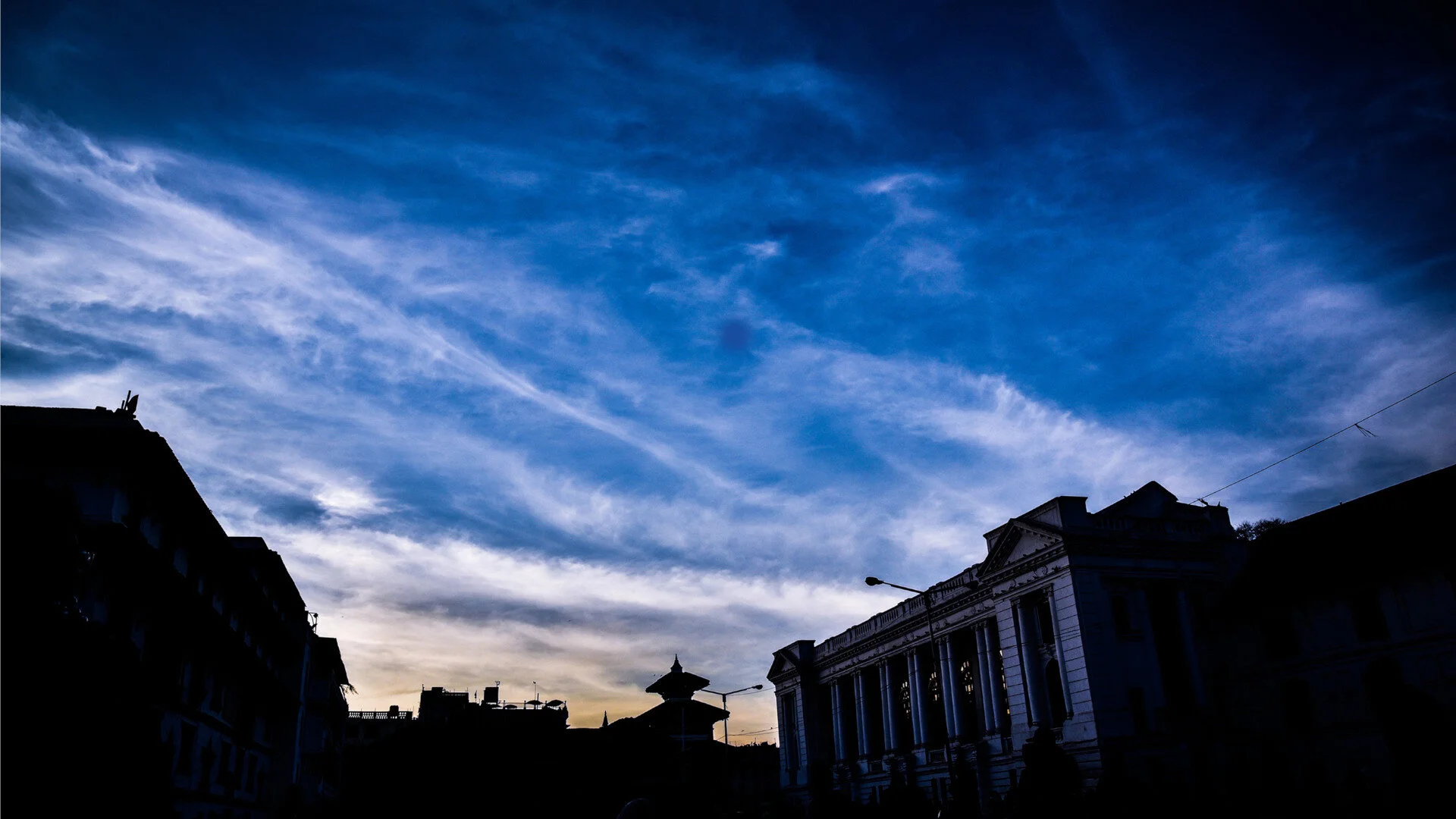
Walking the streets of Basantapur Durbar Square, one can witness a peculiar amalgam; it is hard to describe seeing the European façade of Gadhi Baithak find a place amongst traditional Newari masonry. This peculiarity creates a spell, enticing all to imagine a bygone era.
Shanker Hotel itself is an example of old-world elegance. A neo-classical palace commissioned during in the 19th century with the utmost luxury and magnificence.
With the turn of the century and end of the Rana rule in Nepal. It was then converted into a luxury hotel. Its baroque facade shines bright even today in the 21st century with ancient carvings displayed in grandiloquence. It is rare to experience such grandeur, coupled with the utmost hospitality in Nepal.
A Cultural Amalgam
Every itinerary to Nepal features experiencing its capital, Kathmandu. Making way through the busy streets, bustling markets and heritage sites. The amalgam of Hinduism and Buddhism is clear as night and day.
The discovery and founding stones of this valley are of the Buddhist faith. The township of Manjupatana, created by Boddhisatva Manjushri was the first of many in this valley. Today, it is home to numerous cities such as Kathmandu, Lalitpur, Bhaktapur and ancient villages such as Tokha, Bode, Khokana and Thecho.
It is rare to find such a cross-cultural diversity in the modern world, with two distinct faiths such as Buddhism and Hinduism calling one valley home. The unique discipline of Vajrayana Buddhism flourished in this valley even though the origins of it lie in Tibet. It has grown even further with multiple sects of Buddhism such as Mahayana, Theravada, and Vajrayana intersect each other in such a small space.
This cultural amalgam gave birth to the unique pantheon of deities worshipped by the native inhabitants of this valley. When one dives into the Newar pantheon, divinities of both faith have equal importance and respect. Some even come to life, few are living gods and goddesses.
Describing what creates this cohesion is difficult, unearthing the mysteries of it a monumental challenge. It is best to enjoy it than to dissect it.
The Last Light of Magic
Many have crossed oceans and walked treacherous trails to find, understand, learn and heal themselves through the magic of the eastern world. I have crossed paths with many who left westerly pleasures and made temples and monasteries home. I’ve heard many say, Nepal is one of the last places in the world where magic still exists.
From shaman’s to mystic sages and jogini’s (female practitioners of the dark arts); ancient healing practises and tantra rituals. Drawing a scientific conclusion at times is difficult due to the secrecy and mysticism.
On the road to Patan Durbar Square near Nya: Tole (Na Tole), lives a family of Bajracharyas. They for generations have been the doctors for the people of Patan. But they have no medical degree. During my commute, I saw a group of tourists in awe. The Bajracharyas have installed clear glass doors and windows. All can see their practice.
The mystic doctor was patting a woman with a traditional broom. He whispered secret chants during the process. Once the healing process was over the woman bowed and departed. A gentleman came and sat down in her place, behind him was a cue of five more individuals.
I have sat in that very spot as a young child. Confused and scared, I remember holding my mother's hand as he patted me with a traditional broom. To calm my senses, I closed my eyes. The gentle taps were quite soothing. As he manoeuvred the broom in a sweeping motion from my head to shoulder and feet, it seemed like he was cleaning what my mother told him was my problem.
A morsel of rice was then wrapped in a piece of old newspaper to be placed under my pillow. Another was to be sprinkled in the cardinal directions of my room. Did it work or not, I shall never know. But, it was good enough to give hope and strength to my mother.
POPULAR ITINERARIES
SIMILAR POSTS
Bapacha: The Living Hero of Patan - Part II
According to the tale, a Kirati King(King Patuko) who once ruled Lalitpur went far to set up a perimeter around the Bahal and caused obstacles to the devotees and travelers. Then a priest afraid of the Kirati ruler decided to send his son to perform the daily rituals. He thought the Kirati soldiers would just let him go thinking he was a child.
The next day before dawn, the boy left for Kwatha. As expected, the Kirati soldiers ignored him, thinking he is just a small boy. He opened the main gate and performed his duties. Lastly, he prepared breakfast for Sakyamuni Buddha and placed it in front of him.
The boy was curious to why Shakyamuni Buddha did not take his meal. Thus, he waited patiently.
He then made a modest request, “ My dear Buddha, please! Please wash your hands and face. Your breakfast is ready and getting cold. My parents are occupied with their household chores, thus have sent me to attend to you.”
There was no response from Shakyamuni Buddha. The boy having the purest heart kept on repeating his humble request. He did not know that he is talking to an idol made of bronze.
The boy continued requesting Shakyamuni Buddha, but his cries were unanswered. He then stated, “ Oh my dear Buddha, if you do not accept my request, then I will have to stay here, and I will go hungry.”
The idol then slowly moved, took the holy water fetched by the boy and washed its hands and face. It then took the breakfast the boy had prepared. A gentle smile came on the boys face, as he watched his beloved Lord accept the meal he prepared.
At home, his parents anxiously waited for his arrival. They heard the door creak; it was their son. They hugged him dearly and asked, “ What took you so long?”
To which the boy answered, “ I performed all tasks that you told me, father. At the end of which, I served Shakyamuni Buddha his breakfast. But he did not take his meal, I requested him many times, but my cries were unanswered. I then told him that if he does not take his meal, that I would have to wait here and I would go hungry. It was only then, Shakyamuni Buddha cleansed himself and ate his meal.”
The boy's parents were rendered speechless. Thus they decided to follow their son and see it for their own eyes.
The next day, they looked from a distance as their son perform his tasks. He brought holy water and breakfast, which he placed in front of the idol which slowly cleansed itself and ate.
The boy's parents were in joy as they witnessed an extraordinary event.
Once they reached home, the priest said to his wife, “ My dear, how long will we do this? Send our son, amidst such danger. It will not be long before the soldiers become suspicious of him.
To which his wife answered, “I agree, but what can we do?”
The priest called his son and requested, “ My dear boy, tomorrow once you finish performing the daily tasks, I want you to put forth a humble appeal to Shakyamuni Buddha. Please let him of the Kirati ruler and his followers actions which has removed all security from our lives.”
The boy, gentle and obedient; did as his father requested.
To his appeal, Shakyamuni Buddha responded, “ When you come tomorrow, bring a cup of cows milk.” He returned home and told his parents of the Buddha’s response. The next day, he performed his tasks and then placed the cow's milk before Shakyamuni Buddha.
“ Do you know of the bauga (a pit made to dispose objects used in religious activities), near the fort of the Kirati ruler?” asked Shakyamuni.
“Yes, my dear Buddha.”
“Pour this cup of cows milk into the bauga while you head home.”
The boy did as instructed and poured the cup of milk into the bauga. A mild buzzing was heard, which got louder and louder.
To his surprise, thousands of hornets flew out of the pit. They created a great noise and began stinging followers of the Kirati ruler. The hornets swarmed the fort next, and created mayhem.
The Kirati ruler and his family became terrified and ran away.
Many died that day, and only eight hundred escaped from the northern gate of the city. This locality is as Chyasa, meaning eight hundred in Nepal Bhasa.
At last, peace returned to the city of Lalitpur.
Centuries have passed since and even till this day, the Bapacha: a young, smart, gentle boy is the head priest of the Kwa Bahal. The monastic community has successfully preserved the old practices and ritual conducts, and shall never forget the extraordinary feat of the Bapacha.
POPULAR ITINERARIES
SIMILAR POSTS
Bapacha: The Living Hero of Patan - Part I
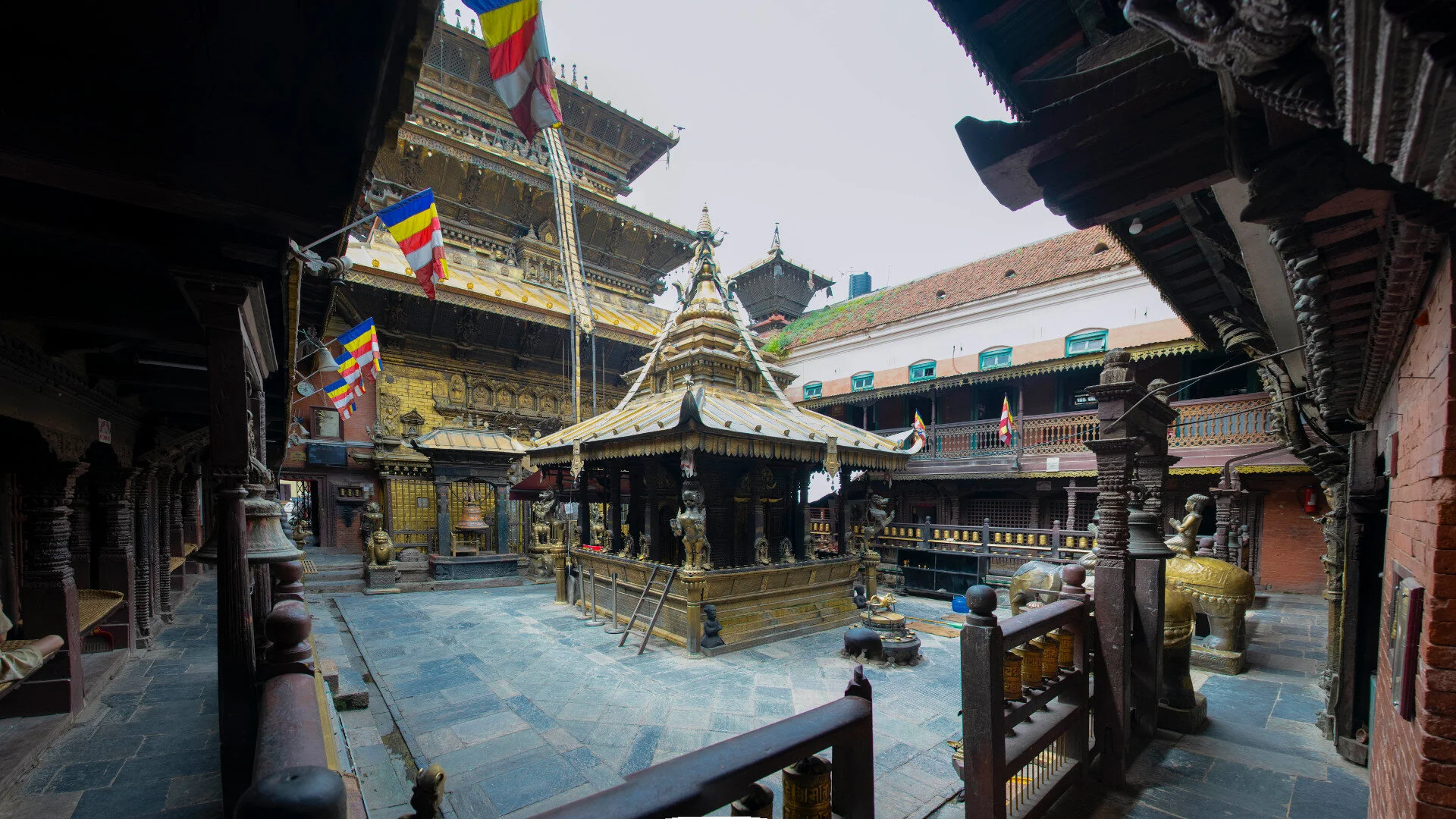
Lalitpur, a city of diverse culture, art and tradition is home to many wonders and mysteries. In it lies a sacred space which has stood the test of time and outlasted various dynasties that once battled to rule this glorious city. This sacred space is no other then Kwa Bahal, which today is also known as the Golden Temple of Lalitpur.
Lalitpur, a city of diverse culture, art and tradition is home to many wonders and mysteries. It was known as Patan in a bygone era, this name is still associated with the core settlement of the city. In it lies a sacred space which has stood the test of time and outlasted various dynasties that once battled to rule this glorious city.
This sacred space is no other then Kwa Bahal, which today is also known as the Golden Temple of Lalitpur. The main complex houses the idol of Shakyamuni Buddha, locally known as Kwapajju which was rescued from the ruins of Pingala Bahal by a descendent of the monasteries priest. (An ancient monastery established by Pingala Devi that once stood in the Pasupati area).
Kwa bahal was commissioned, by King Bhasker Dev Verma a Thakuri king who hailed from Noakot (Nuwakot) mountains and appointed after Jaya-Kama- Deva who did not have any children.
“This Raja had no issue, so after his death the Thakuris of the Noakot mountain came and elected a Raja from among themselves.” Wright, 1990: 157
The location where he established the bahal was once known as Kwatha, meaning a fort. This site is known to have been the domain of a Kirati ruler, who had commissioned a Buddhist shrine. The ruins of which was converted, into the abode of Kwapajju.
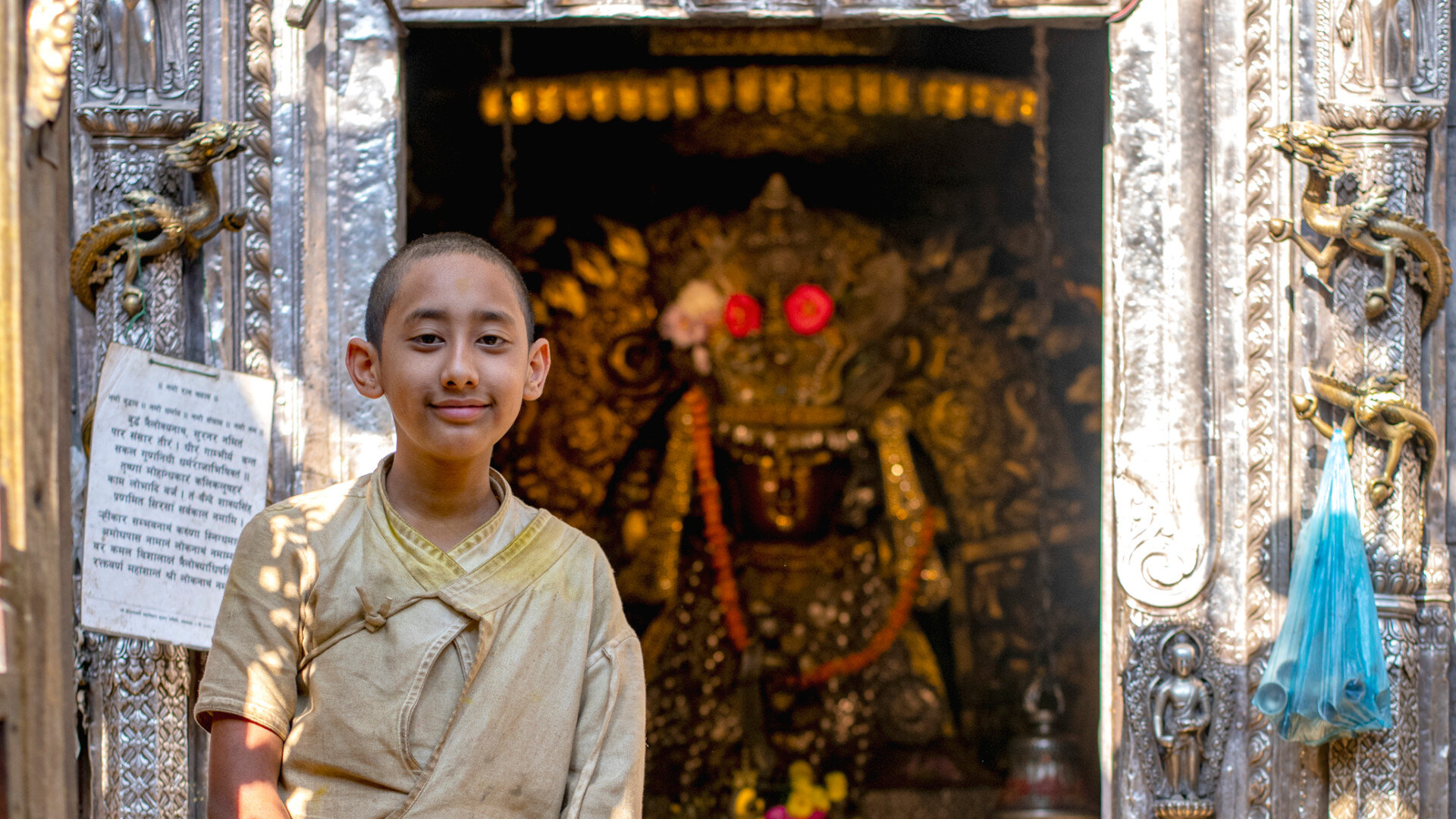
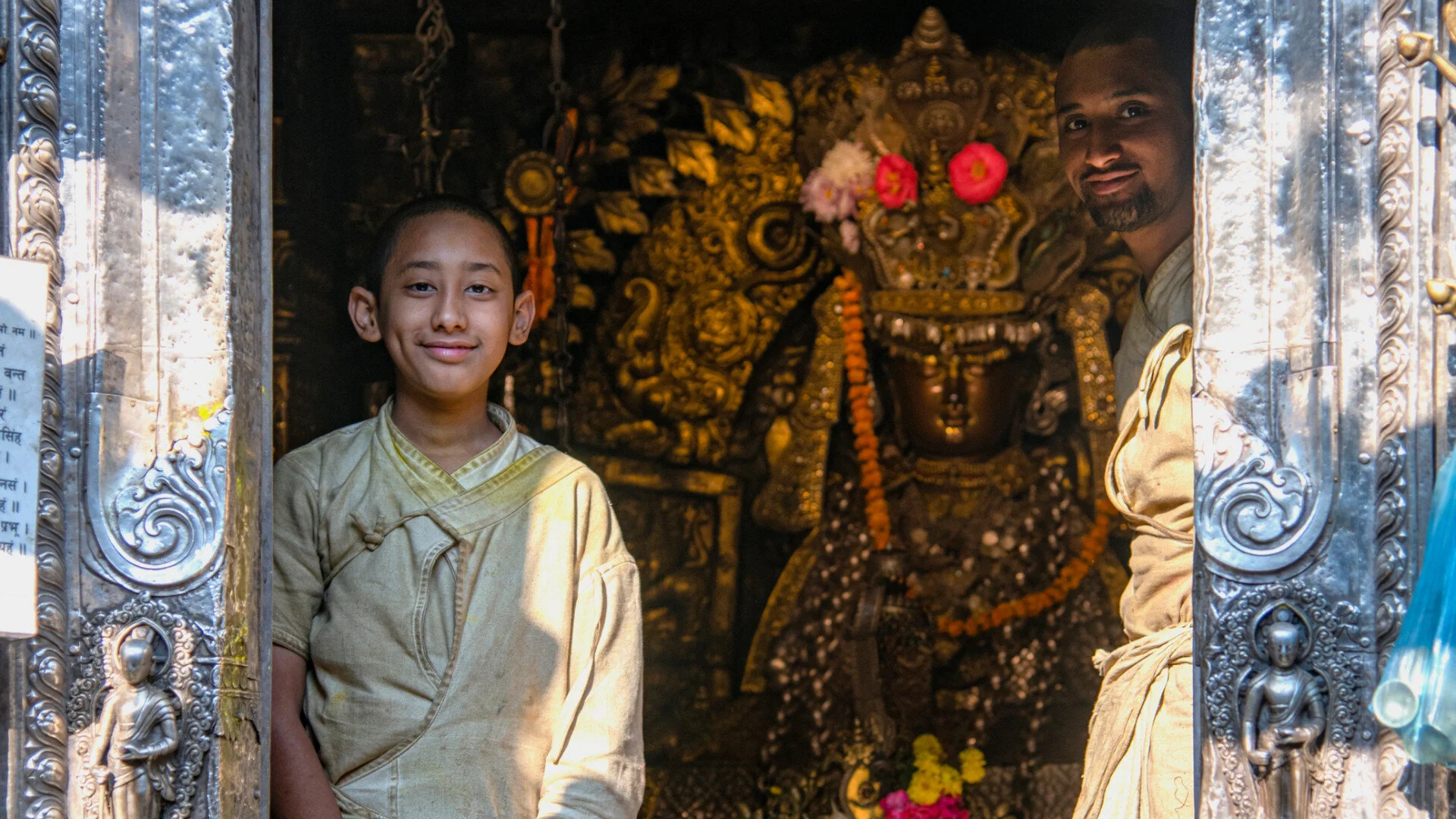
Every month a deopala (caretaker) is appointed at Kwa Bahal who bears the responsibility of overseeing all rites and rituals. His first act is to nominate a Bapacha, a young boy aged 10-12 years; smart and gentle who shall attend to all the need of Kwapajju (Shakyamuni Buddha).
Traditionally he (Bapacha) is nominated from within the members of the deopalas family. If a suitable candidate is not found, he is picked from the households who are members of the monastic community.
Once a candidate is ordained, his initiation process begins.
His head is shaved as an act of purification and he puts on a uniform, which features a long-dress, cotton belt and no shoes. His diet consists of only vegetarian food. For the month, he isolates himself to only his religious duties. He is bared, from contacting his friends and even his family. These restrictions may seem like taboos but are steps to ensure his full devotion, and focus.
He is guided by Neekulimha, who for generations has been the custodian of many Bapachas. She ensures his well-being, cooks him specific food and makes sure he follows all the codes and conducts.
His day beings at the crack of dawn offering a special prayer to the idol. He rings a bronze bell, waves the yak-tail and sprinkles holy water on to the devotees. He beats a dharma-gandi ( a wooden instrument), which reminds the local people of their religious (dharma) duties. During his working hours, the passage to the main temple is blocked by a metal chain so that devotees may not distract or get too close to him. He is assisted by an older boy inside the Kutgar (The space where the idol is placed) to perform rituals.
One of his prime duties is making a scheduled walk around the locality of the Golden Temple monastery. He takes a specific route once in the morning and later in the evening. During his commute, he rings a bronze bell which he holds in his left hand. The other holds two keys of the bahal gates. He walks barefoot, and in complete silence, every day. He is escorted by a gentleman who warns others to make way for the Bapacha.
You may be curious about why a young boy is assigned such an important and challenging role?
The tale of the origin of Bapacha passed down from oral traditions goes as follows.
In antediluvian times it is said Lalitpur, was ruled by a Kirati King named Patuko. He established his capital at a hillock near the monastery, where his ancestors once once built a fort. This place is still known as Patuko, which lies opposite of the cross-roads of the path to Mahapal.
He (King Patuko) and his followers troubled the locals greatly. He even went far as to set up a perimeter around the bahal and caused many obstacles to the devotees and travellers. The religious duties were conducted by a priest, who was extremely frightened by the Kirati ruler. One day, he decided that it was too dangerous for him to head to the monastery, thus, decided to send his son instead.
The boy was young and innocent. Thus his father thought the Kirati soldiers would just let him go thinking he was a child. Being obedient, he listened to his father carefully, as he taught him the way to perform the daily rituals.
POPULAR ITINERARIES
SIMILAR POSTS
Thecho and The Navadurga - Part II
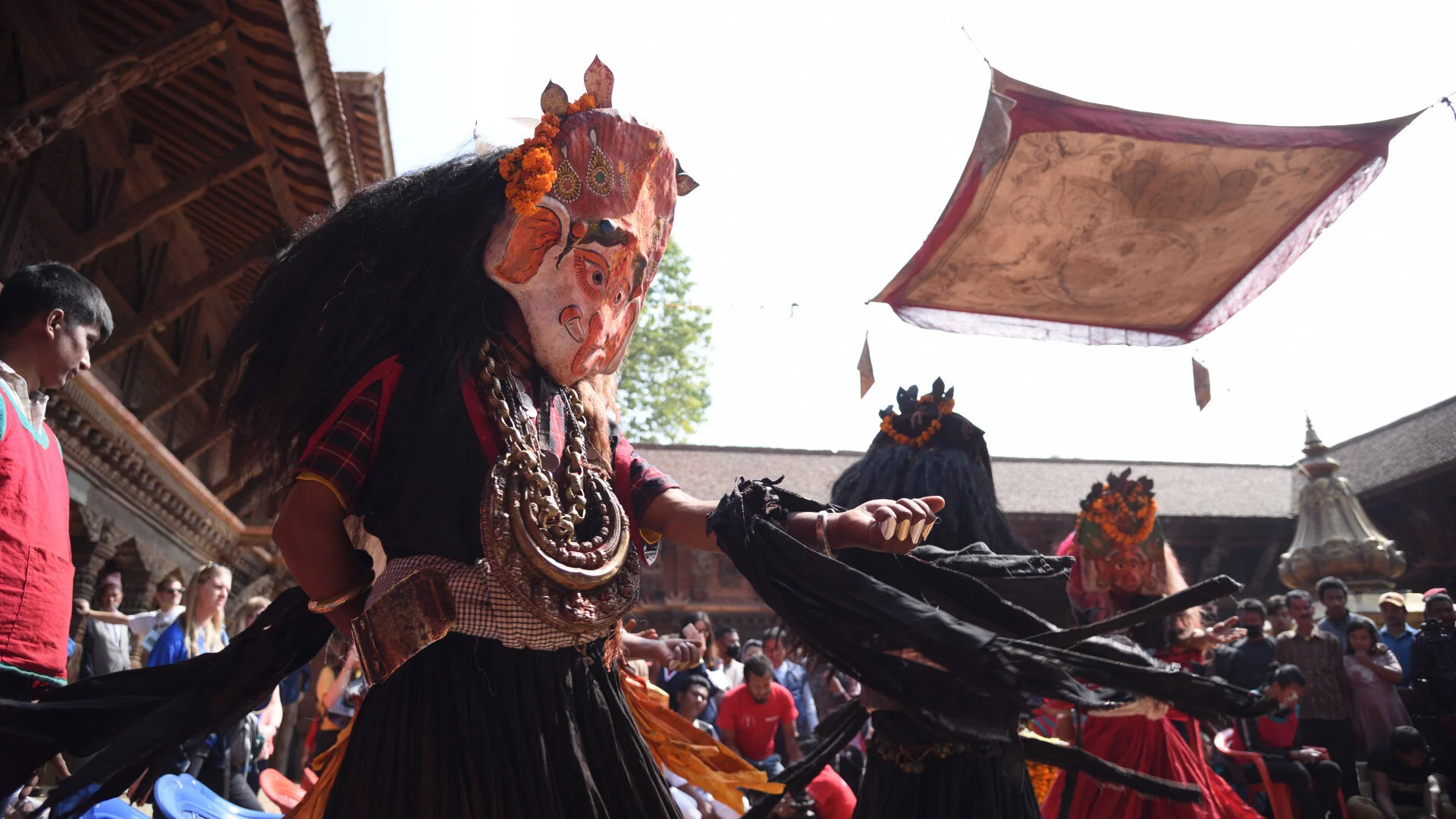
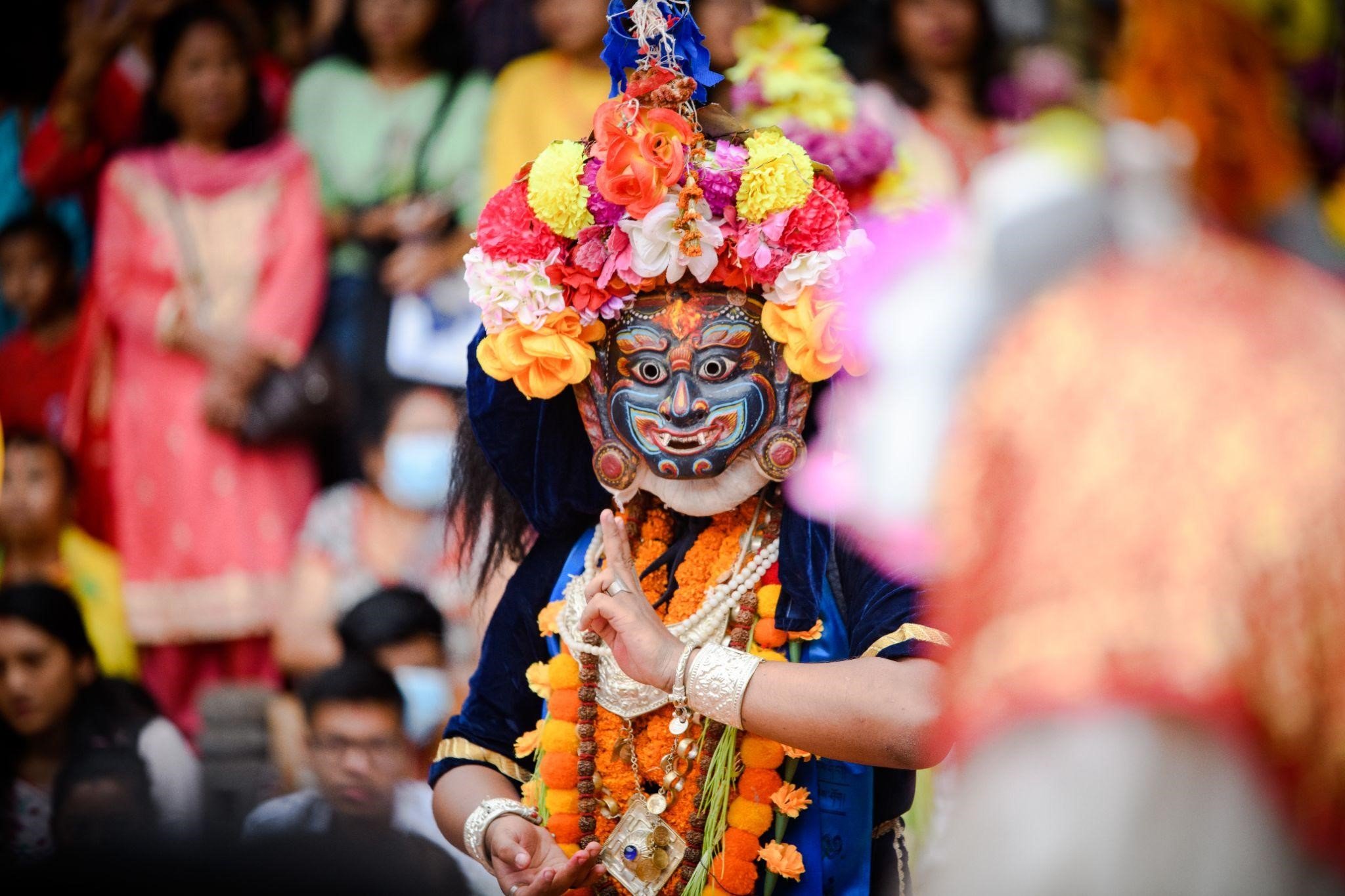
The Navadurga masked dance is performed twice a year: during Dashain and Yomari Punhi. The idols of Bhramayeni, Balkumari, Bhairava, and Navadurga are carried around the town in chariots. A group of men who observe religious rites adorn the masks of the Navadurga Gaan and present the iconic traditional dance at the Dabhu (open-air stage) at the Lacchi (communal square) within the city.
This group bears similarities with other indigenous masked dances such as Sikali Naach (Khokhana), Ajima Naach (Kathmandu), Sapta Matrika Naach/ Gatu Pyakhan ( Kirtipur) and Asta Matrika Naach (Lalitpur).
These dances feature the manifestations of Shakti/ Parvati: Bhramayeni, Maheswori (Rudrayani), Vaishnavi, Kumari, Indrayani, Varahi, Chamunda and Maha-Laxmi. They are accompanied by Bhairava, Shima (Male Lion), Dhuma (Female Lion), Lord Ganesh and Lord Kumar.
The Navadurga Naach (dance) also features the same set of deities but Bhairava, Varahi and Chamunda play a central role. Given how these three are great warrior avatars with Bhairava being the wrathful manifestation of Lord Shiva; Varahi being the boar avatar of Lord Vishnu and Chamunda the fearsome aspect of Parvati. It projects a warrior aura that helps strengthen the thought of it being instituted to protect the country.
The masked dance is performed twice in a year: during Dashain and Yomari Punhi.
In the town of Thecho, amongst all the Newar festivities, Yomari Punhi holds the highest rank. During which, the idols of Bhramayeni, Balkumari, Bhairava and Navadurga are carried around the town in chariots. The procession circumvents all nine toles (communities) of the city. After which, a group of men who observe religious rites adorn the masks of the Navadurga Gaan and present the iconic traditional dance at the dabhu (open-air stage) at the lacchi (communal square) within the city.
The ensemble features a total of eleven dancers who adorn the masks of Bhairava, Shima, Dhumba, Lord Ganesh, Varahi, Chamunda, Bhramayeni, Maheswori, Vaishnavi, Kumari and Indrayani. The tunes are provided by a team of four, where one carries a large drum called dhime but has an odd shape. The other three play a small thin cymbal known as taa. A member of the guthi (an ancient communal organisation created by either the state or community members to perform religious rites, conduct festivals; maintain, preserve temples and other religious activities) carries the idol of Navadurga.
In 2018 AD, after 24 years they entered the square on the eve of the Bijaya Dashami. Previously to which, they visited during the full moon of Kojagrat ( Kojagrat Punhi). In the year 2019 AD, after forty years they presented their intricate routine at the dabhu (open-air stage) of Patuko in Patan Durbar Square.
The strings of this ensemble are tied with the goddess Mani-Talava. Who for the past twenty-four years stayed dormant atop a pagoda temple inside the cortex of Mul Chowk. The dormancy was not caused by any ill-fortune, or misalignment of the stars. Rather the inability to perform the rituals to invoke her and conduct the festivities.
In 2018 AD, after a combined effort she was invoked.
On the day of Navami, Khadgas (Swords carried by goddesses) along with a severed buffalo head are brought from the temple of Maha-Laxmi and Khokana respectively. Later in the evening, the troupe of Navadurga arrive at Lagan Khel.
Under the shadow of the Ma Shimah (Mother Tree), the righteous men prepare themselves. After conducting special rites, the group make way for Patan Durbar Square.
The goddess meets the Navadurga Gaan at the junction of Mangah (Mangal Bazar). Bhairava, Varahi and Camunda offer large garlands respectively and in their intricate manner follow Mani-Talava into the cortex of Mul Chowk.
At midnight, the group heads toward Patuko where opposite to the Agam Chhen (temple of the tutelary deity) they perform for almost 1-3 hours. Once the dance and ceremonies are over, they head towards the palace to rest and make arrangement to head home.
They return to the royal cortex on Chaturdashi, where they perform till mid-night and on the day of Kojagrat Purnima present their routine during the day as well. Crowds gather in masses to witness, a fully grown buffalo be roped and tackled down by the guthiyars (members of the guthi). The deities then consume blood directly from its vein and then perform another routine. They then indulge in a special feast known as bhuwae, and after dusk head towards Thecho.
Concluding this article, it is evident that Nepal Mandala (Kathmandu Valley) took on the facet of interpreting deities through masked dances. It doesn’t just have symbolic meaning but also a purpose. Globally it is a common practice found in indigenous communities, where each interprets their deities or faces to project fear, strength and unity.
This ancient tradition is on the verge of extinction. It finds hard to co-exist in a modern time, where its purpose is questioned, and methods called bizarre and gory.
A proper methodological study is in urgency to document and archive its history, rites, routine and the intricacies of the dance. Efforts from various channels e required to preserve this unique tradition and its roots.
POPULAR ITINERARIES
SIMILAR POSTS
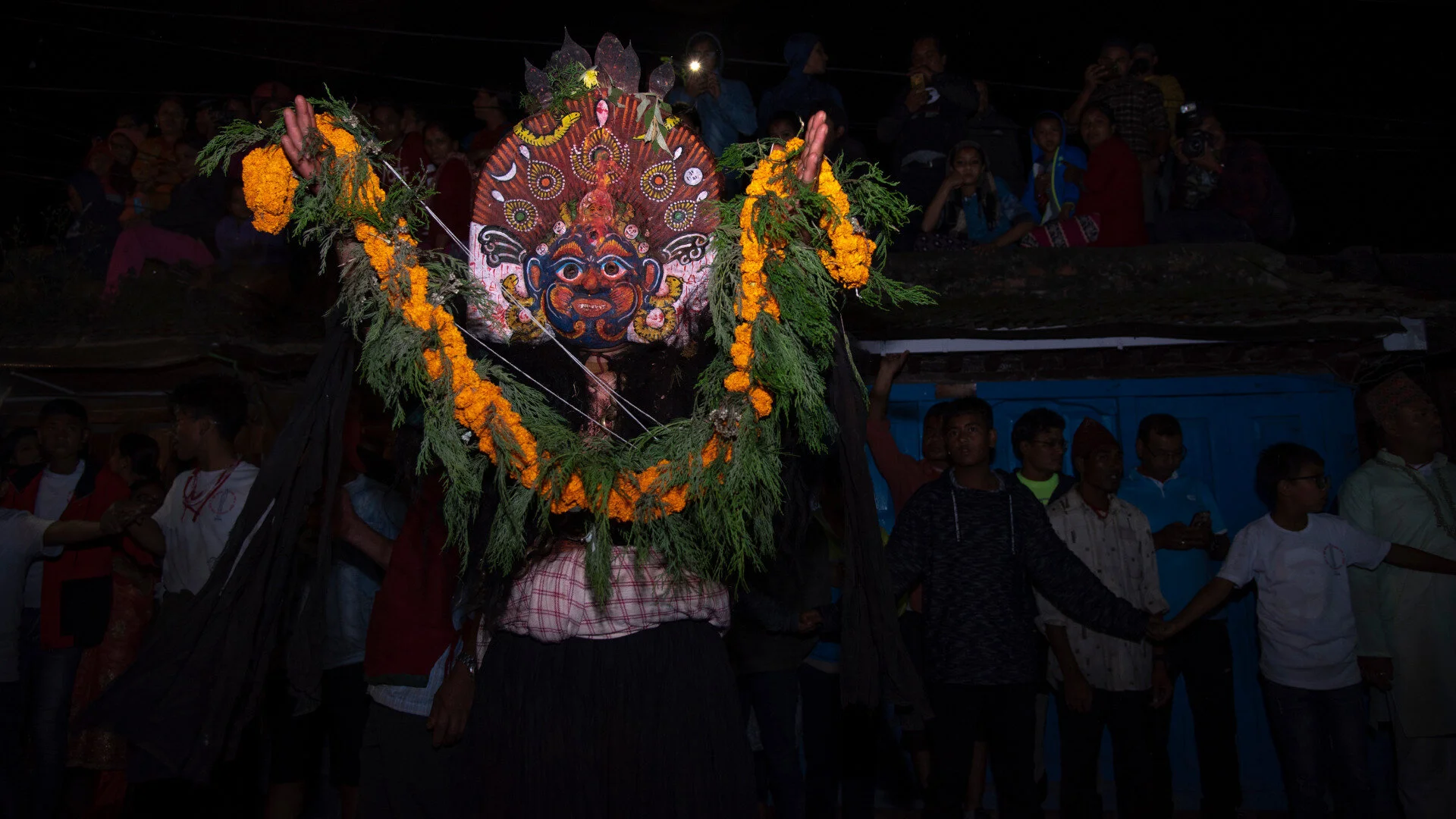
Thecho and The Navadurga - Part I
Durgas are the various demonic manifestation of Parvati, the Shakti of Shiva, and Navadurga means nine Durgas, Mahakali, Kumari, Barahi, Brahmayani, Mahesvari, Viasnavi, Indrani, Mahalaksmi, and Tripurasundari. Navadurga dance, a legendary traditional mask dance of Navadurga Bhawani of Thecho is performed every year during Vijaya Dashami and the days following the "Yomari Punhi" festival.
South of Lalitpur lies Thecho, an ancient village once known as Dyecha during the Lichhavi era when the settlement was in the low lands near Nakhu River.
When a landslide struck, the entire town was moved, to higher ground. The upper lands were known, as chhen choy ( chhen refers to home and choy: up) which later was altered into Thecho.
During the 16th century, the village was upgraded into a township by a Malla king of Lalitpur and renamed Dharmatharipur. Comparing regional history (the establishment of Jitapur {Khokhana} in the 15th century by Amara Malla of Kantipur), the founder of Dharmatharipur must have also commissioned the temple of Bramhayeni (Shakti of Lord Bramha).
The village of Thecho historically lies adjacent to an old trade road to India. Following the road south leads to Sankhu, an ancient Lichhavi era city with pieces of evidence that suggests older origin. An inscription that dates back to 538 AD inscribed by King Vamanadeva states how Sankhu was built as a trade route from Kathmandu to Kuti, Sigate and Lhasa in Tibet.
North of Thecho lies another Lichhavi era village, known as Sanaguthi (Sunakoti). The evidence of Sankhu is fortified by an inscription here. It also dates to the 5th century and mentions about Managriha and Kailashkut Bhawan. These infrastructures are ancient institutions developed as resting houses and some even as isolation areas for traders, religious travellers, priests and monks.
The above mentioned geographical details shall help one understand the institution and practise of the Navadurga Gaan (Group) better.
This ensemble is one of many troupes of mask dancers, that lie at various corners of the Nepal Mandala (Kathmandu Valley). But, is one of two that shares the name of Navadurga Gaan, the other is in Bhadgaon (Bhaktapur).
During my avid adventures following the mask dancers of Thecho as they made their way to Mangal Bazar in Patan Durbar Square, I made the acquaintance of Mr Prashant Mali, a journalist by profession and member of the organising committee. It was through him I got to learn that this troupe is connected to Manamaveshwori, the tutelary deity (family deity) of Lichhavi King Mana-Deva. (According to the vamshavali, King Mana-Deva isof the second Rajput dynasty {Lichhavi}).
Manamaveshwori is originally called Mani-Talava (Mani refers to Mani Jogini of Sankhu and Talava: Deity upstairs).
“Mani Jogini’s shrine is at Sankhu, Bajra Jogini’s at Sankhu and at Phurphing, Bidyadhari Jogini’s below Swayambhu, and Hingu Jogini’s south of Thapathali and also west of Patan” Wright, 1990 “History of the Kingdom of Nepal” Asian Educational Services: 90
She was instituted in Lalitpur by King Bir (Vir) Deva of the first Rajput dynasty (Lichhavi) who was also the founder of Lalitpur. He also commissioned Mangah, the name he gave to the centre of his city. Today it is known as Mangal Bazar.
“... he built a chaitya and a dhara [water fountain], and erected a Sivaling, a Ganesha, a Mahakala, and a Mandapa, and built a Durbar for the Raja, all of which he consecrated. Being a devotee of Mani Jogini, he named all these after the goddess as follows: Mani Talava [i.e Taleju in the royal palace], Mani-chaitya, Mani-dhara, Mani-linga, Mani-Ganesha, Mani-Kumara, Mani-Mahakala, Mani-Mandapa, and Mani-gal-bhatta.” (Wright 1972:133)
When the troupe reaches near Mangah, Mani-Talava is carried by priests to the junction. Bhariava ( Tantric manifestation of Lord Shiva), Chamunda ( Fearsome avatar of Parvati) and Varahi (Boar Avatar of Lord Vishnu) of the troupe present large garlands and offer salutations. The ensemble then follows Mani-Talava into the palace. It is here, they dance till mid-night and perform sacred rites the next day.
Now, connecting all pieces of evidence, it is safe to say this traditional dance has Lichhavi origins.
In chronology, it is also stated that King Gunakamadeva, the founder of Kathmandu, revived the worship of the Navadurgas.
“.…. he also revived the worship of two sets of Nava-durgas, the one inside, the other outside, of the country.” Wright, 1990: 154
He was a descendent of King Bir (Vir) Deva, and the tradition may have died out to later berevived after hundreds of years. But there are no proper writings that state the locale of the practice and its details.
In Nepal Mandala, traditional masked dances are an indigenous form of bringing deities to life and instilling fear. These divinities are mostly Asta Matrikas or Nava-Durgas (both have similar characteristics with only a few variations) which are placed in the outskirts of the township. In some areas, these temples are also accompanied by military barracks. An example of which in modern times is the temple of Lomari Devi ( Bhadrakali) and the Bhadrakali Barrack.
Given how Thecho lies in the old road to India, the indigenous practice could have been a way to ward off evil both in human and supernatural form.
POPULAR ITINERARIES
SIMILAR POSTS
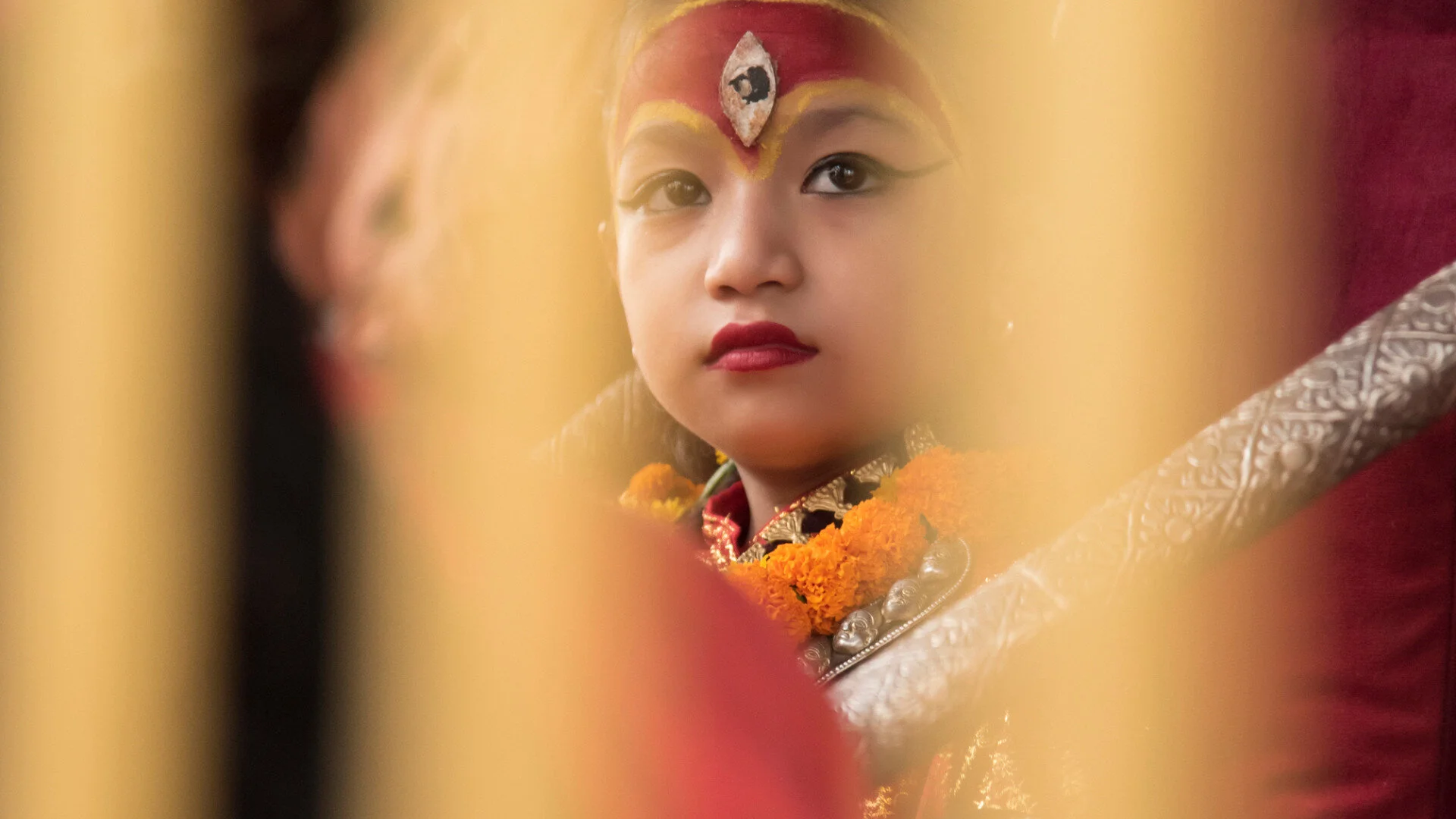
Kumari: The Tale Of The Goddess - Part III
There are many legends about the origin of how the Kumari Jatra tradition started. The most popular one is of King Jaya Prakash Malla, the last ruler of the Malla dynasty, which tells how the goddess Kumari vanished when the queen finds out to whom the King secretly visited every night.
The tale passed down from oral traditions goes as follows.
Continued…
He looked to her and asked, “Should I be worried about my neighboring kingdoms?”
She took the dice, and just as she was about to roll them, the door was bust open!
Armed guards surrounded the duo from every corner. The king felt confused, and just as he was about to speak, the queen entered the room.
“So, this is where you disappear to, MY KING!”
To which the king responded, “My beloved let me explain.” The king was interrupted by the queen, “DON’T! I find you in the late hours discussing state affairs with such a beautiful young woman!”
“But my love…” the king tried again.
“I can’t even leave you out of my sight for a moment!”
“Both of you… I had enough.” The attention of the room now shifted toward the beautiful young woman. Even the simplest of minds could have noticed that she is no ordinary mortal.
The room fell silent.
She gently placed the dice atop the board. She looked around the room: her sight reached the king’s eyes. She smiled.
She then looked to the queen, and that beautiful smile turned into a sharp look of authority.
In an instant, she threw herself up and spread her ten arms, eight of which held vessels of wielding power. An aura of flame emanated and surrounded her. Her gentle face turned frightening, and her third eye appeared.
Her nostrils flared, as she drew in deep breaths in anger.
She was no other than Taleju herself, revered as a wrathful aspect of Durga.
The soldiers dropped their weapons, and the queen drew back. The king was on his knees.
“HOW DARE YOU THINK OF ME IN SUCH A MANNER?”, she took in a breath and as she exhaled the aura of flame around her grew warmer. “Goddess, please forgive us! Please, I beg of you!” said the king.
“YOU HAVE SEEN THE LAST OF ME! I shall not stay in this kingdom any longer. You mortals and your jealousy, ENOUGH!”
“Goddess, please heed my cry! How would I reign without you?” appealed the king.
“You won’t! Your reign will soon come to an end, and your dynasty with it. For you and your brothers will unite for the last time. You shall fight alongside them, and it shall be your last.”
The flame grew larger and turned into a blinding streak of light. The Goddess had disappeared.
“I think your mission has now been accomplished?” said the king in a deep voice. “How should I have known, that it was goddess Taleju herself?” exclaimed the queen.
“You could have just minded your own business and leave me to mine.”
This night might have been the last but wasn’t the first time the king discussed state affairs with the Goddess. He had become so dependent on her advice, that after this incident: he lost all command to rule.
He kept his priests busy inside the Goddesses mammoth three-storied temple, making offering of all sorts; leaving no stone unturned. He prayed, heeded to her and waited anxiously.
Finally, the Goddess appeared but in a dream.
“Oh, my dear king, you’ve prayed more in these past few days, then many do in their entire lifetime. Your priests have been making offerings for days and nights. I will never forget the insult I suffered. But if you wish to see me again in mortal form, find a young virgin girl of the Bandya caste group. Choose the unblemished one, who exhibits thirty-two signs of perfection, for she will be my living manifestation, and your kingdoms living Goddess. Celebrate her, worship her as you worship me.”
The king awakened from his sleep. He joined his hands and thanked the Goddess. The morning that followed, he called in his ministry and his priests.
He instructed his priests to find the exact match and his ministers to put together the schematic to build her a beautiful home/palace. In the days that followed a young child from the Bhandya household who met all the criteria was found. She then was taken to the Taleju temple and in a special ceremony installed as the living embodiment of the Goddess.
To conclude this article, before king Jaya Prakash Malla, a living goddess sanctioned by the state was in the city of Lalitpur installed by Lichhavi king Laxmikamadeva. Over time, it is possible the tradition died out or took the form of a hidden cult. Many bahals and bahils of Nepal Mandala (Kathmandu Valley) have evidence of being the home of a living Goddess. The commonality among them is that embodiment of the Goddess has always been a girl from the Bhandya (Shakya and Bajracharya) caste group.
During the reign of Jaya Prakash Malla, he could have stumbled upon the hidden cult. Thus, he must have commissioned grotesquely introducing the tradition and have it sanctioned by the state in his kingdom of Kathmandu. We should keep in mind how, after king Yaksha Malla divided the kingdoms amongst his children: the Malla kings became rivals.
The merger of Goddess Taleju and the primordial Kumari of Nepal Mandala is an example of cultural assimilation. He took it further and build her a home/palace, and also introduced a chariot festival. It helped embolden the process and aided in creating the new identity of the primordial Goddess Kumari and her manifestation.
Today the three old Malla kingship states (Kathmandu, Lalitpur and Bhaktapur) have their customs and methods when it comes to caring for their living Goddess. They are one but different, but truly unique and primordial.
Correction:
In part I of this article, I mentioned she is called Dyah Meiju in Newari. Dyah means god and Meiju roughly translates to a noblewoman. It is also a word used to refer to a woman of the Bandya caste group.
POPULAR ITINERARIES
SIMILAR POSTS

Kumari: The Tale of the Goddess - Part II
The assimilation of Taleju and Kumari occurred in Kathmandu and is said to have been during the reign of King Jaya Prakash Malla, the last Malla king of Kathmandu. The most well-known tale of the living goddess was born during the reign of Malla Kings.
The most well-known tale of the living goddess was born during the reign of these Malla Kings.The chronology of Malla kings varies in multiple chronicles. The word Malla denotes wrestler. During the reign of the second Rajput Dynasty in Nepal Mandala, the son of kking Ari Deva was a valiant wrestler. He was given the title of Malla and was known as Abhaya Malla. It was during his reign Nepal Sambat calendar was introduced. “Nepal era introduced, beginning in October 880 AD”- (Wright, 1990: 314)
After which historical lines are blurry of the Malla Kings. Their lineage resurfaces after a significant amount of time in the city of Bhaktapur. A township built by king Ananda Malla, second son of king Abhaya Malla it is from here the Malla Era of Nepal Mandala began.
According to legends, during the conquest of the Mugal Empire king Harisinha Deva, a king of Ayodhya Dynasty who ruled Simraungarh fled to Nepal Mandala along with his people. It is said Bhaktapur and Simraungarh had good relations fortified by trade and marriage. They were welcomed, with open arms in Bhaktapur and both cultures assimilated to create the unique identity of Bhaktapur.
A part of this assimilation was the introduction of Tulaju Devi. She is commonly known as Taleju Bhawani. Over time she became the tutelary deity (family deity) of the Malla Dynasty. She is believed to have been the tutelary deity of king Harisinha Deva.
She (Tulaju Devi) is worshipped, through a sacred yantra which was brought to Bhaktapur by King Harisinha Deva’s people.
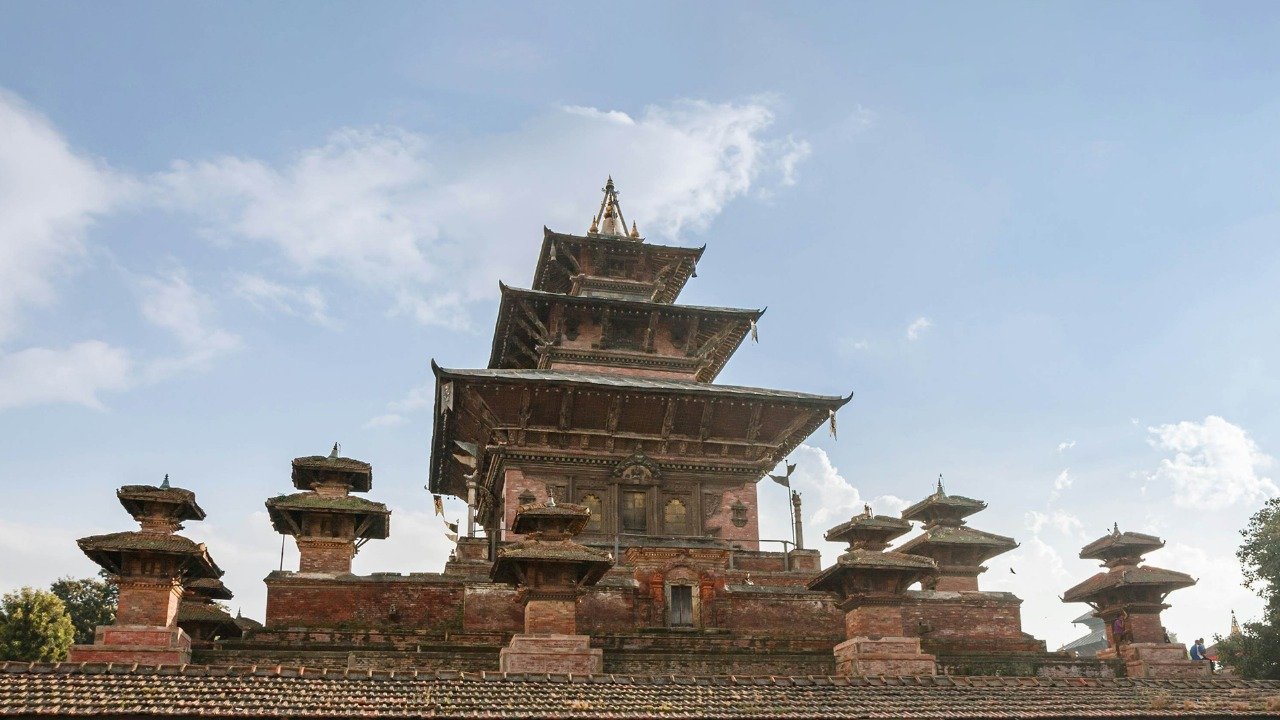
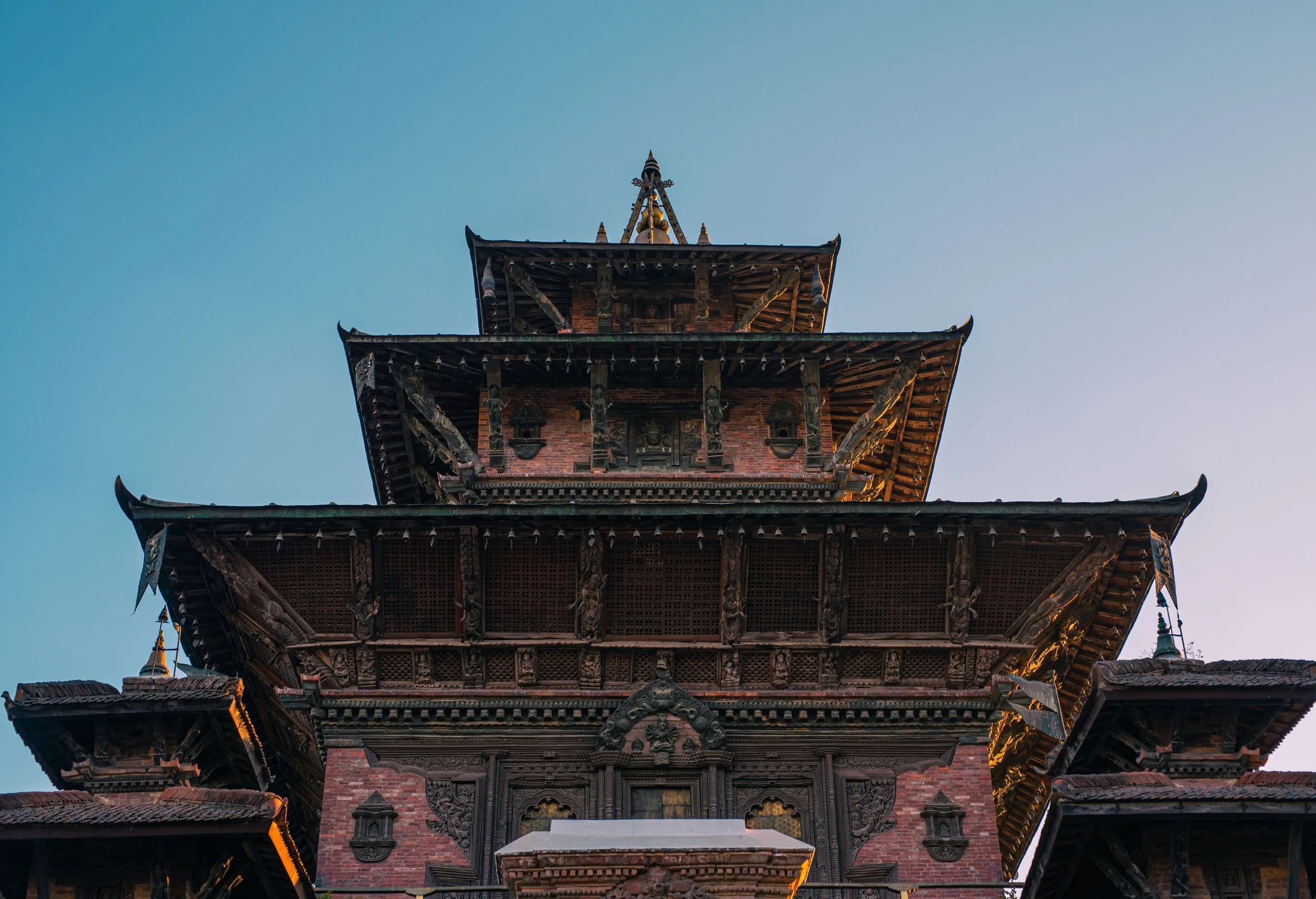
Today, temples of Taleju Bhawani can be found in all of the Malla kinships of Nepal Mandala. In Bhaktapur, her yantra is housed in a sacred courtyard. Whereas in its sister states she has two mammoth temples built in traditional pagoda design. The construction of both, were in the late Malla period. The temple in Kathmandu was built by king Mahendra Malla in 1500 AD, and that of Lalitpur was first built by king Siddhi Narshinga Malla in 1640 AD and later by king Srinivasa Malla in 1667 AD after it was damaged by a fire.
The assimilation of Taleju and Kumari occurred in Kathmandu and is said to have been during the reign of King Jaya Prakash Malla, the last Malla king of Kathmandu. He is also the king who commissioned the chariot festival of the living goddess during Yenya Punhi (Indra Jatra).
The talepassed down from oral traditions goes as follows.
The last ray of sunlight had fallen and the people of Nepal Mandala slowly made ready their bed. At Yeh Lyakhu (Kathmandu Durbar) the palace gates were shut. The guards made their regular patrol. The Byanjankars (cooks) prepared the royals their nightly meal. After which the queen left for bed, and asked her husband to join soon.
The king, however, had a different intention.
The moon had almost reached the centre of the sky. The king felt the time was right. He made his way through the royal courtyard and entered a secret room.
“You’re late today? Was anything the matter?”
“No, I was just waiting for the courtiers to fall asleep.” said the king.
The room was lit by a dim lamp, at the center of which was a small table. The king made ready the board and dice (a game of Tripasa) atop it.
“How were your people today?”
To which the king responded, “Nothing of urgency came up. Only news of the Gorkha Rajas (Kings) another triumph. His eyes are set on this Mandala, he will not rest until he conquers it.”
The king took a brief pause, and with hopeful eyes looked to her and asked, “What do you think I should do?”
“For now do nothing,” she paused to throw the dice and continued, “The whispers of war can be heard. The people are already scared! For when the tower of this valley falls ring the war bell. Fortify your gates, and make arms ready.”
The king made a mental note and paused to take a deep breath. He took the dice and threw them.
“Aha, beautiful!” he looked please at the results.
He looked to her and asked, “Should I be worried about my neighboring kingdoms?”
She took the dice, and just as she was about to roll them, the door was bust open!
POPULAR ITINERARIES
SIMILAR POSTS
Kumari: The Tale Of The Goddess - Part I
There are several tales about the history and culture of Nepal. Among all those legends and stories, one is the goddess Kumari. The story tells about the origin of the goddess Kumari, a living goddess worshipped by Hindus and Buddhists of Nepal.
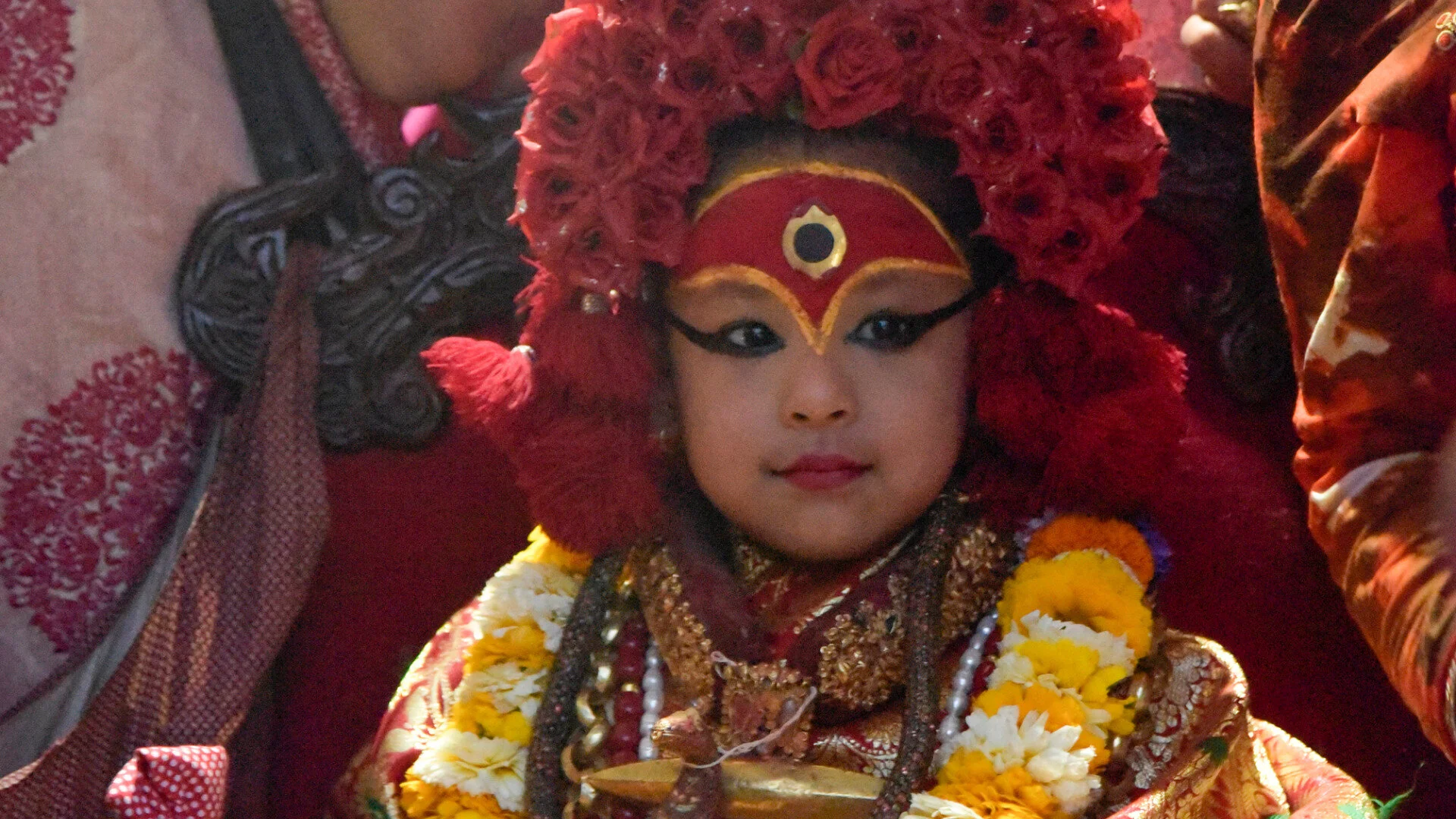
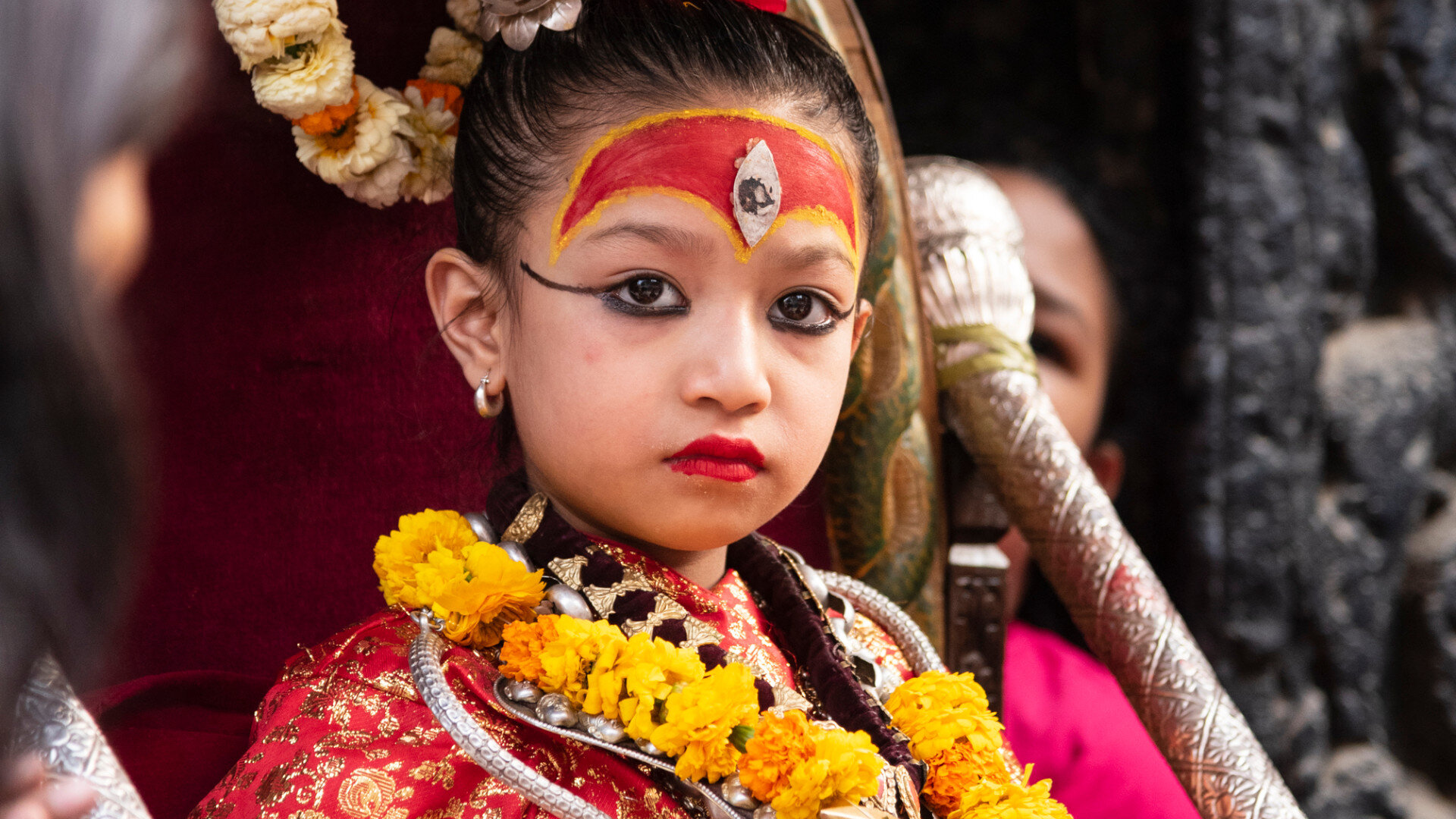
When one pictures the magical heartland of Nepal, the image of Kathmandu is incomplete without a young girl dressed in red with mascara highlighting her eyes and seated in a throne. Traditionally known as Dyah Meiju (God Mother), this enchanting young girl is the symbol of power, candour, and divinity.
Tracing chronicles, the first mention of Kumaris comes during the episode of Pingala which occurred in the Dvaparayuga and lasted for fifty years. This period is denoted as the arrival of the goddesses in Nepal Mandala (Kathmandu Valley).
“Having heard of the arrival of the goddess, all the Kumaris of different directions appeared- Balakumari of Thimi in the east, Kvathache Balakumari in the south, Maitidevikaumari in the west, close to Janesvara who came from Balkhu Pitha, and Kaumari of Mangalapura in the north, who formerly resided in Visalanagara near Bhasmesvara. These Kumaris are the primordial ruling deities of Nepal.” - Bajracharya & Michaels. 2016 “History of the Kings of Nepal: Introduction and Translation” Himal Books: 26
These deities are still highly regarded in the Newar pantheon. They are also viewed as the manifestation of Devi, and some as Shakti Pitha’s.
It is believed that the Kumaris aided King Gunakamadeva, during his conquest of creating a township. He was a king during the Lichhavi Era who in a dream was instructed to found a city north of his abode at the junction of Bagmati and Vishnumati rivers and to centre the city around the temple of Kanteswara Mahadev (today known as Aakash Bhairav).
The town that he put together is known as “Suvarna- pranali- Kantipur” (Wright, 1990: 156). He designed the township in the shape of a Khadga ( Sword of Goddesses) with the temple of Kanteswara Mahadev in the centre. After the completion of the town, a day was marked in celebration of the occasion. Today that day is known as Yenya Punhi in Nepal Bhasa ( Yen meaning Kantipur/Kathmandu and Ya meaning celebration). Today it is commonly known as Indra Jatra, which is an assimilation of Yenya Punhi, Indra’s arrival to Kathmandu and Kumari Jatra which was instituted by King Jaya Prakash Malla.
His grandson, King Laxmikamadeva is credited to have been the founder of a cult which worshipped a living goddess.
“ This Raja thinking that his grandfather had acquired so much wealth and conquered the four quarters of the world through the aid of the Kumaris, he resolved to do the same. With the intention he went to Patan Durbar, and having worshipped as Kumari the daughter of a bandya, living in a bihar near the Durbar, known by the name of Lakshmi-barman, he erected an image of Kumari and established the Kumari Puja.” - Wright, Daniel. 1990 “History of Nepal.” Asian Educational Services: 157
During the reign of the famous Malla King Siddhi Narshinga Malla, this bihar was moved west and today is known as Ratnakar Mahabihar. The spot of the old bihar houses Sundari Chowk, and the famous golden tap, Tusha Hiti.
Even till this day, the daughter of a bandya (Shakya and Bajracharya) is worshipped as the living goddess. The cult has its set of rules, customs and norms during the selection process. She (The Living Goddess) is chosen at a young age and sits on the throne till she reaches puberty. She is succeeded by another young girl selected from the registered bandya households.
I presume the cult grew and diffused to other vicinities of Nepal Mandala (Kathmandu Valley). Multiple pieces of evidence show the cult existed in various bahals of Nepal Mandala which have been documented by Isabella Tree in her book “The Living Goddess.” Over time the cult dissipated from multiple bahals.
Nepal today has three Royal Kumaris ( Kathmandu, Patan, Bhaktapur), five Communal Kumaris ( Makhan Tol, Kilagal, Nuwakot, Bungamati, Tokha) and three living gods; two in Kathmandu ( Kathmandu Ganesh & Bhairava) and one in Tokha (Ganesh).
Defining what she represents is difficult due to the primordial nature of the goddess Kumari. But in my research and understanding, she is viewed as the shakti of Lord Bhairava. She is one of eight mother goddesses(Asta Matrika) in Lalitpur. It is known as Aji Ma group in Kathmandu and Nava Durga in Bhaktapur and Thecho. Over time cultural assimilation has lead to additions and loss of the core identity of the goddess and her living manifestation.
The most well-known tale of the living goddess was born during the reign of the Malla Kings.
POPULAR ITINERARIES
SIMILAR POSTS
The Smaller Chariot Part II: The Legend of Min Nath
The Legend of Min Nath: smaller chariot paraded along the streets of Patan during Rato Matsyendranath festival worship dates back longer than of Rato Matsyendranath. Before the Rato Matsyendranath festival in Kathmandu, there use to be another chariot festival. A chariot of an idol, Min Nath or Karunamaya.
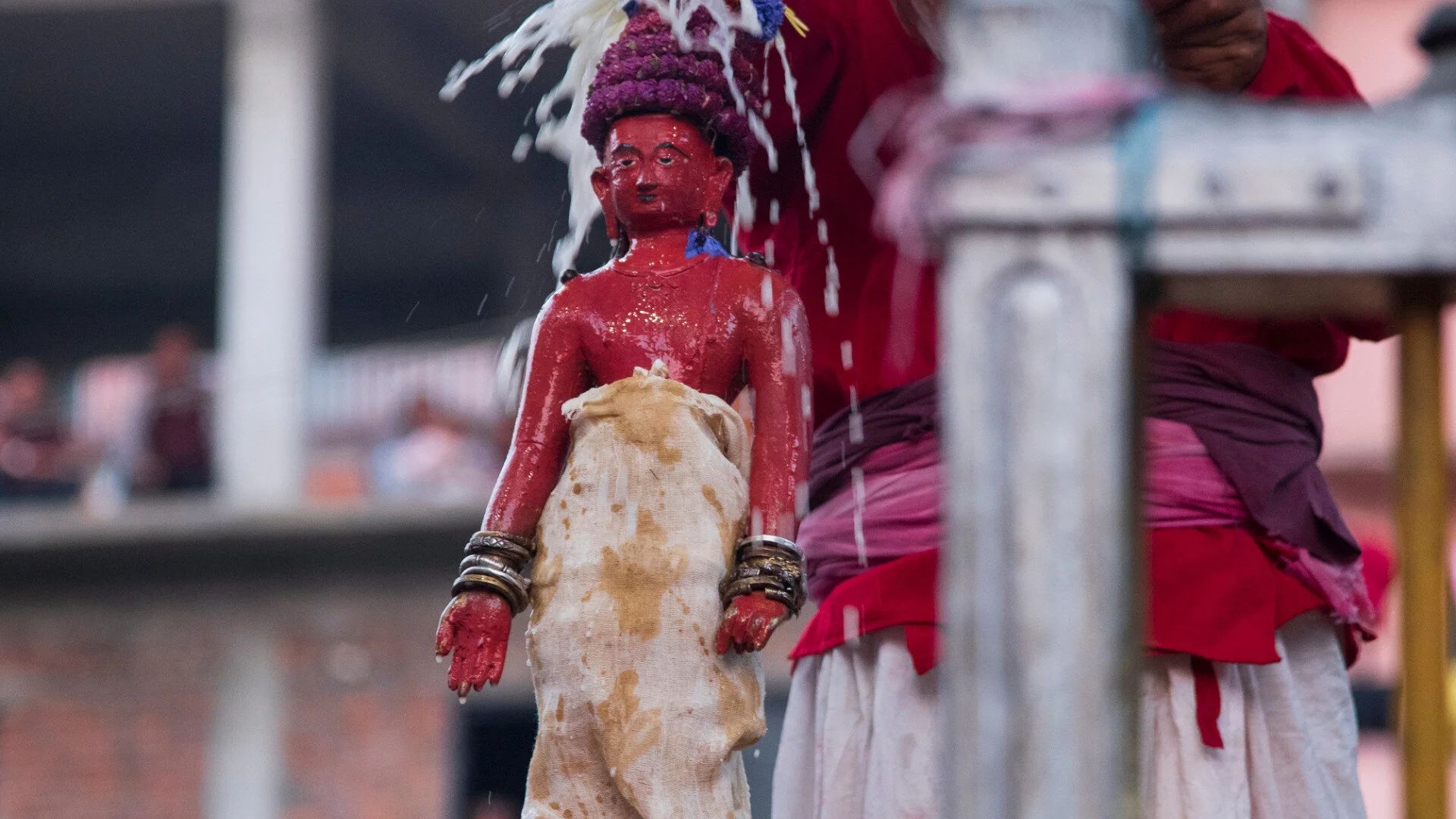
Seated in the smaller minaret styled chariot is an idol that over time has garnered many names. In the native dialect of Nepal Bhasa he is known as Chak: Baha Dyo (The god of Chak Baha in Patan of Lalitpur) and in Nepali as Jatadhari Lokeshwor ( Braided Hair Lokeshwor), but he is commonly called Min: Nath.
The legend of Min Nath passed down from oral tradition goes as follows.
Once there lived a pious king at Lagankhel of Matiligrama ( which was incorporated into the larger kingdom of Lalitpur), who was named Brisha Deva. His daily routine featured a walk to visit a nearby Buddhist stupa. He used to circulate the stupa several times reciting sacred prayers. One day during the process, he suddenly died!
His body laid there, waiting for last rites, whereas his soul had been brought to Yamaloka ( the land of the death) by Yama Dutas. He was placed before Min Nath, who is also known as Dharmaraj. It is him (Dharmaraj/ Min Nath) who decides what is right or wrong with the dead.
King Birsha Deva found the land enchanting. He heard the soothing sounds of the Gandavyuha- Sutra ( A sacred Buddhist scriptures) and saw how the God of Mercy ( Min Nath) treated those who suffered by squeezing water from his wet braided hair. For which he is also called Jatadhari Lokeshwor ( Braided Hair Lokeshwor). Now came the turn of king Brisha Deva to be inspected by Min Nath.
Upon a thorough inspection, he (Min Nath) told his messengers (Yama Dutas) that it is still too early to fetch king Brisha Deva and to take him back to his own home.
King Birsha Deva returned to his place. His lifeless body slowly began to move and he came to life.
The king was highly impressed by the spiritual atmosphere of Yamaloka and thus conjured a plan to recreate the same scenic setting in his kingdom. He requested master artisans to create a beautiful image of Min Nath and introduced the practice of reciting Gandavyuha- sutra.
Thus was born the cult of worshipping Min Nath.
When king Birsha Deva finally did pass away, his brother Balarchan Deva ruled in Matiligrama.
One night king Balarchan Deva had a dream in which Min Nath told him, "O king when you shall awaken, you will see a bird flying towards a particular place. Build a beautiful home for me at the spot where the bird alights."
When the king awoke, and he reached out to his astrologers, they unanimously stated that the dream was an auspicious one.The king built a monastery, the first of its kind in Matiligrama at a site where he saw a bird perching atop a tree. The monastery was named Jesthaverna Maha Bihar, meaning the first-ever monastery. The image of Min Nath was enshrined at the Bihar, and the tradition of a chariot festival was instituted.
When the trio of King Narendra Deva, with priest Bandhudatta and Rathacakra Jyapu, returned with Karunamaya and decided to institute a chariot festival, they wished for there to be only one chariot festival in Lalitpur.
But the unified kingdom of Lalitpur had seven chariot festivals.
It is said that six of the seven gods agreed to discontinue their chariot festival in honour of Karunamaya, but Min Nath wished different. Priest Bandhudatta tried his best to bring Min Nath to his control, but he failed.
After which Min Nath, opened his third eye and projected a beam of light which hit a small stupa outside the Baha gate. Another variation, states he threw a bajra ( lighting bolt). The stupa is still present at the premises and seems to have been hit by a strong force.
Thus, the chariot festival of Min Nath was not assimilated into that of Karunamaya, allowing the cult of Min Nath to continue and develop its own identity.
A schematic for a combined procession was created featuring two chariots, one of Karunamaya and the other of Min Nath. In honour of the other six gods and their chariot festival, they were incorporated into the chariot of Karunamaya, accordingly.
For almost two millennia and more, the chariot of Karunamaya has made its way through riveting terrain and waited at Jhana Ko for Min Nath. It has in time become not just a chariot festival but the identity of the city and the valley of Nepal Mandala ( Kathmandu Valley).
It has grown as a symbol of religious and cultural unity, with worshippers of multiple religious sects bestowing prayer and worship to the God of Compassion ( Karunamaya) and the God of Mercy (Min Nath).
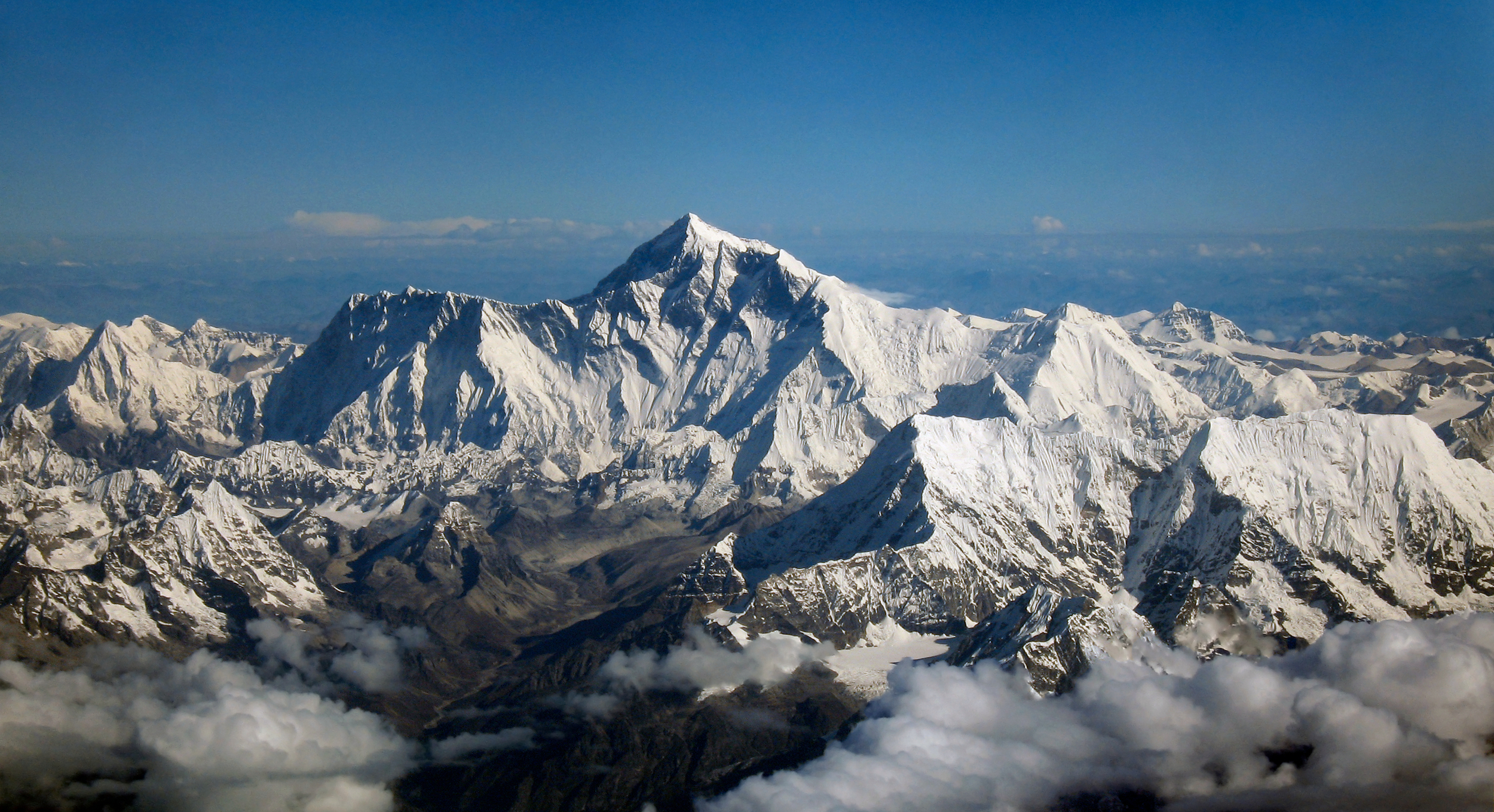
This trek is specially designed to reach the Everest Base Camp including Kala Pattar which is the best view point to view the sunrise over the high Himalayas including the Mt. Everest. This trek requires 13 days.
USD 1515 PER PERSON -- TWIN ROOM SHARING BASIS