
Sikali: A Unique Take on Dashain
While most of us rejoice for nine days in the most auspicious festivity of Dashain, people of the Newa community partake in a unique cultural blend in a historic town. For ages, the post-harvest celebration has had its own significance and this Newar festival for the people of Khokana is parallel to the ideologies of Dashain, ‘Victory of good over evil.’
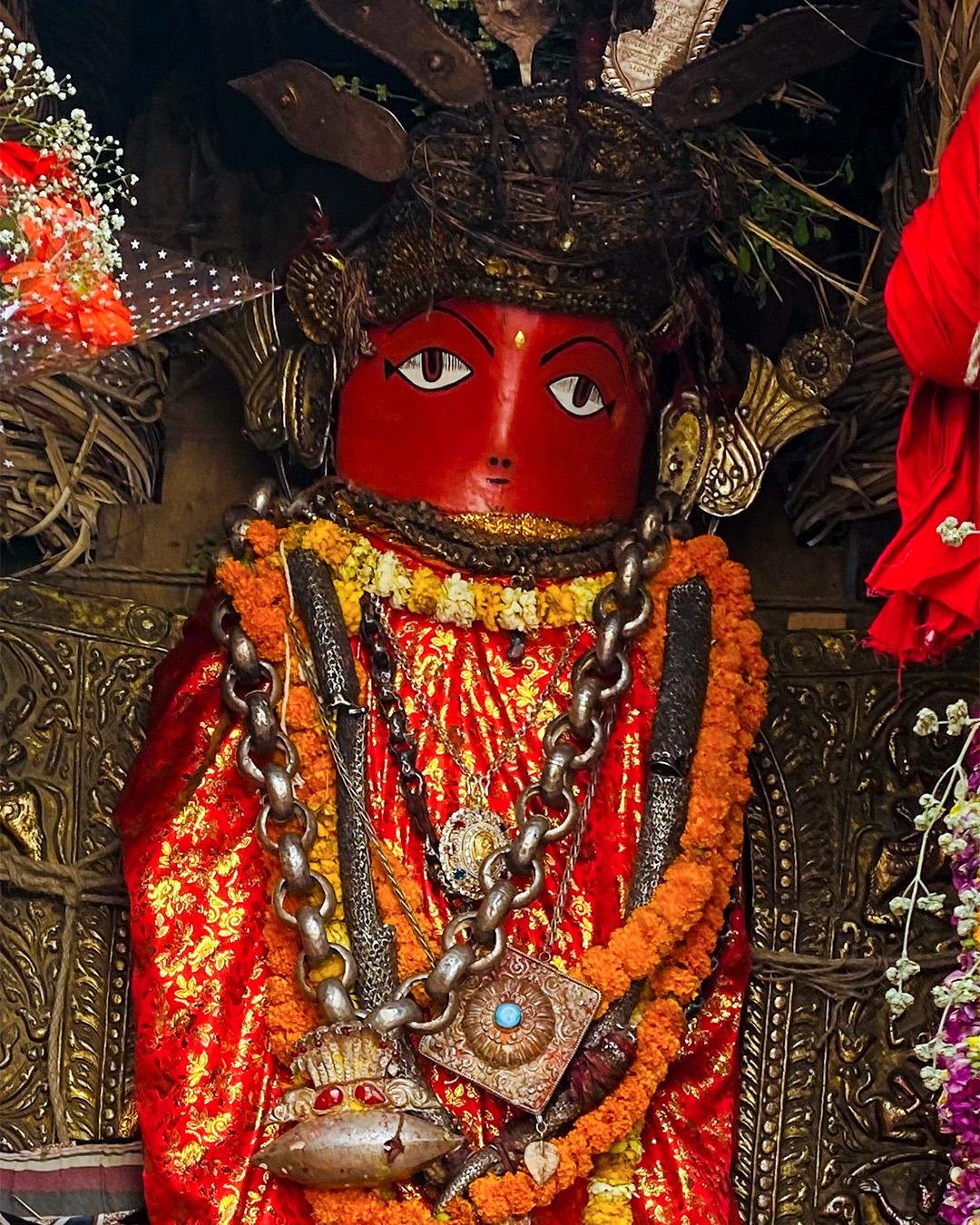
Historically speaking, the festival is dedicated to the name of the goddess Sikali, more commonly known as Rudrayani and Ajima. Famously known for carrying the reputation of a healer in society, Sikali are guardians committed to being the protector of children. During the seven days long festivals starting from Ghatasthapana, Goddess Rudrayani is carried in a wooden chariot for a stroll throughout the village. She then rests in front of the Sikali temple where she belongs surrounded by religious copper vessels.
On the day of Fulpati, they commemorate the occasion with a special cultural dance in the heart of Khokana. In the Malla era of the 15th century under the ruling of the King, Amar Malla made various temples under the name Matrika’s (Mother Goddesses). Amongst them, Rudrayani, commonly known as Maheshwari became a well-renowned deity. A special temple was made in her name and the town of Khokana dedicated its life to her service. For that matter, the King selected Dangols and Maharjans and relocated them to Pachali Bhairav for maintaining and catering service. While establishing the foundation of the Kingdom, the city was famously known as Jitapur.
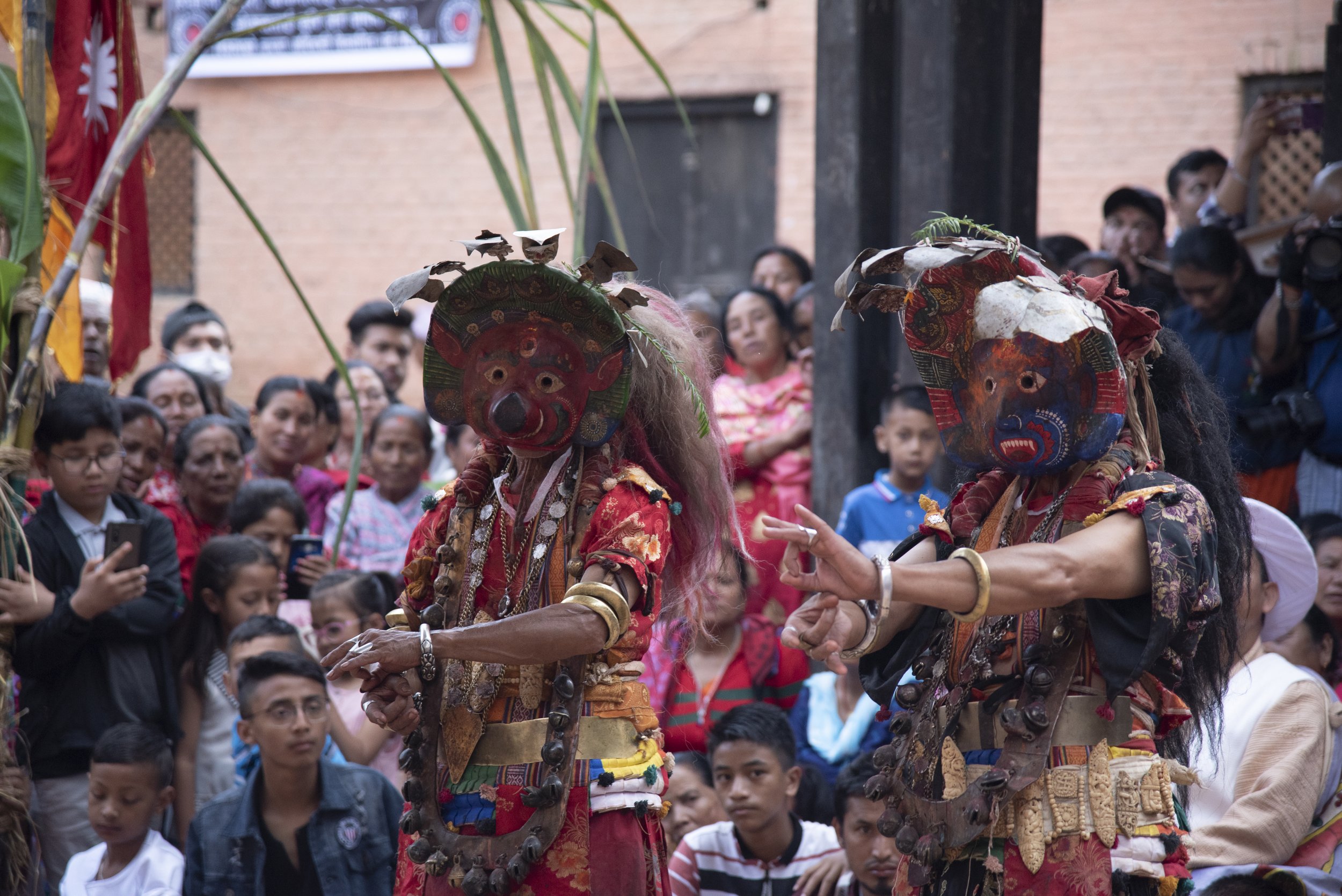
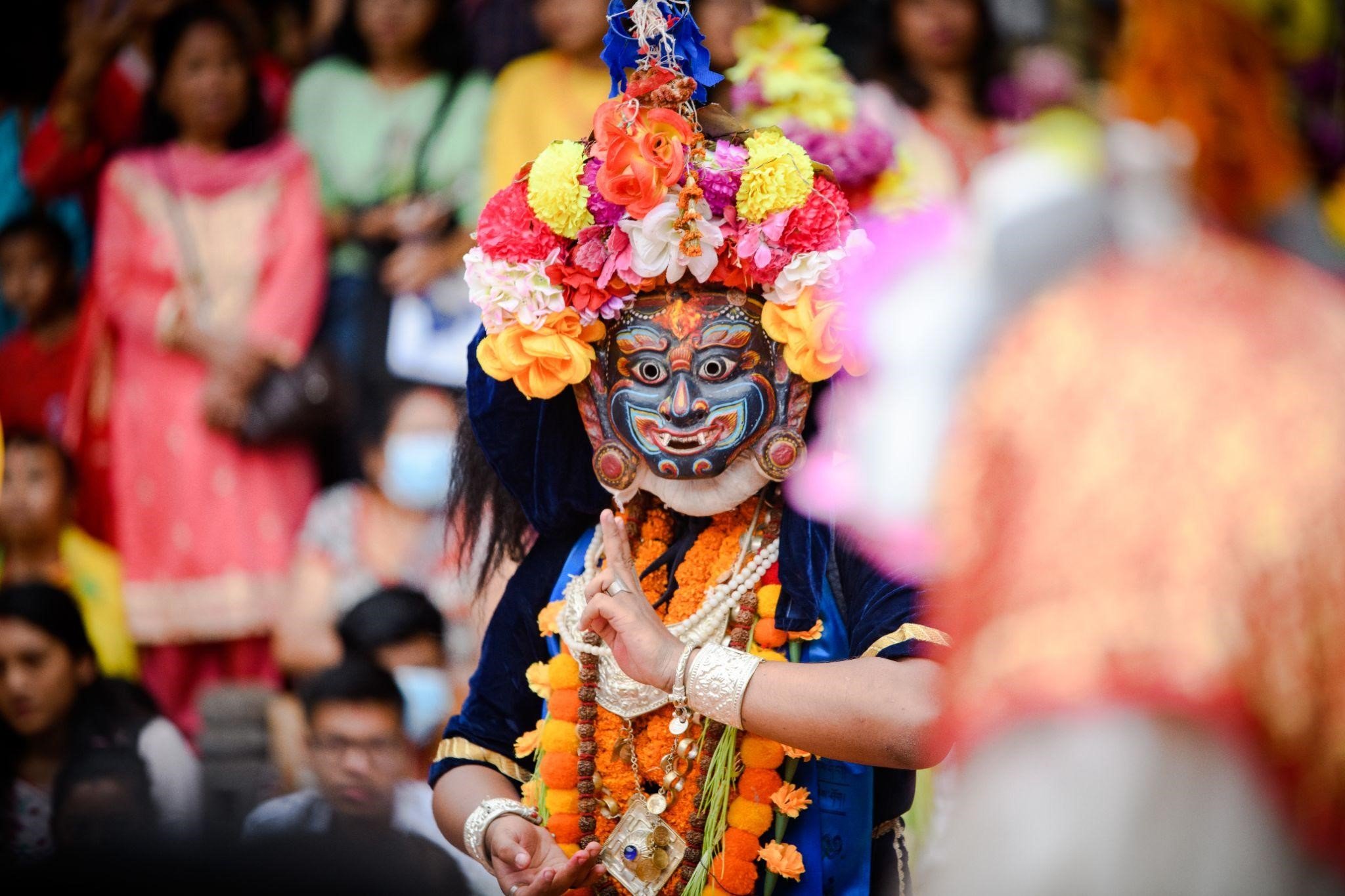
So, in today’s era, how is tradition conducted? Well, it is conducted by the prestigious priests with decorative ornaments and plain white robes. About 14 masked goddesses come together to perform a graceful dance with each other. Locals have strong faith that their devotion to protecting them and their town from grave calamities and misfortunes. Previously, the deeds performed in the festivity were also known to reduce the high child mortality rate in Nepal. It was a common myth before modern medicines and vaccines came into existence.
Talking about the origin of the word Khokana, it is a Newari word Khokana where “Kho” means to weep and “Kana” means to tell. Legend says that in this land a respected Maharjan priest of Pachali Bhairav residing in Kathmandu lost consciousness because of a high cold fever. The village Vaidya, in a state of shock and confusion, thought he was dead and was taken to the bankside of Bagmati for cremation. His wife joined beside him in the pyre following the historical Hindu practice of Sati Pratha.
A heavy downpour then resulted in everyone leaving the cremation and running towards the shelter. But surprisingly, as the pyre started burning, the priest gained consciousness. Thinking of this as a bad omen, the people of the locality didn’t allow both of them to enter the city again.
With nowhere else to go, they decided to make their living in Kudesh, ‘Ku’ meaning Bad and ‘Desh’ meaning country. There’s a hearsay that claims Goddess Sikali Devi blessed the couple and they started a new settlement on the northwest side of Khokana, the rest is history.
During the final day, a distinct performance is held by the elders of the community. Presented in an archaic form of storytelling, it involves traditional music with people in godly dress up and a mask of famous gods and notorious demons. This represents a great diversity of people coming together as one. A huge commotion is created by individuals to witness the auspicious occasion of Sikali being taken to the temple. The spectacles take blessing from her for health and prosperity. Even tourists from far and long come to get a glimpse of this holy entity.
POPULAR ITINERARIES
SIMILAR POSTS

Yenya Punhi: A Jubilation of Kathmandu - Part II
According to legends, it is believed that the mother of Lord Intra required a Parijat( a white flower) to perform a ritual. For which Lord Indra descended to earth in search of the flower. He disguised himself as a commoner and while trying to take the flower out of the lawn of a Jyapu. He caught Lord Indra and held him captive blaming him of trying to steal. Lord Indra was imprisoned and not allowed to go back to heaven.
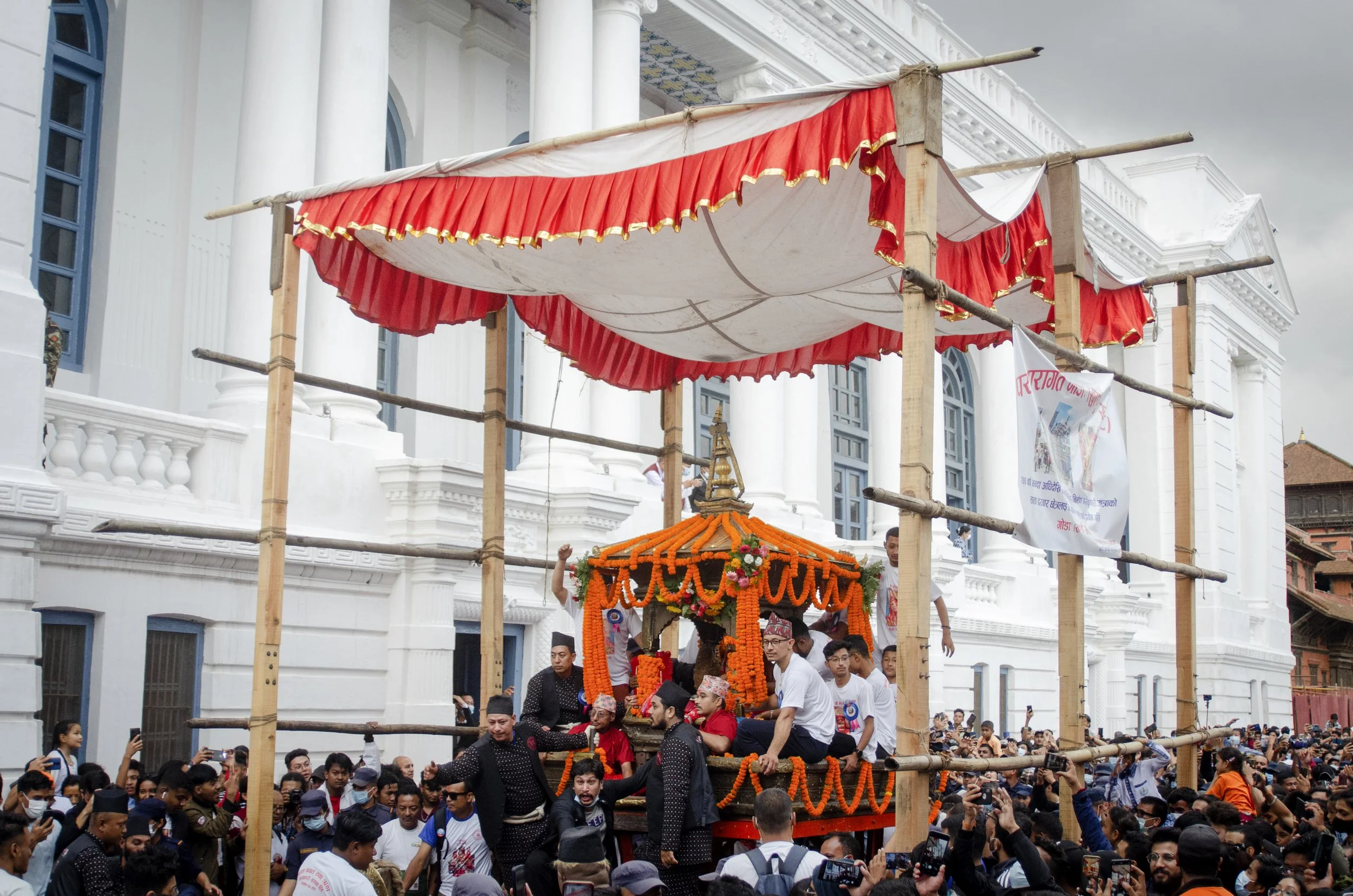
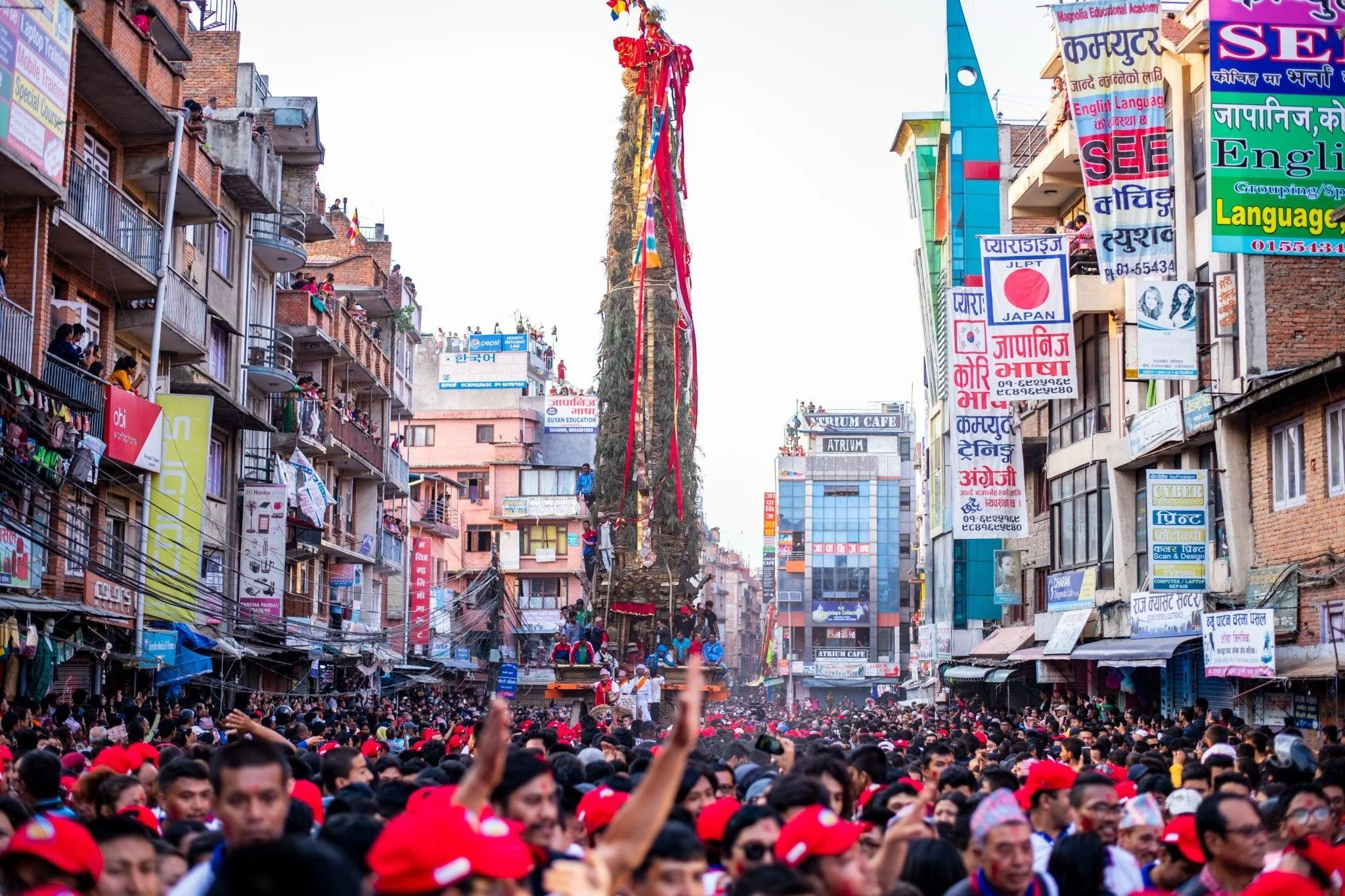
Regarded as the biggest festival of the then Kingdom of Nepal Valley, the true origin of the festivals are still debated. But this festival is believed to be founded during the Licchavi Era by King Gunakamadeva, the founder of the city of Kantipur (Kathamandu). The celebration of Indra Jatra is made of three different series of rituals: Kumari Jatra, Indra Jatra and Bhairava Jatra. Each have their own legends and ceremonial components but as a whole, turn the centre of Basantapur Durbar Square into a grand affair. The square is a sight to behold from the break of dawn till midnight, as the chariots of Kumari, Ganesh and Bhairava make there way through the inner city of Kathmandu. Every street comes to life with masked dances, merry music during the eight days of festivities.
According to legends, it is believed that the mother of Lord Intra required a Parijat( a white flower) to perform a ritual. For which Lord Indra descended to earth in search of the flower. He disguised himself as a commoner and while trying to take the flower out of the lawn of a Jyapu. He caught Lord Indra and held him captive blaming him of trying to steal. Lord Indra was imprisoned and not allowed to go back to heaven.
The mother of Indra grew worry some as her son hadn’t returned from Earth. Phul Khusi ( The Vahan of Indra) descended upon Earth to find his master and wondered around the streets of Kathmandu. During when a great festival was occuring in the Kathmandu and after hours of searching, Phul Khusi found Lord Indra. Phul Khusi took the news to heaven after which, his mother descended from heaven to free her son. She requested the villagers to release her son, but didn’t heed to her words. Only after Lord Indra reveled his true form. The mother of Indra made a promise to the villagers to give in return a final rainfall for their harvest to prosper and she would lead them to the gateway to heaven.
Accepting the conditions the villagers freed Lord Indra and let him go with his mother, a group of villagers followed them to the outskirts of Kathmandu to find the doorway to heaven. But Lord Indra’s mother tricked the villagers by putting forth a large mist which left the villagers confused and in dismay as Lord Indra and his mother went to heaven. To commemorate this event, during the celebration of Indra, a Dagi ( Procession) takes the same path every single year. “The circumbulation of the city is performed in order to reach heaven in the Dagi’s footsteps to meet the dead relatives. The families scatter grain by the wayside so that they would not forget the way home. One finished, they throw what remains of there offerings in a plce called Bhuta Satta, near Kasthamandap, and wash their faces at Maru Hiti fountain. Afterwards, they either return home or go to bathe in Indra’s Pond ( Yamki Da), which is located on a hill 12 kilometers west of Kathmandu.” Toffin,1992,86)
The festival of Indra Jatra is a feast to all senses, the air is scented with the smell of incense, and the sound of drums and traditional instruments tranquil once ears. For the eyes, one can behold the procession of Living Goddess Kumari along with Lord Ganesh and Lord Bhairav. The chariot is pulled for three consecutive days. The first day is known as Kwaneya during when the chariot makes its way from Basantapur, Maru, Chikanmugal, Jasidewal, Lagan, Bhimsensthan, Baru and ends at Basantapur. The second day is known as Yenya Punhi on which the chariot procession begins from Basantapur to Pyaphal, Nyata, Tengal, Nhyaokha, Nhaikan Tol, Asan, Kel Tol, Indra Chowk, Makhan and ends at Basantapur. The final day of the procession is known as Nanichaya, the chariot is pulled by revellers from Basantapur tp Pyaphal, Yatkha, Nyata, Kilagal, Bhedsing, Indra Chowk, Makhan and ends at Basantapur.
During the festival of Indra, various idols and masks of goddess are taken out of their normal abode to be exhibited to the people. The most prominent of which are the Sweta Bhairab mask and the idol of Akash Bahiran. Similarly an image of Indra is displayed at Maru and Indra Chowk. Various forms of dances such as of Lakhe Aju, Mahakali Naach, Halchowk Bairab, Phul Kushi, Devi Kyakhan are performed on specific days and nights of the festival.
POPULAR ITINERARIES
SIMILAR POSTS
Yenya Punhi: A Jubilation of Kathmandu - Part I
Amongst the great celebrations of this valley, nothing beats the pomp and flair of Yenya Punhi. Commonly known as Indra Jatra- a name derived from the lore of Indra- the heaven king's visit to Nepal. This festival is larger than life, with symbolism and meaning going back thousands of years- neatly preserved by the Newars.
The jubilation of Kathmandu is a combination of festivals. It features the veneration of multiple deities. The Newar name Yenya denotes "Celebration (ya) of Kantipur/ Kathmandu (yen)". The township during the Lichhavi era was called Yen. Its sister cities were respectively called Yala (Lalitpur), Kwopa (Bhatgaon/Bhaktapur) and Kipu (Kirtipur).
The origins of the festivities are very vague. However, the careful analysis presents a similarity to ancient paganistic rituals of Europe. The day of Yenya Punhi aligns with the change of season in this valley. The season transfers from Barsha (Monsoon) to Sarad (Autumn). Reviewing the procedures of various festivals in the valley: evidence is drawn to how the Yasi/ Yosi (Ceremonial Pole) is hoisted to alert the citizens of change. The same was observed in medieval Europe. The ceremonial May Day pole symbolized the advent of spring. A stark similarity to Bhaktapur's Yoshi was erected during Bisakh Jatra to celebrate the end of winter and the beginning of spring.
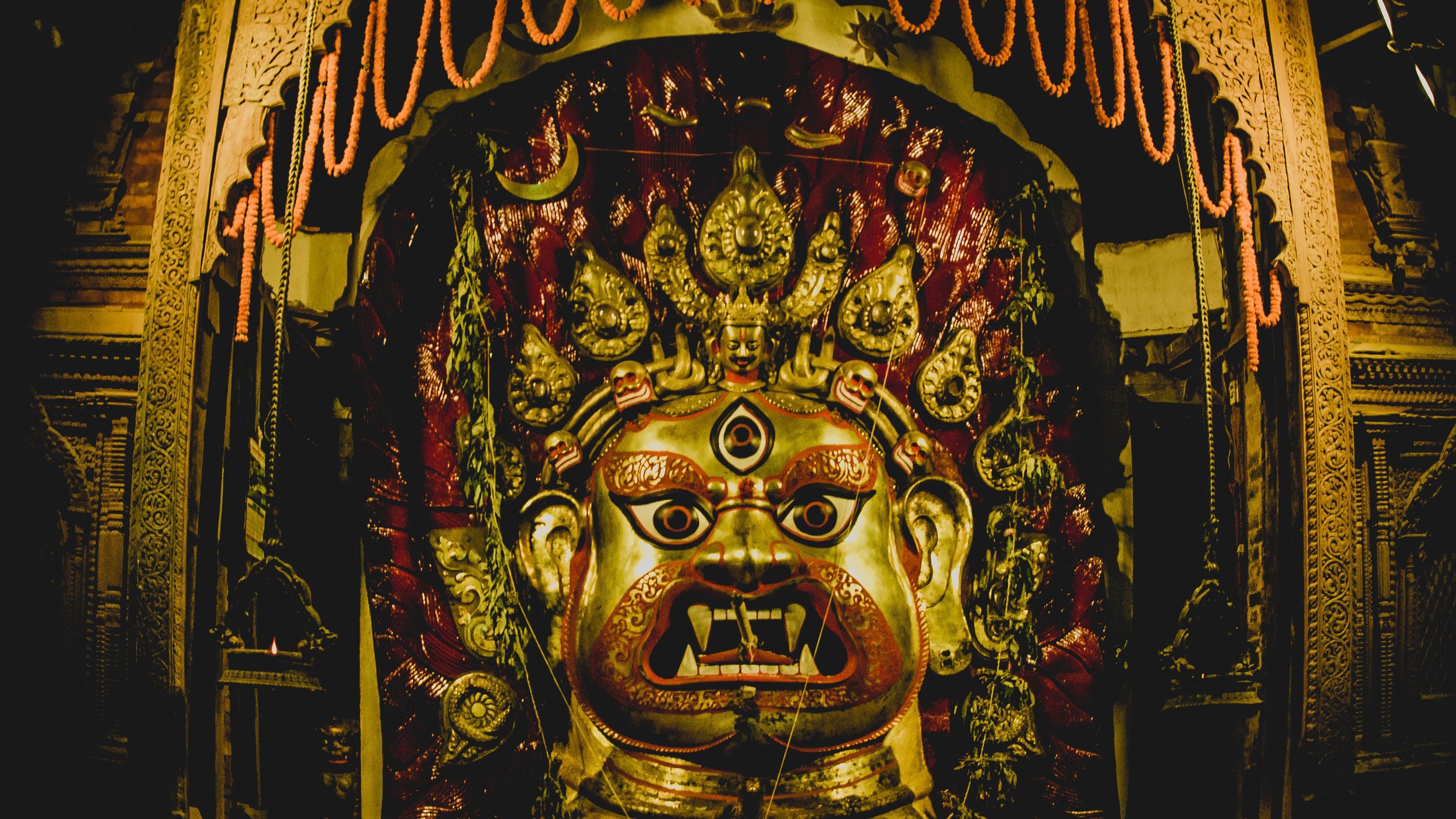
After the Earth, the festival features associations with the guardian deity of Nepal Kingdom- Bhairava. The association was made during the Licchavi Era. A legend goes as follows:
As instructed, the King merged the existing villages of Koligram (Yambhu) and Dakshin Koligram (Yengal). He defeated rulers of various petty states and created his new city. He also established a beautiful stone spout gilded in gold, Lu Hiti (Gold- dhara/ Sundhara). It featured an intricate water-management system, and royal canals (Rajkulos) channelled river water to the spout. He named the city Suvarna Pranali Kantipur. Here, Suvarna means golden, Pranali means system. Kantipur is a mixture of two words - Kanti, meaning beautiful and pur, which means place.
To celebrate the momentous occasion, he initiated a festival known as Yenya. The word is a mixture of Yen- the Newari name of the city and Ya- celebration. It is also called the celebration inside the town.
It is possible King Gunakamadeva’s celebration overlapped the change of seasons, and the two elements became one.
The inception of Indra in the festival is a great mystery. Indra is a god from the Vedic era. He had deep roots in the classical Indian pantheon, but his worship slowly began to fade. Some believe that due to his nature his worship began to fade. Anthropologist G.S Nepali writes, "The festival of Indra Jatra suggests perhaps the memory of a conflict between the two tribes- the followers of Indra and their opponents. The festival is perhaps an Indo-Aryan feature which survives in Nepal, but is totally forgotten in India."
The goddess of Indraghat arrived in the Nepal Kingdom during the rule of King Dharmadatta. The goddess is referred to as Indrayani, locally known as Manamaiju. The hill where she settled in this valley is referred to as Manamaiju. It could be that after her arrival, the worship of her husband Indra also began.
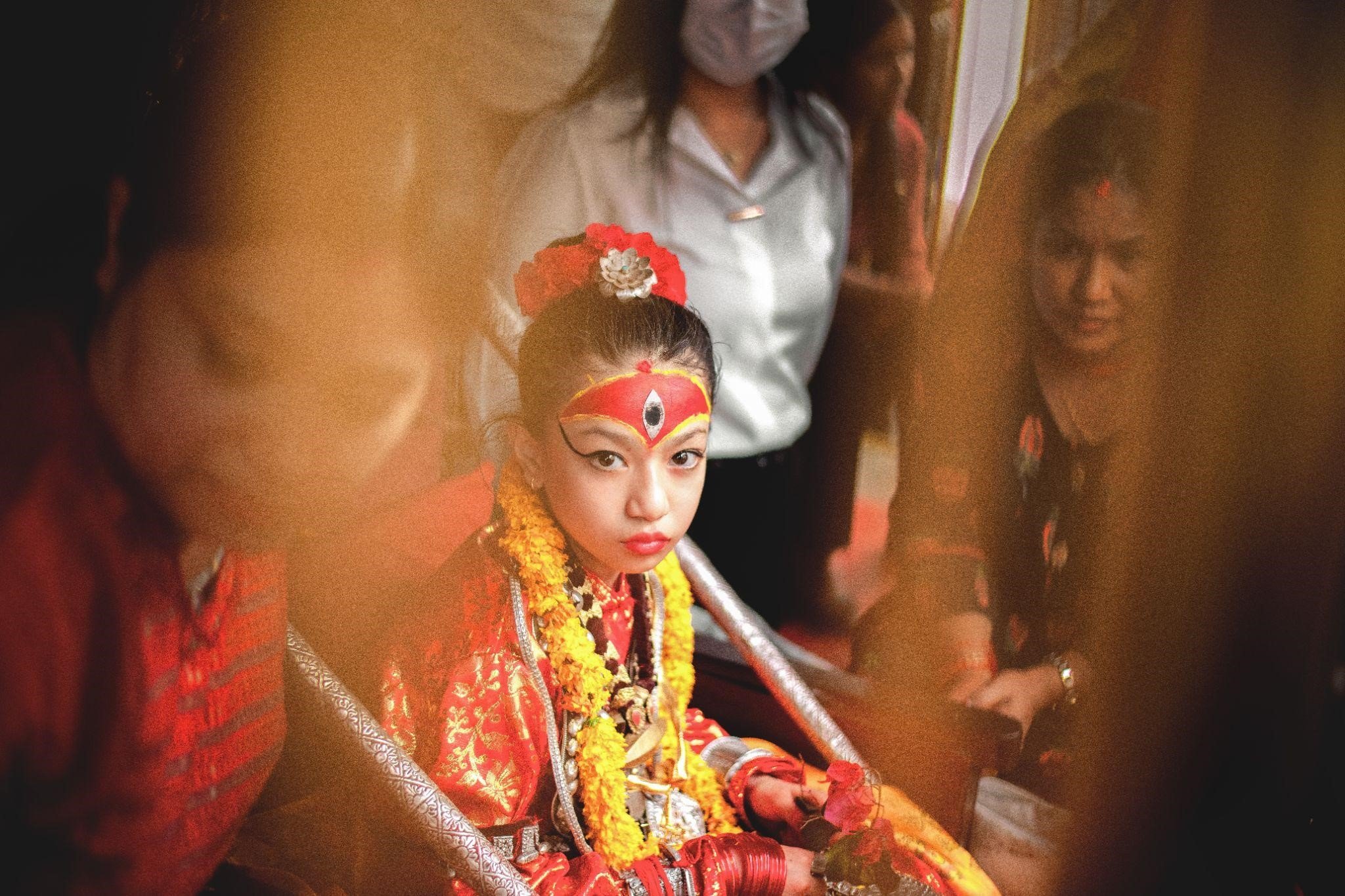
The third fold of this festival is the female guardian of the Nepal Kingdom- Kumari. A Kumari is a living goddess embodying the energy of the divine feminine. She is worshipped as Taleju Bhawani, Durga or Parvati. During the Malla Era, King Jaya Prakash Malla had an unfortunate encounter. He lost the trust of his tutelary deity Tulaju Devi (today known as Taleju). After multiple requests, she came to his dreams and directed him to begin worshipping a virgin girl of the Bandra (Buddhist Newar) community as her manifestation.
To read the full version of the incident click here
These elements combined have created an atmosphere of great jubilation. The core activities related to these deities are accompanied by various magical creatures and the presentation of beautiful dances and plays.
POPULAR ITINERARIES
SIMILAR POSTS
Mohni- A Cultural Experience
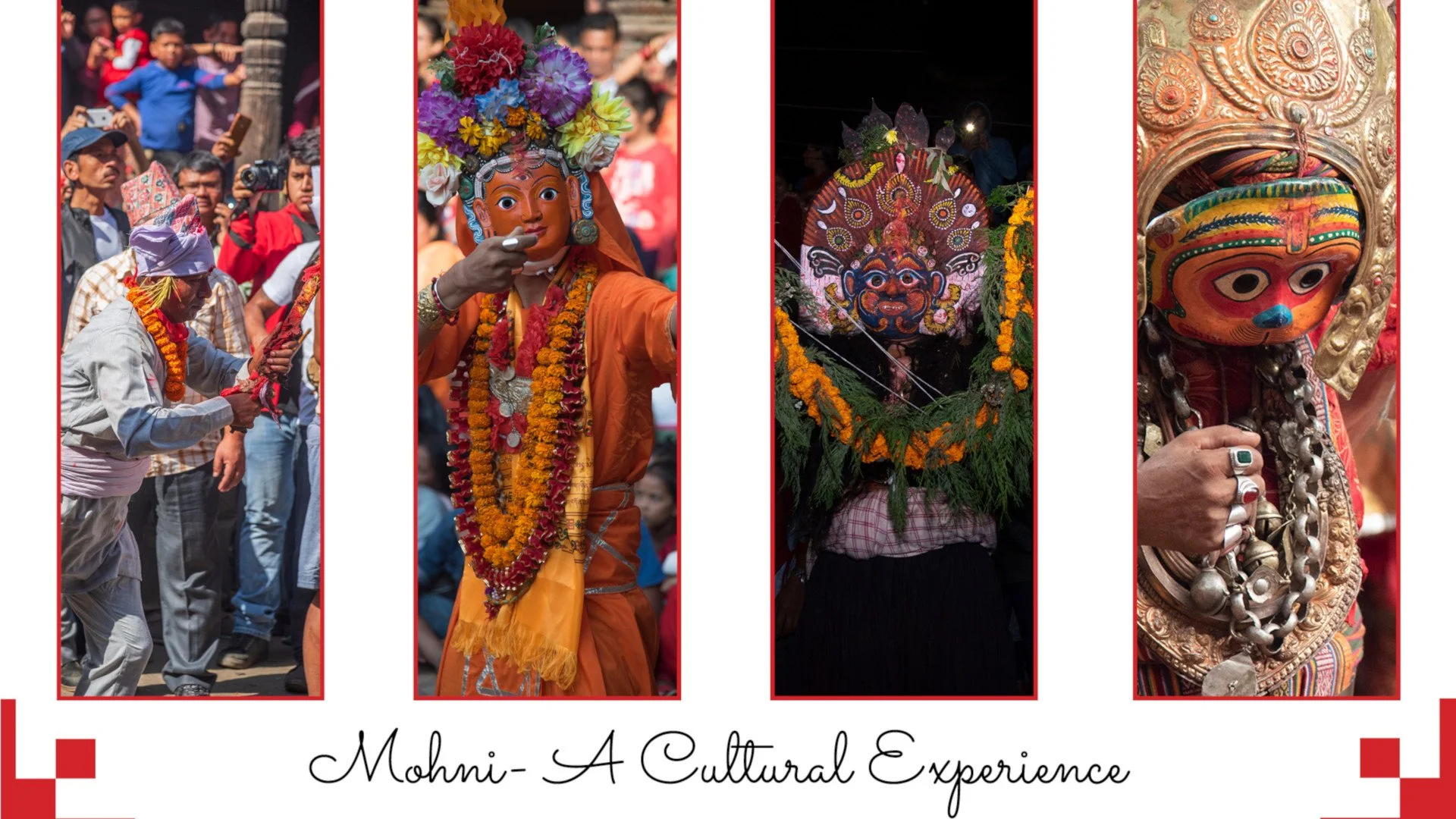
For an outsider to truly experience Mohni, s/he has to be invited by a Newar to their home. Over the years, due to its close celebratory proximity to Dashera, the grand festival of India, it was also considered Dashain- the Nepali rendition of Dashera. But, in reality, Mohni features a few similar elements brought by migrants from the south. Apart from this, the customs and traditions are completely different.
The core celebrations are private. But the Newars, over the years, found a way to liven the public atmosphere as well. Thus, various smaller events take place during the core two-week festival. As these cultural traditions take place in public spaces, one can absorb the cultural experiences easily.
To learn more about the celebration: Click Here
Mentioned below are a few of these events. They amplify the celebrations of Mohni via the presentation of numerous dances, skits and others.
Sikali Jatra
On the southern end of the city of Lalitpur lies the picturesque village of Khokana. Historic in nature, stepping foot inside the settlement is equal to walking back in time. The old mud-brick houses and ancient heritage mingle with the new concrete construction.
A unique aspect of this village is how the inhabitants do not celebrate the main festival of Dashain. They, however, rejoice in a celebration known as Sikali Jatra. It begins on the day of Ghatasthapana and ends on the day of Fulpati.
During this period, the inhabitants perform ancient rituals. Amongst these are the Sikali Naach and the skit of Khokhana. Elders adorn the masks of various deities and re-create a play depicting old tales. Whereas in the premises of the Sikali temple, an arcane ritual takes place.
Asta Matrika Dance
Traditionally known as Ga Pyakhan, this ensemble features 13 masked dancers who embody the principal mother deities of the city and chief gods. In Nepal Bhasa (Newari), Ga means group and Pyakhan- dance, whereas Asta Matrika Dance in Nepali.
This dance originated in the 17th century. As per chronicles, the king saw the deities dance towards his palace and enter the courtyard. The king rushed to take their blessings, but as he entered the court, they vanished. To commemorate this auspicious event, he initiated this dance.
This performance is annual and begins on Ghatasthapana- the first day of Mohni. The dancers follow strict discipline for eleven days. Primarily the presentation takes place in the evening, but on the seventh and tenth day, the show takes place during the day at Mul Chowk of Patan Durbar.
Pachali Bhairab Jatra
Towards the southern end of Kathmandu lies an open-air temple with a peculiar deity. The worship of Pachali Bhairab, as per numerous chronicles, began in the 10th century, during the rule of king Gunakamadev. The festival of Pachali Bhairab takes place on the fifth day of Mohni. Devotees flock to the temple to seek his blessing and to witness the chariot festival. The deity is carried on a palanquin by community members and take a designed route on the old city roads. At Hanuman Dhoka, the idol rests, and special puja is conducted. Post which, the procession heads towards Kumari Chhen (House), where the living goddess locks eyes with the bronze idol. Until she instructs that she is satisfied, the ritual doesn’t stop. After her instructions, the procession completes the circuit, and the statue rests inside the temple premises.
Khadga Jatra
On the morning of the tenth day, three scared swords are brought to Patan Durbar Square from the temple of Mahalaxmi in Lagankhel. Young boys tease the sword-bearer, and a deadly chase ensues. It is a spectacle that attracts a handsome crowd. Once they reach the palace cortex, the sword-bearers are welcomed with a special ceremony. The swords are then placed inside the temple and taken out in the evening.
Thecho Navadurga
The ensemble from Thecho, a semi-urban village south of Lalitpur, visits Patan Durbar Square on the evening of the tenth day. It features masked dancers who embody mother goddesses and other chief gods. They perform a sacred dance in the palace courtyard and indulge in a feast as well.
POPULAR ITINERARIES
SIMILAR POSTS
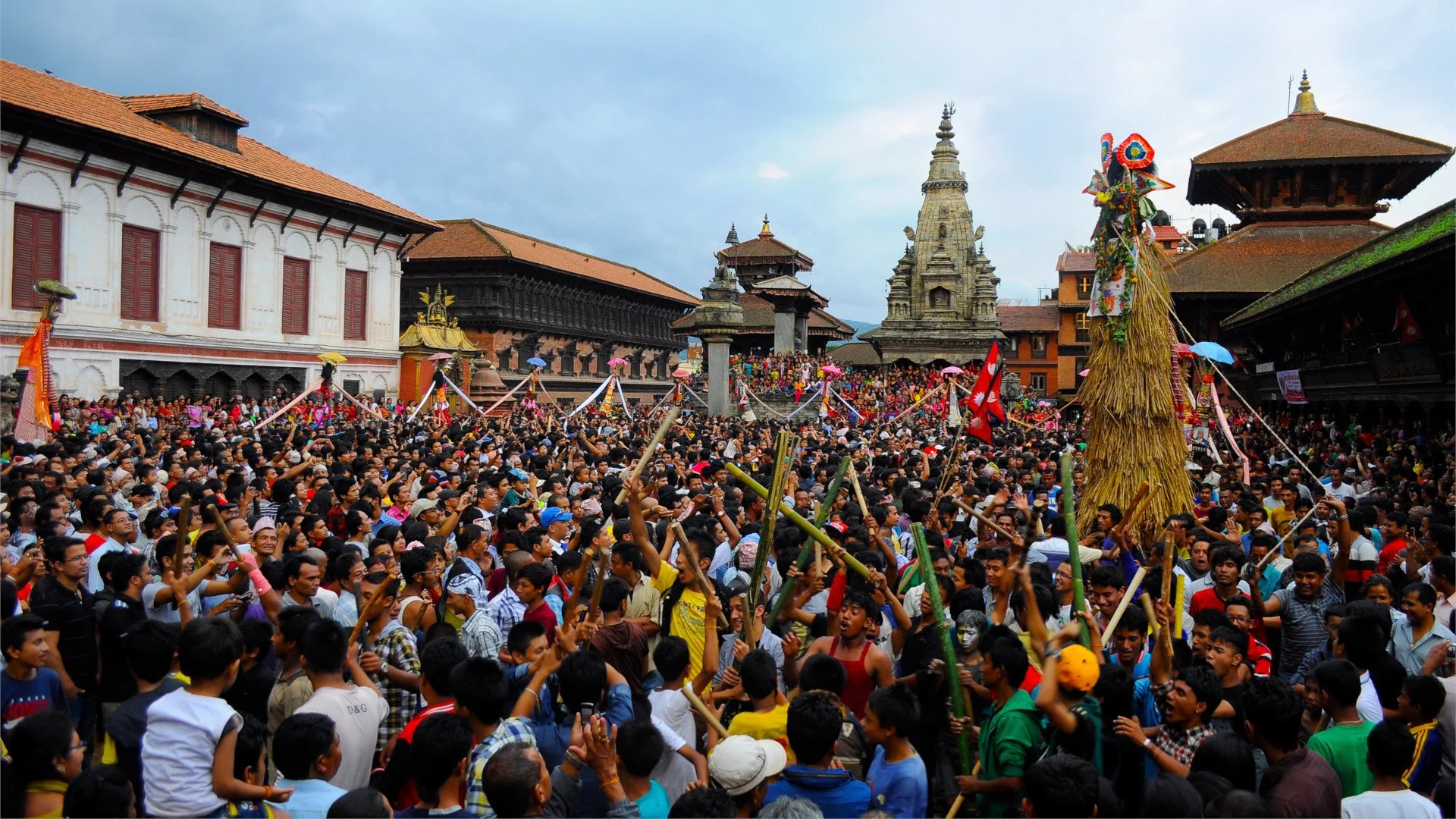
Gai Jatra A Day of Remembrance
Annually on the day of Bhadra Krishna Pratiprada, the valley of Kathmandu wakes to celebrate a festival like no other. Known as Sa Paru in Newari, and Gai Jatra in the Nepali, during the day individuals choose to commemorate the members of their family who have recently departed.
The thing that makes this festival so unique, is the way of commemoration, it isn’t done shedding tears but by spreading laughter and love. The festival is observed for a total of eight days, but the grand festivities occur on the first day. Celebrated only inside the Kathmandu Valley, by the natives of the Newar Community each city of the then Kingdom of Nepal celebrates the day in their unique manner.
According to legends, it is believed that King Pratap Malla of the Malla Dynasty instituted the Gai Jatra after the death of his son. His wife had been stricken with grief and all remedies of had thus failed. King Pratap Malla couldn’t bare the condition of his beloved wife and thus instituted a long procession, to bring forth to the Queen that it wasn’t only she who had lost a dear member of the family. Seeing the procession eased her sorrows, but it didn’t get the job done. Thus he announced a reward would be granted to anyone who would be able to put a smile on the queens face. It is also believed that, he granted full freedom of speech during the festival. The citizens accepted the challenge and came forth with various jokes and ridiculous apparel. Seeing which, the Queen finally broke a smile and laughed.
After which the celebration of Gai Jatra took a new leaf in the valley, where it became not just a way to commemorate the departed but also a way to spread joy and happiness to the once who did. Anil Chitrakar in his article for ECS Nepal states another legend related to the beginning of Gai Jatra, “As the Buddha was going around teaching the Dharma, a woman by the name of Krisha Gautami approached him crying and carrying a dead child. She demanded that if he was as great as people had told her he was, the Buddha should bring her child back to life. It is said that the Buddha calmly asked the woman to get some mustard seeds from a home where there had been no deaths so that he could sprinkle them on the child and bring him back to life. The woman agreed and began her quest to get the seeds from a home where no one had died. House after house she had to listen to sad tales of death in each family. As the day wore on, the woman realized the futility of her effort. The process of healing had begun.”
It is believed that Gai Jatra is a tribute to the departed soul. In Hinduism and Hindu mythology the cow is believed to a holy animal which would lead wondering spirits of the departed soul towards heaven. The departed are believed to hold the tail of the cow while they make their journey across the Vaitanrni River( The river between Earth and Naraka, the realm of Yama the god of death) without facing any hurdles.
The festival of Gai Jatra has multiple forms of observance in each city of the then Kingdom of Nepal Valley. In the city of Kantipur (Kathmandu), the procession makes its way thorough the old routes of the city and to the Durbar Square. Revellers of all forms can be seen, but the pack is normally lead by children dressed what we call, “ Gai Jatra” attire. In Patan, the day of Gai Jatra has very less participants as Patan( Lalitpur) celebrates Mataya. Mataya and Gai Jatra bare similarities, both long processions and mostly observed by individuals who have lost a member of their family in the recent year.
If one truly chooses to see the grand festival of Gai Jatra, then one must head to Bhaktapur. The entire Durbar Square area, lights up in a grand celebration with chariots known as Taha-Machas, which indicate the departed are taken around the city. The most unique paradeis known as Ghinta Ghisi which has two rows of individuals each with two small sticks hitting each others stick. It bares similarities with the Indian dance of Dandiya.
The festival of Gai Jatra holds a special communal importance in the Newar communities. The communities come together to organize, songs and music for the procession. The festival brings together members of the community where they can share condolences and also provide encouragements to the family members of the departed. It also helps make aware the younger generation, the cycle of life and how everyone has to die and it is a part of life. But that doesn’t mean that one has to always stay in mourning, and sorrow and the activities of the festival help bring love, laughter and joy into their lives.
POPULAR ITINERARIES
SIMILAR POSTS
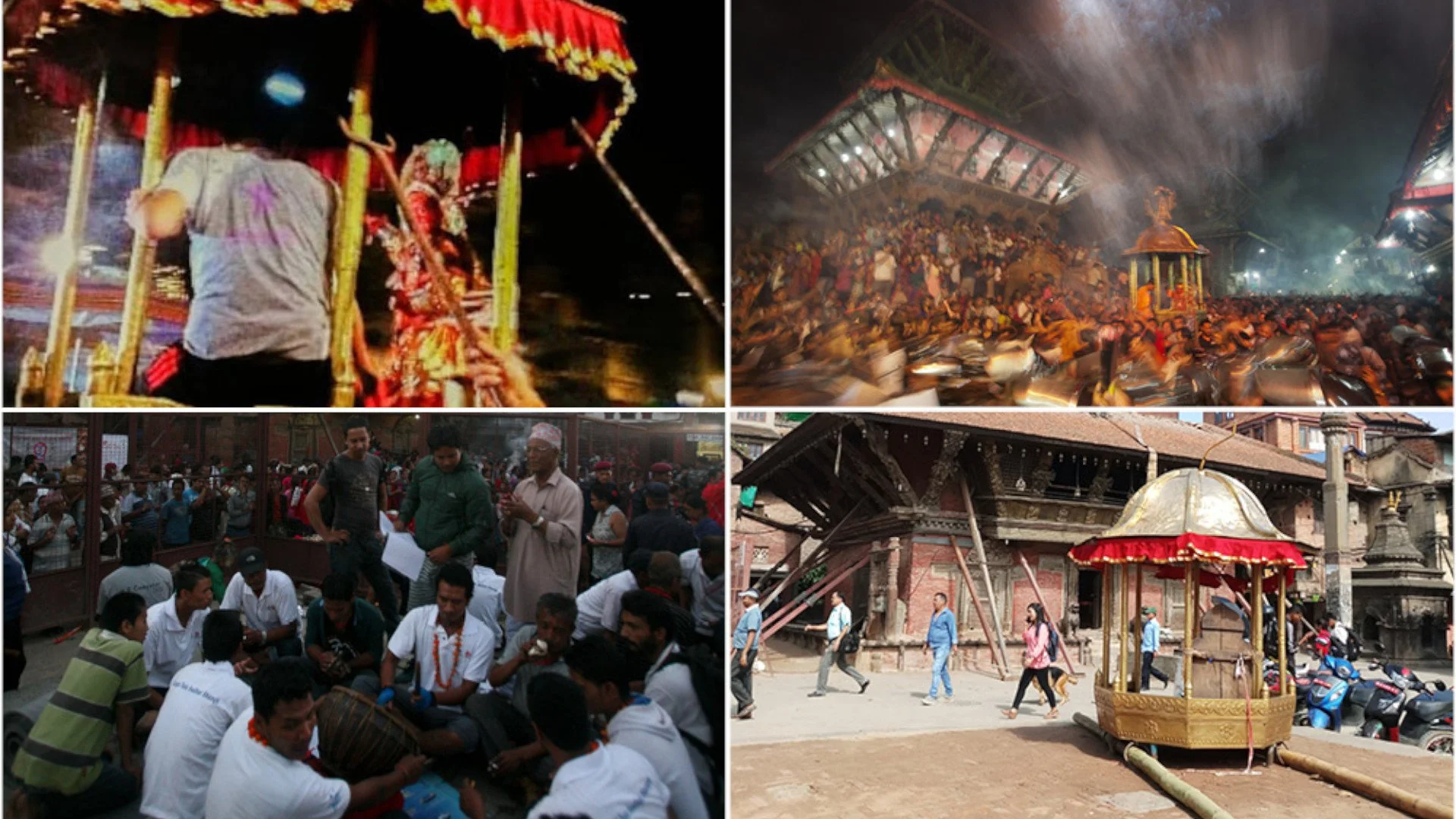
The Legend of Bhimsen - Part II
While walking down the narrow allies of Newar dwellings, you might hear the phrase, Bhimsen maharaj ki jaya (Cheers to Lord Bhimsen). His name is invoked by his patrons while lifting heavy weights or before a trading venture. Worshipped by both Hindus and Buddhists, he holds a special place in the pantheon of Newar deities.
Continued…
The king was impressed with the artist's creation and gave his approval. It was brought to the hall of the temple for the installation ceremony by the priests. During the installation process, the king personally paid a visit. He wished to bask under the aura of the triumphant statue.
The priests initiated the ritual process to bring life into it. He began chanting spells and bestowed many offerings to Bhimsen. To demonstrate his tantric capacity, the priest inserted a piece of cotton inside its nostrils. To the surprise of all, the idol sneezed thrice. During this process, light emanated from the idols nostrils, concluded that it had come to life.
The king was astounded seeing this magnificent feat. He quickly took off a ring of nine jewels from his right hand and presented it to his guardian deity. From this point on, the square opposite the temple was renamed tuyulako by the people, meaning a place blessed by Bhimsen light.
The people of Lalitpur amongst all the Newar dominions worship Bhimsen the most.
He is revered as the god of wealth and prosperity by them. Households engaged in trade and commerce regard him as their patron saint.
Bhimsen his strength and fierceness are desired by all. Children chant, I want to be like Bhimsen; strong and mighty.
In Lalitpur, we have two festivals dedicated to Bhimsen; Bhin dyo Puja and Bhimsen Jatra. The first is a linear procession that features devotees clad in traditional attire. They circumvent the city and offer their prayers to the numerous temples dedicated to him. It is celebrated annually in the month of Magh (January-February).
The second festival, Bhimsen Jatra, is celebrated with great pop and flare. On the ninth day of Bhadras (August- September) dark moon, a gilded chariot is placed on the dabbali (raised platform) in front of the temple by devotees.
Thousands of devotees wait to witness a procession that makes a designated route around the city. The temple priest ventures onto the upper floor of the temple to take a replica idol of Bhimsen. Legend has it that it is full of many replicas. A statue automatically comes forward while the priest enters the room.
He then gently brings it down onto the second floor and performs an invoking ritual. It is then taken outside the temple by him, and a loud cheer follows. The revellers make ready the chariot, and the idol is placed onto it by the priest. The revellers chant Bhimsen maharaj ki jaya as they lift the heavy chariot. Musical ensembles provide tunes of encouragement, and the procession moves forward. Patrons holding incenses lead the parade.
The prescribed route is within the old city. It makes its way through narrow allies and stops time and again due to an overhead maze of wires. Revellers take turns to lift the chariot, and the festival ends almost at midnight after it completes its circular route.
It is then rested in front of the temple by the revellers. The priest carries the idol back into the temple. The festival is then drawn to a close. The revellers complain of aching shoulders but tell tales of a glorious night the next day.
This festival is the hallmark of Newari culture, the Newars credit Bhimsen for their blessed fortunes. Newars dominated branches of the silk route and became renowned traders and merchants.
The farming community worships Karunamaya (Rato Matysendranath) and the merchants, Bhimsen. These two living deities who attained divinity through their compassion, strength and grace hold a special place in the heart of all Newars. The temple sustained damage during the 2015 earthquake. The restoration was completed recently with the help of patrons and agencies.
POPULAR ITINERARIES
SIMILAR POSTS
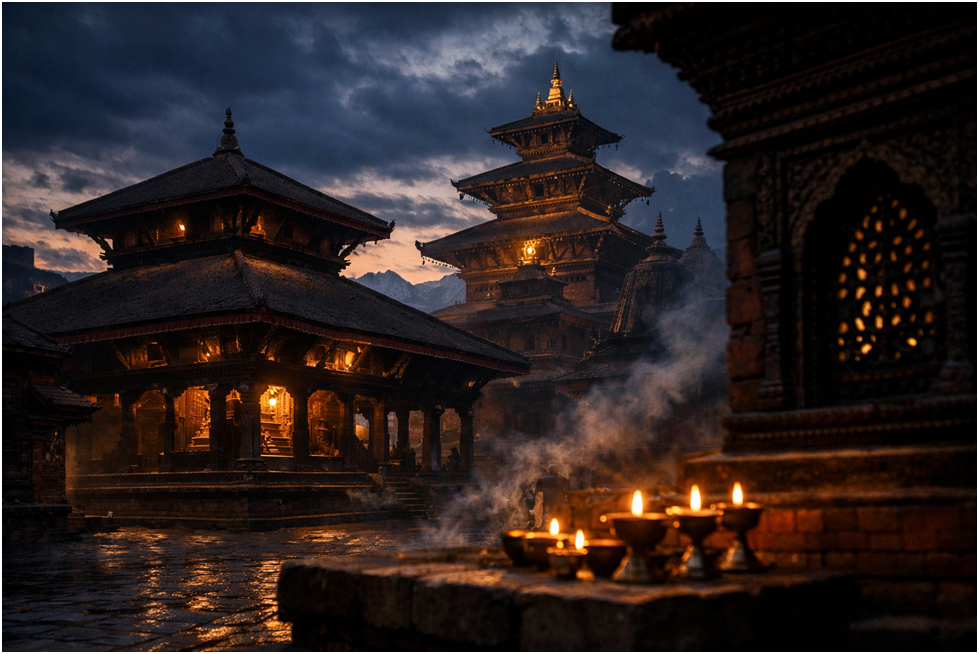

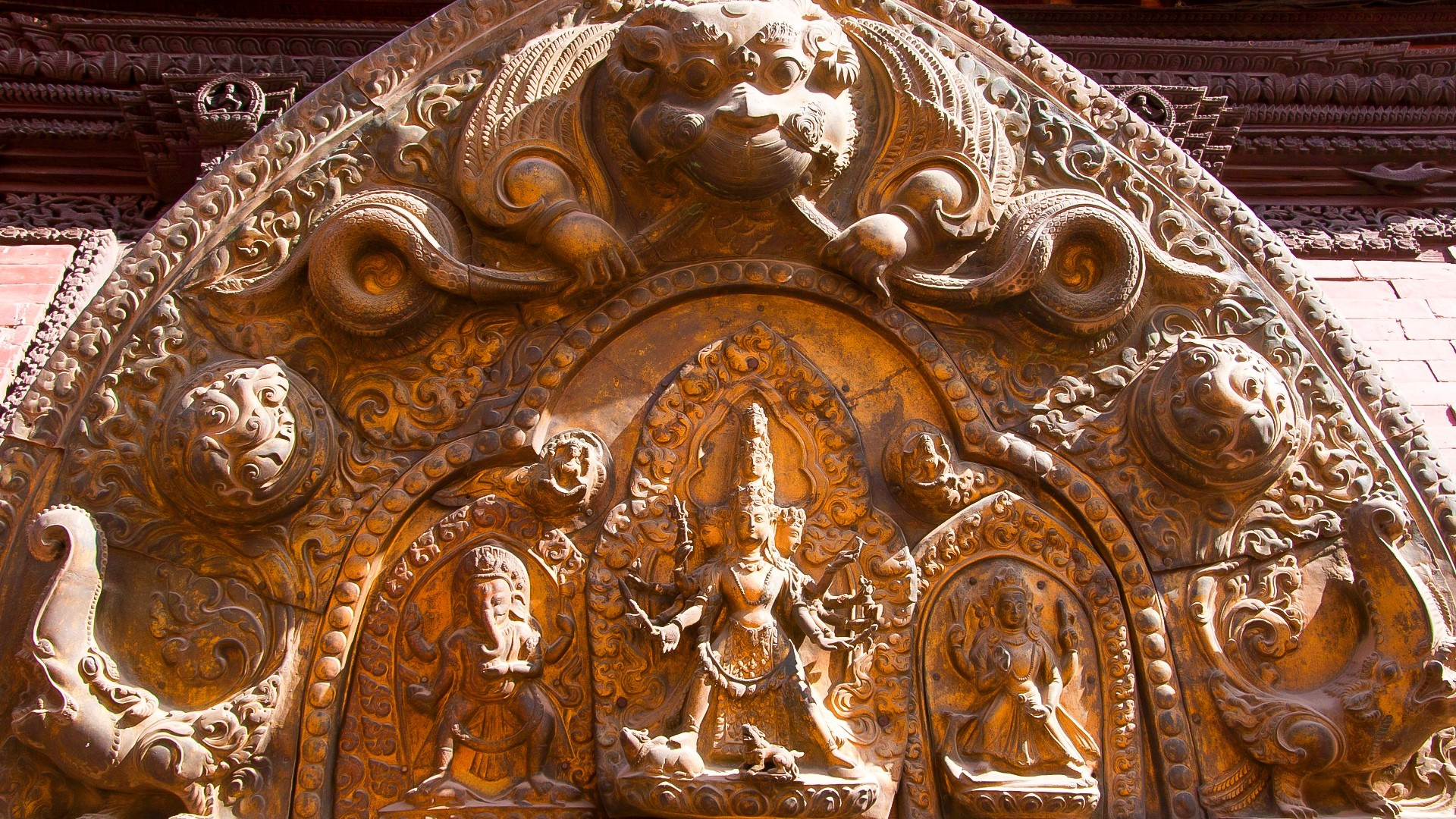

The Legend of Bimsen - Part I
The Newar pantheon features a multitude of deities. It is a diverse array of gods and goddesses of both Hinduism and Buddhism. Amongst them is Lord Bhimsen, worshipped by the households with the occupation of trade and commerce. Revered as the god of wealth and physical strength, he also has a festival known as Bhimsen Jatra. How he entered our pantheon is foretold by a legend, something that I, like other Newars, grew up with as a classic bedtime story.
In the square of Patan Durbar lies a beautiful temple dedicated to Lord Bhimsen. In Newari, he is called Bhin Dyo. He (Lord Bhimsen) is one of the five Pandava brothers of the epic Mahabharata. Amongst them, he is the only one worshipped as people believe he alone attained divinity.
He was an extraordinary child with great strength and bravery. Hence he was named Bhimsen, meaning terrific. During his youth, he was famous for two things: his brute strength and a large appetite. Reaching adulthood, he grew a robust moustache, one to match his terrific and fierce outlook.
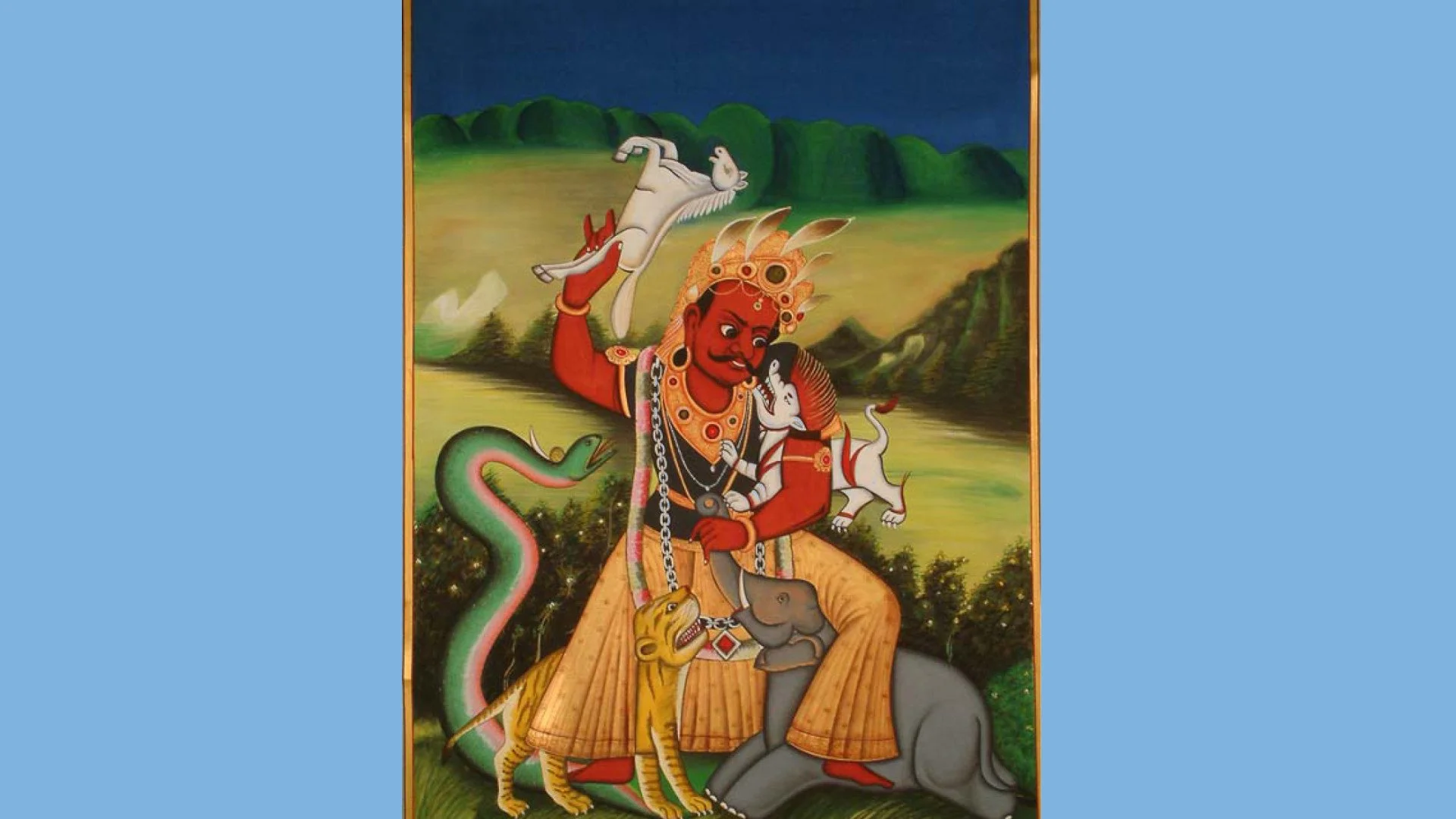
The highlight of his life was a great battle fought against Dushasana, his rival. He (Dushasana) was one of the Kauravas who dragged Draupadi. She was the common wife of the Pandavas. During an event, Draupadi was pulled by her hair and stripped naked right before her husbands. Bhimsen was consumed with rage but was helpless. He upheld the code of honour but marked Dushasana and vowed to kill him.
During the great war of Kurukshetra, he killed Dushasana with one blow from his mace.
In a land, east of Kathmandu valley lies Dolakha. Here it is believed the Pandavas spent their twelve years of exile. It is also home to a unique temple dedicated to Bhimsen. In the centre of this temple is a triangular shaped stone idol of Bhimsen. The local people worship it as an idol. The temples uniqueness comes from its ability to foretell danger.
The idol perspires from time to time, and it symbolises a bad omen for the country. The locals believe that it is Bhimsen trying to protect his people by warning them through sweating. The idol is said to have sweated in:
1. 2007 B.S: When the Rana Regime ended
2. 1934 A.D: Before the great earthquake
3. 2001 A.D: A few days before the royal massacre
In an ancient time, a lady of Dolakha was married to the prince of Lalitpur. She brought with her a clay idol of Bhimsen as dowry. It depicted him engaged in battle with Dushasana. The figure was enshrined in a small temple by them.
The temple was restored after a fire in the 17th century by King Sri Nivas Malla. He raised it to 4 storeys high and placed three roofs.
After the death of Sri Navas Malla, his son Yog Narendra Malla became King. He desired to replace the clay idol with a metal one. He paid a visit to the workshop of a renowned artist and put forth his request. This craftsman was known for being the best in metal casting and modelling. The King envisioned a magnificent statue of Bhimsen stance in a fighting pose against his rival.
The artist began work, and within a few days, he prepared a handsome wax model. An ancient technique where molten metal is poured onto a wax mould to develop a cast.
The King inspected the model but was disappointed as it lacked life. He requested the artist to remodel and focus on a more lively fighting style. The artist remodelled it as requested, but the King was still disappointed. The King became so furious that he caught hold of the artist's neck.
The artist cried loudly, my King, forgive me. I know what is missing, and you have shown it to me. Give me another chance. I shall not disappoint again. He let go of his neck and gave him one last chance.
He was able to satisfy the King in his final attempt. The idol looked fierce, lifelike and portrayed Bhimsen in a fighting stance about to kill Dushasana.
POPULAR ITINERARIES
SIMILAR POSTS

An Interesting Yomari
The mouthwatering delicacy known as Yomari is a staple in Newari households. Traditionally prepared during the Newar month of Thinla, which coincides with the Gregorian period of December, the treat is a homage first presented to the deity Annapurna Devi. It is prepared in a similar shape in most Newar households but in a peculiar manner in the community of Pucho.
The month of Thinla in the Newari calendar is when the paddy seeds planted during Tachala sway like fields of gold. The delicacy of Yomari is part of the harvest moon festival, which is known as Yomari Punhi (Purnima). It coincides with the Gregorian month of December.
A Yomari has a special place in the heart of most Newars. The name is derived from a fruit that falls in the fig family natively found in the region. The shape of the fruit is a base for a traditional Yomari prepared with the first batch of grain and presented to Annapurna Devi. Linguistically, Yo means preferred or liked, and Mari means bread.
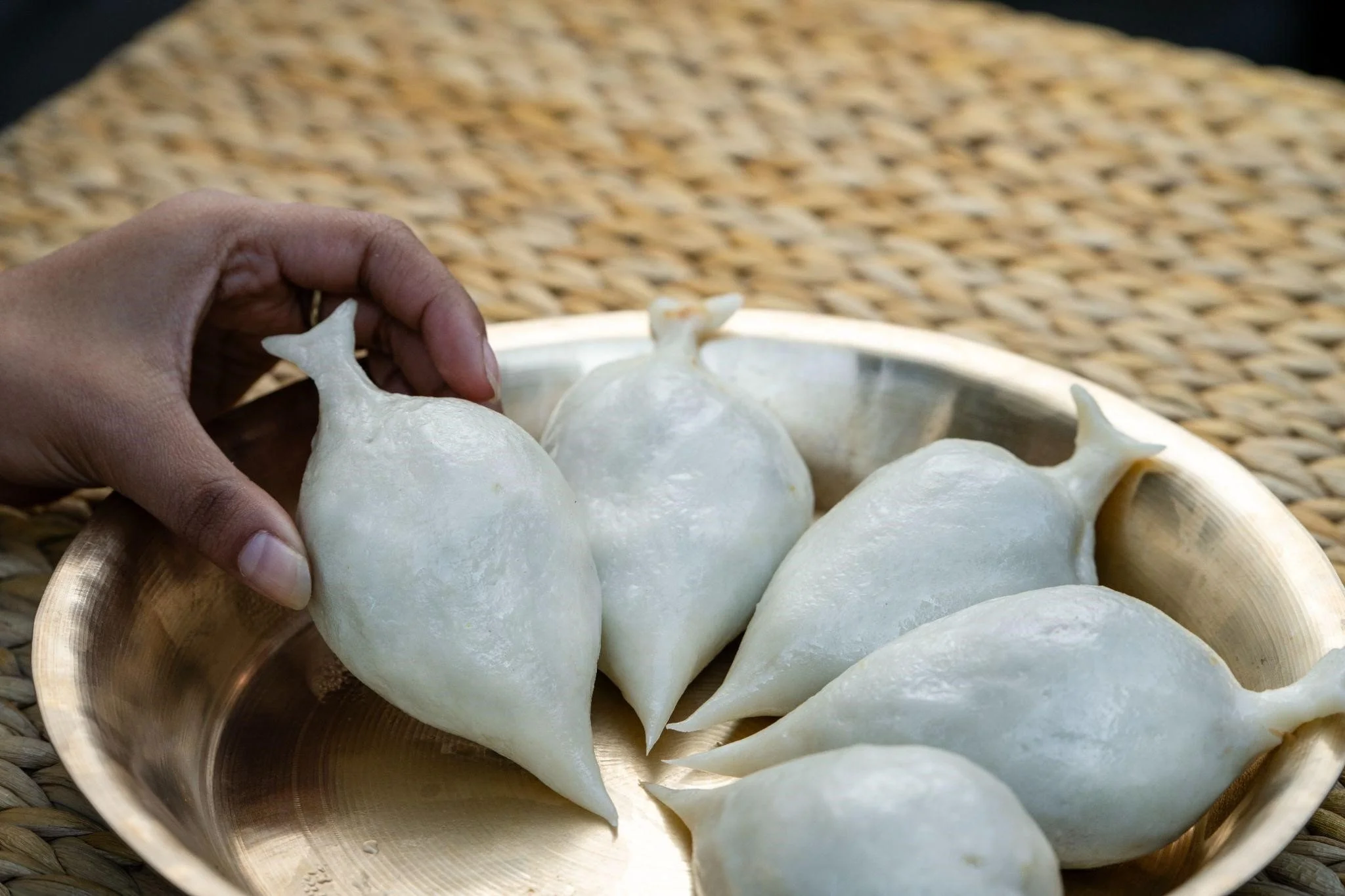
Traditionally it features a mixture of molasses and brown sesame seeds. The shell is prepared from powdered white rice and is shaped to resemble the Yomari fruit. Apart from the month of Thinla, the delicacy is put together during various family rituals, especially during the second birthday. Medium to small-sized Yomaris are strung together to make a garland offered to the child.
The account of an interesting Yomari is from the community of Pucho. This place today is generally called Pulchowk. This area is home to Maharjan farmers whose ancestry is from the Eastern mountains. As per chronicles, the King of Patan gave refuge to Kirats banished from their homeland. The King welcomed them with open arms. Acknowledging their preference of living in higher altitudes, they were given a place in Pucho.
The historicity of the region goes as back as the draining of the lake known as Nagard, which today is the Kathmandu Valley. The peak of the hillock of Pucho is known as Shilapur Banagiri. Banagiri in ancient Newari means a place where an arrow fell. As per chronicles, after Bodhisatva Manjushri decided to drain this lake to create a sanctum, he shot a powerful arrow for the purpose. It fell on this very hill. Post which, Bodhisatva Manjushri came up with a different plan which featured draining the water from Kotwaldwar (Devichaur). Kotwal is the name of the mountain, and dwar means a gate.
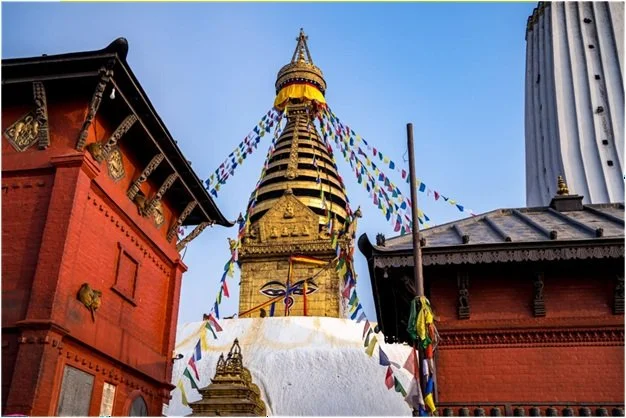
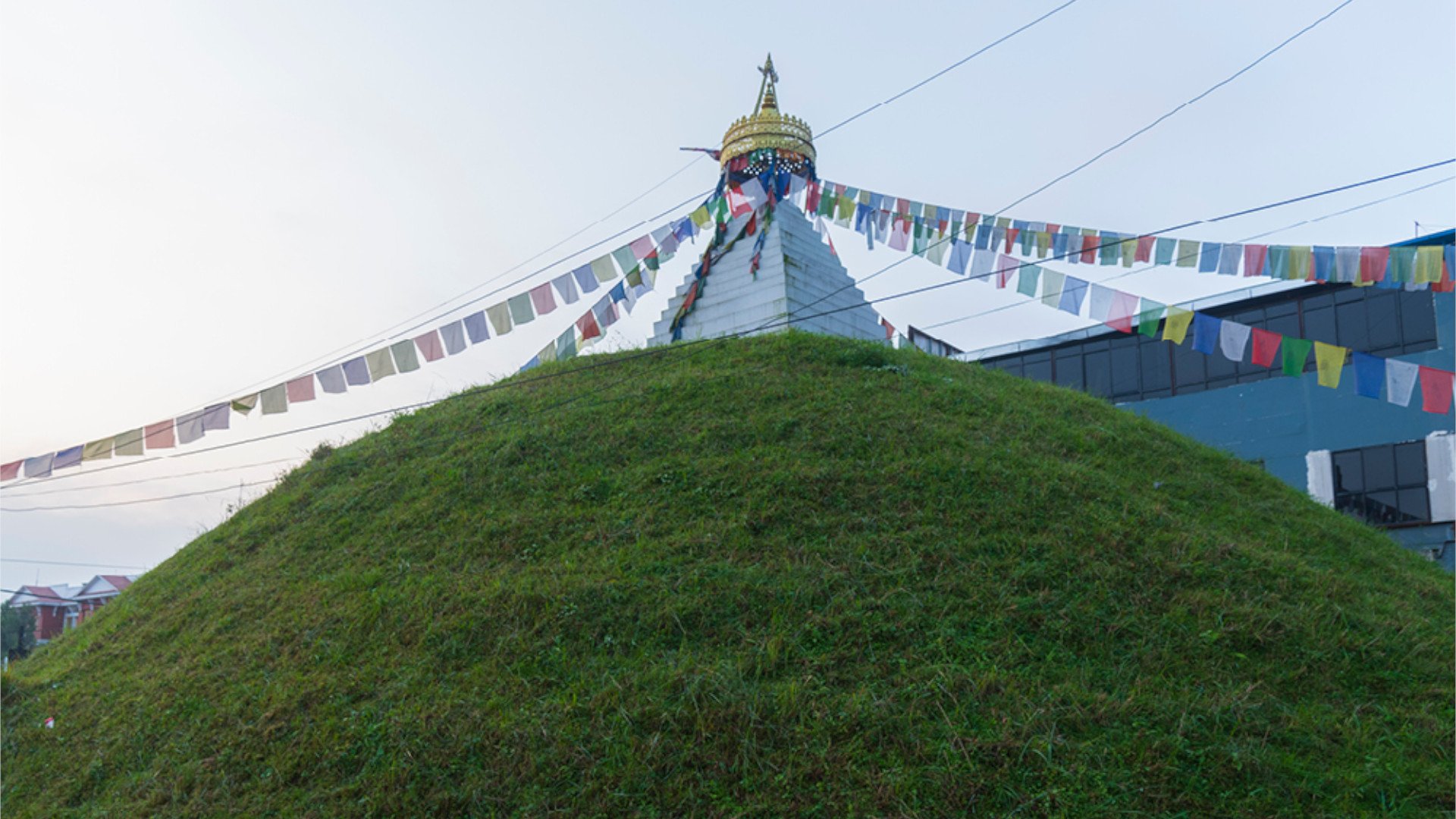
As the valley prospered, it became renowned in Asia as a prime Buddhist sanctuary. Locals suppose that the Great Samrat Ashoka visited this valley and established five earthen mounds. Four of which were dedicated to the yugas. The symbolism behind the fifth is still unknown. These mounds then later become the boundary of the city of Patan. The western stupa is on the foothill of Silapur Banagiri.
This mound plays a historic role as not just a boundary marker but also a landmark. The community of Pucho, which primarily featured Buddhists and the later Kirat refugees who assimilated into the Newars, hold it as a part of their identity.
During Yomari Punhi, the locals cook the delicacy in a unique shape similar to the earthen mound. It is known as Chibamari, Chiba meaning an earthen mound/stupa and Mari meaning bread. The shell is distinctly triangular and bears an uncanny resemblance to the 13 step finial of the Pucho mound. The filling is more chunky in this area, meaning the molasses is not melted.
The incorporation of two distinct cultures shows the importance of religious values and monuments of this region. The Chibamari is distinct. Over the years, it has become the identity of the people.
POPULAR ITINERARIES
SIMILAR POSTS
The Importance of Karunamaya: Rato Matsyendranath
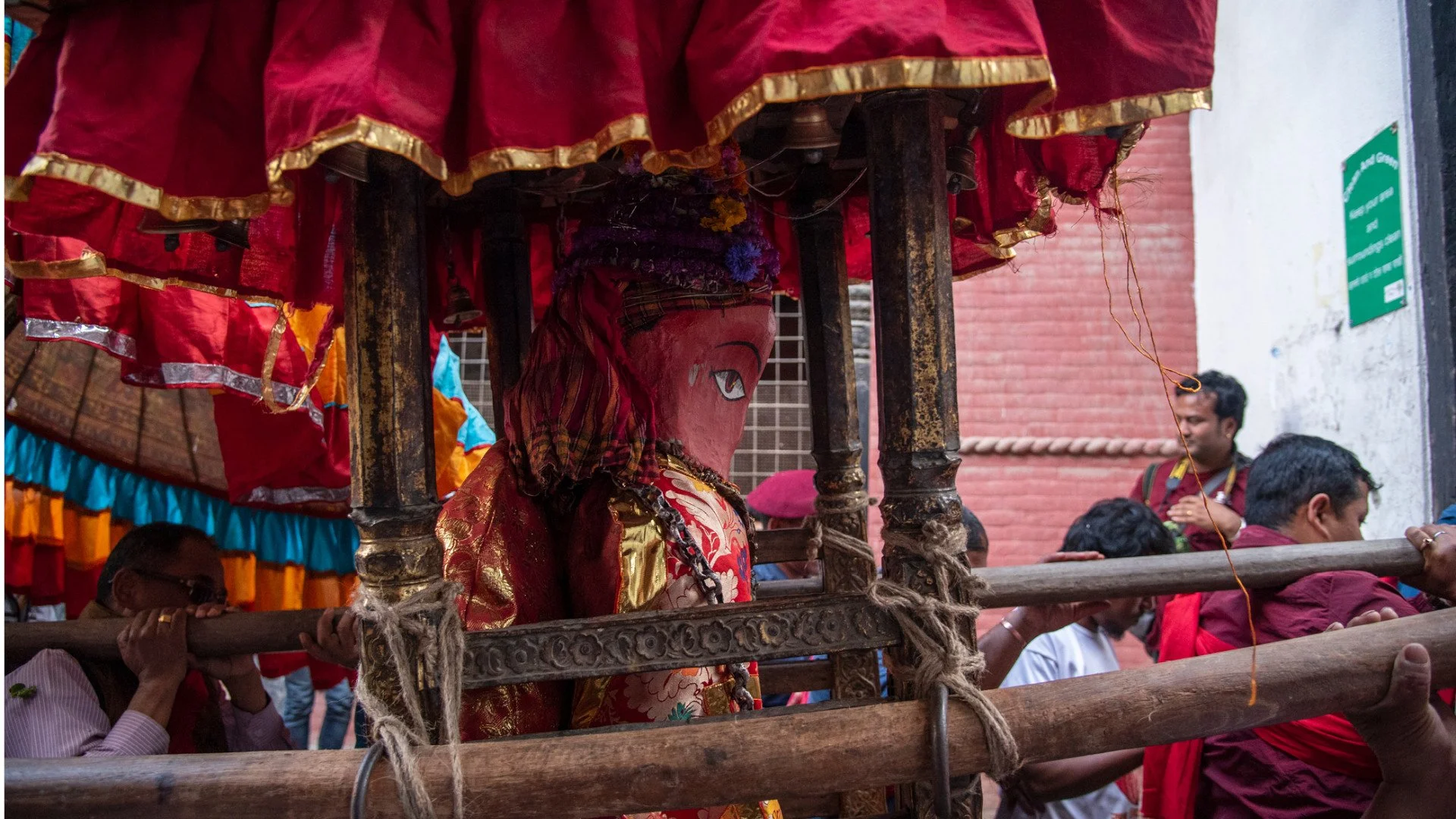
Amongst the various deities of the Kathmandu Valley, Karunamaya holds the highest rank. He is known by multiple names such as Bunga Dyo (God of Bunga), Aryavalokitshwor Padmapani and Rato Matsyendranath. He is revered by citizens of both the Hindu and Buddhist faith. One of the most elaborate chariot festivals in the world happens annually in his honour.
Non-Newars always marvel at the magnitude of the festivities that surround them. The pop and flair combined with the faith and dedication towards building a chariot 5 stories tall and circumventing it in the old streets of Patan is a sight to behold. The locals view him as a messiah and would not refrain from turning any stone for his celebration.
So why is Karunamaya so important?
Thousands of years ago, the citizens of this valley faced a dire crisis. It was significant enough to wipe out the entire civilisation of Kathmandu Valley. As agriculture was the occupation of the native inhabitants, a mysterious ill plagued the fields. The seeds planted with love and care grew to only wither. The farms that were to resemble gold began to look like desolation.
The people didn't know the cause, nor did they know the exact remedy. With the years harvest down the drain, they could only hope the reserves would last them long enough for a rescue. As the people began to worry, the King could not hold his heart. King Narendra-deva was known for his service and dedication to his people. But he had abdicated the throne in favour of his son. King Narendra-deva chose to spend the rest of his life observing monastic discipline.
The tantric master named Banudhatta Acharya, who sided in Te Bahal, knew that far away in a distant land resided the solution to our crisis. He informed the present King Bara-deva and requested him to go to his father and request if he would accompany the tantric master in his journey. For as long as the true King is alive, he cannot take his son.
King Narendra-deva accepted. He, along with Bandudhatta and Ratnakar Jyapu, left for an adventure. The destination was Kamakhya, which falls in present-day Odisha of India. There, the team met with a master farmer named Karunamaya. The trio told him of the ill that plagued their kingdom. Karunamaya wished to visit the valley and relieve it himself but wasn't allowed to by his mother. Thus, he passed on to them the needed tools, seeds and knowledge to compact the famine. The trio then bid farewell to the master and returned to the valley. They then applied the findings as instructed, and the fields slowly but steadily began to sway like gold.
It was this feat, the generosity of one man. Who, without any expectations, helped three ailing strangers that earned him a high rank in the pantheon of this valley. Even though he was mortal, the people in this valley immortalised him. A temple was built in his honour in the village of Bungamati. The settlement was renamed Amarpur, meaning a land immortal.
An elaborate chariot festival was designed by priest Bandudhatta. A 5 storey tall chariot was envisioned with featured all the elements of the journey and the temple of Bungamati.
Thousands of years later, even to this day, the people of this valley have not forgotten his generosity. Historians believe that he had a different name. Karunamaya was the general call name which means the compassionate one. Members of the Buddhist faith refer to him as Aryavalokiteshwor Padmapani, whereas Hindu's call him Rato Matsyendranath due to the connection with the tantric master Gorakhnath.
The people ensure the chariot festival happens even at the worst odds because they fear the illness shall return again. All the necessary rituals are performed every year to invoke the deity to ensure the valley's prosperity. The chariot is built at Pulchowk and circumvents the old routes of the city. It comes to an end in the open field known as Jawalakhel. Once the ceremonial display of the bhoto is complete, the idol is taken to Bungamati. Here it rests for 6 months of the year and the other half in the temple inside Patan.
POPULAR ITINERARIES
SIMILAR POSTS
A Unique Day: Bibah Panchami
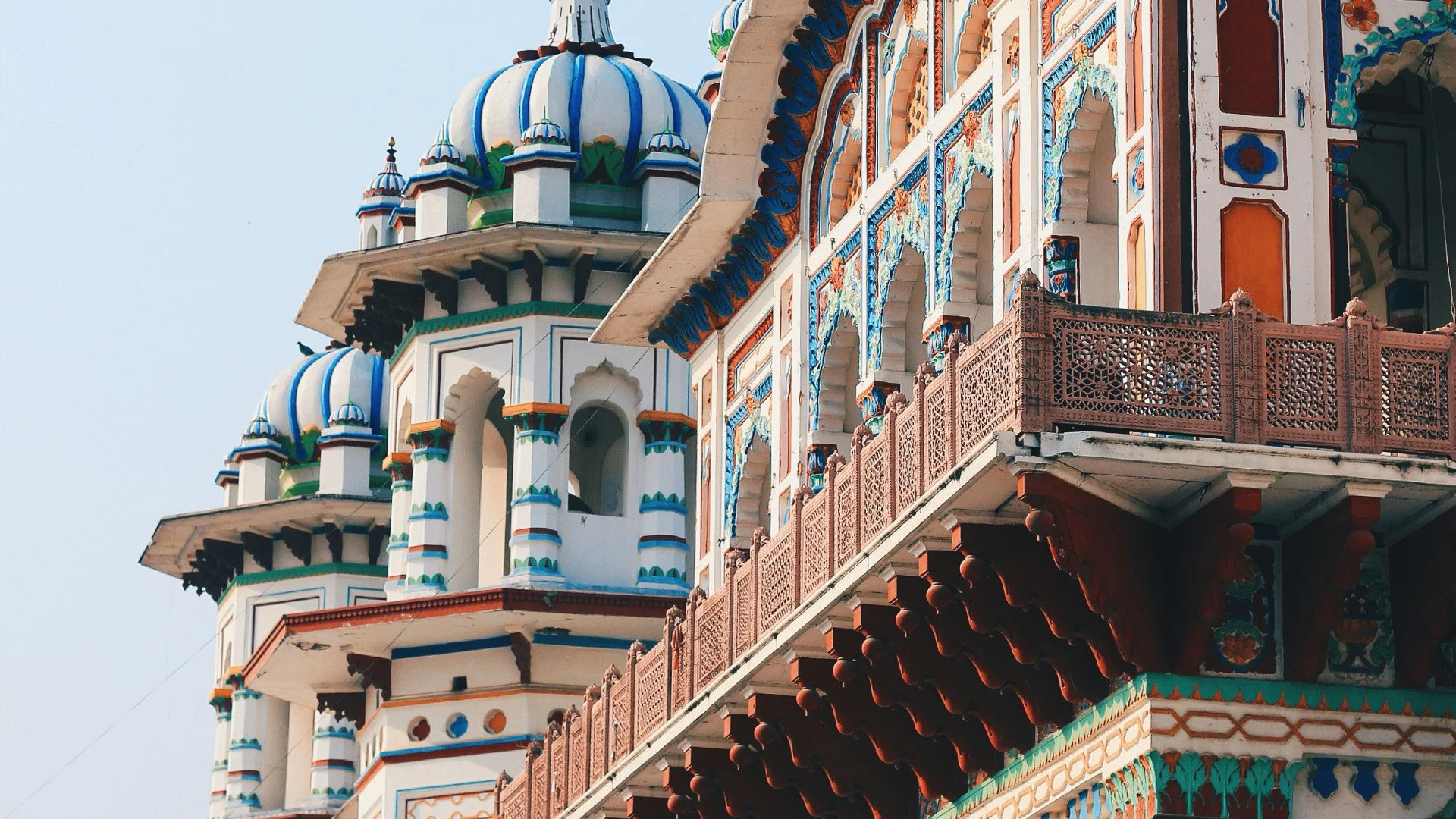
Bibah Panchami, the day that marks the marriage of Lord Ram and Goddess Sita, is a beautiful festival of the Mithila Culture hosted every year in Janakpur, the Mithila capital. On this day, a week-long reenactment of the marriage is done with grand celebrations of the deed that frameworks the ancient Mithila culture and its history.
As written in the legend of Ramayana, the ancient city of Janakpur was the home of the eldest daughter of King Janak, the king of the Mithila Kingdom, princess Sita. She was the daughter of the universe, an extraordinary, ideal woman resonating the beauty of womanhood and femininity. She is also known as the daughter of the Earth. Sita, being the only one who so effortlessly lifted the impossible bow of Lord Shiva, King Janak organized a Swayambar for her where he decided that the man who could lift up that bow would be the one to marry the beautiful princess. After countless men trying but failing the task, the Prince Ram of Ayodhya came in and lifted the bow as effortlessly as Sita did.
The divine couple got married, and ever since then, to celebrate the union of the idealistic gods, Bibah Panchami is celebrated on the fifth day of the Shukla Paksha in the Aradhayana months according to the Mithila Calendar (that falls somewhere around November to December).
As written in the Ramayana, the couple along with Ram’s brother went to reside in a forest (vanvas) as per the wish of his stepmother. The king had told his young queen that he would grant her two wishes. She then told the king to banish Ram and crown her son, Bharata as king of Ayodhya. During this exile, Sita was abducted by Ravan, the king of Lanka. A large battle was bought between the forces of Lord Ram and Ravana. Lord Ram became victorious and was reunited with Sita. Lord Ram was then hailed as a hero and was rightfully instated as the king of Ayodhya. Over the years, their story became a symbol for Hinduism and the victory of good over evil.
Thousands of people crowd the Janaki Temple, Ram temple, and many other temples of the Holy city of Janakpur to worship the god Ram and Sita in the mornings. The Janaki Temple is decorated for the celebration with colourful garlands, flowers, Mithila arts, and the sacred statue of Ram and Sita that stands in the centre of the temple is also cleaned and put on new clothes, just like it is done during any Mithila weddings.
The devotees perform different traditional marriage rituals that are traditionally done at weddings. Every rite is run through with devotional songs ‘bhajans’ that recite the stories and purposes of every action performed. Men and women, especially kids, are dressed up as Lord Ram and Mother Sita and are carried around in chariots during this day. The procession takes place on the bustling roads in front of the temples. Traditional wedding music is played to imitate the ‘baaraat’ (janti) of Lord Ram as he came to marry the princess. In the evenings, the devotees and people of the city gather up in the fairs put out in front of temples where people can explore, dance, eat to celebrate the auspicious day of their gods with each other.
Bibah Panchami stands as a symbol of Mithila culture, which dates back thousands of years. Even today, the exact process followed during the marriage of Ram and Sita are followed with the utmost attention to detail. The various aspects of the celebration present the rich artistic history of the Mithila people and the communities culture. Which has been passed down for generations.
Along with which a sense of togetherness is also taught to the next generation. Families, neighbours, far relatives come together as one, share delicacies they prepared at their homes the night before, and find a reason to appreciate each other and their identity as a community to celebrate the holy matrimony. Making the festival of Bibah Panchami a portrayal of the integrity of the community they build up together.
POPULAR ITINERARIES
SIMILAR POSTS
The Tale of Shankadhar Sakhwa - Part II
The act of Shankadhar Sakhwa is more than of selflessness and grace. His wit and faith did not just bring him good fortune but also to the former kingdom of Kantipur.
Continued…
The day was almost at an end. Sakwal was at his courtyard staring at the heap of sand. Confusion could be seen in his face. Why did the coolies choose to dig at that very spot? They even waited for an exact time. What is this mystery?
Sakwal failed to notice that the sun had already gone down. He was so lost in his thoughts that he could not hear his wife call him for dinner. He then suddenly came back to reality and saw how it was already late. He made his way to his kitchen, where his wife was waiting for him. He finished his meal and called it a night.
In the morning, Sakwal woke up early, as usual, to head to the nearest temples and monasteries to offer his regards. He walked out of his house and was about to open the main door when he noticed something shining in the corner. He opened the main gate, and as light entered, it unveiled something that he could not comprehend. He was quick to close the door so that no one else would see it. He stood there, stiff as a tree trunk with eyes wide open.
It looked like he had seen a ghost. He called for his wife and asked her to come downstairs quickly. As she entered the courtyard, she noticed her husband just standing there. He called her to where he was and told her, my wife, please tell me that this is not a heap of gold dust?
The wife looked down and was utterly surprised. She looked towards him and said, dear husband, this is a heap of gold dust!
Inside the royal palace of Bhaktapur, one could sense that the king was angry. He was at his courtyard staring at a heap of sand. He looked towards his astrologer and said, your prediction failed. The astrologer was confused, but deep within, he was angry. He told himself that he did everything as instructed.
With the king's permission, the astrologer left for his house. He poured out all his anger within the sanctum of his four walls.
The king knew the greatness of his astrologer and how he was never wrong. While he was headed towards his room, he stumbled upon the baskets inside which the sand was brought. He saw an unusual glitter. He moved closer and inspected. He saw specks of gold dust at the bottom. He told himself, my astrologer was right!
The king ran with great haste towards the house of his astrologer. He barged inside and climbed up the stairs quickly. He saw a fire kindling in the fireplace. He noticed a book being burnt. He looked towards his astrologer and said, is this that very book you consulted to turn sand into gold? The astrologer replied, yes, my king!
The king then rushed to save whatever was left of the book. He put his hand into the fire and pulled the pages, and dipped them in a pot of milk that stood near the fire palace. The astrologer rushed to aid his king.
Once they saved what they could, the astrologer asked his majesty why he did that. The king then turned to his astrologer and said, you were right, but we were outsmarted!
Inside the royal palace of Kathmandu, Sakwal was in an audience with the king of Kantipur. Your majesty, I am a merchant, and I have enough wealth for myself and my family. I have stumbled upon this great treasure that I wish to share with my people. I am a righteous man, and if I become greedy, I might have a luxurious life, but it shall come to bite me when I have to cross the holy river after my death. I wish to pay the debt of my country and each citizen with this treasure. I am here to request your permission to do so, said Sakwal. The king was impressed by his righteousness and virtue. He gave permission to Sakwal to complete his endeavour.
To commemorate this feat, Sakwal was given the right to start a new era. He consulted with great astrologers of the kingdom and issued the new epoch of Nepal Sambat.
POPULAR ITINERARIES
SIMILAR POSTS
Chhath: A Homage to the Sun God
The festive flair in Nepal never dies. The diversity of various ethnicities and their traditions go on throughout the year. Amongst such festivities, Chhath is the largest festival in the Madhesh community. The celebrations last for a total of four days. During which, devotees worship the sun god and various other deities and pray for prosperity and longevity.
The communities of the southern region of Nepal, collectively known as the Madeshi community, have numerous festivals such as Holi, Chaitya Dashain, Chhath, Dashera, Dipawali and others. Amongst them, Chhath holds great significance.
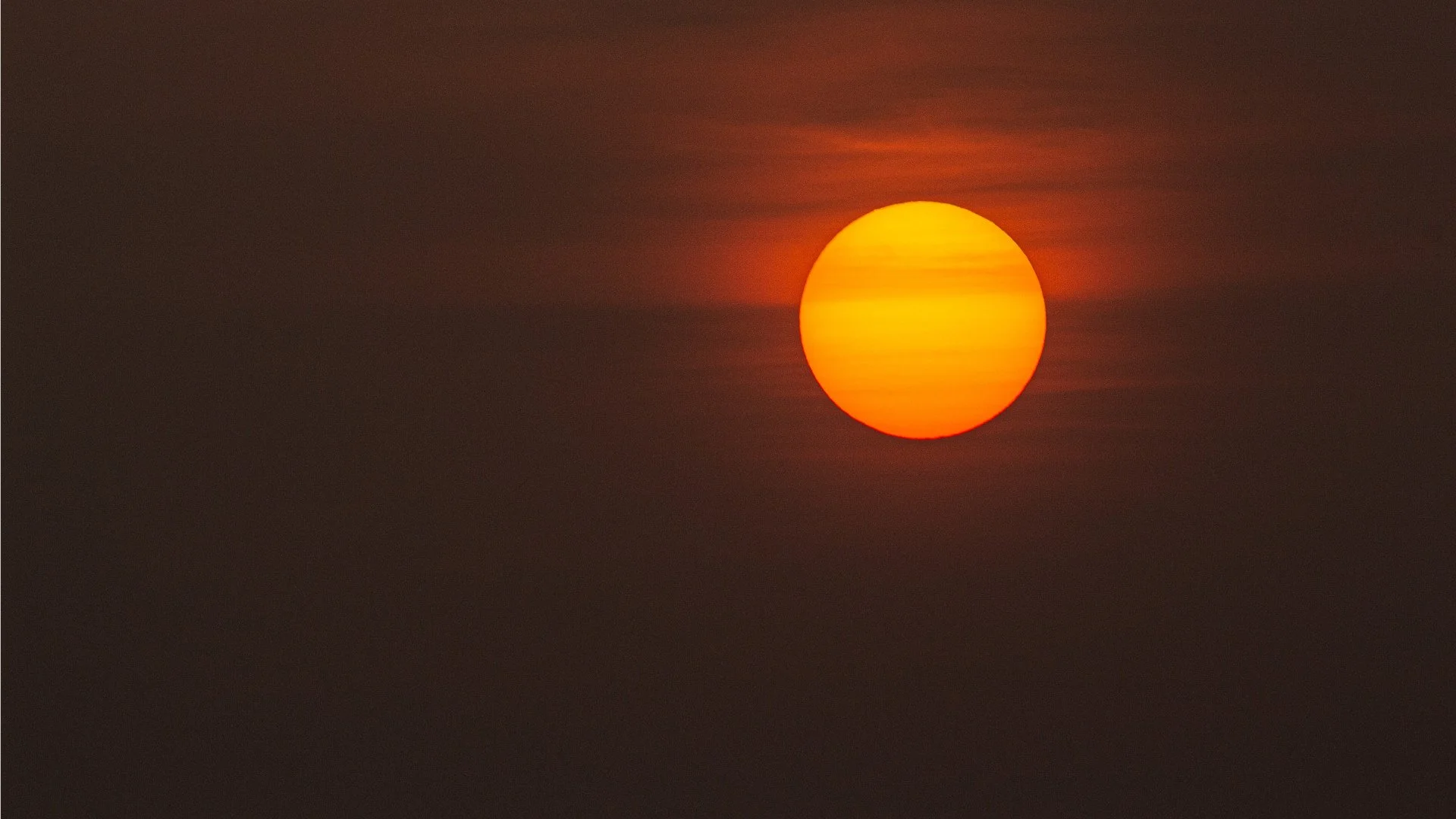
During the festival of Chaath, devotees worship the Sun God with high venerations. People view this deity as the force that binds the universe together and provides energy. Through the rituals and traditions, families welcome prosperity into the family and prevent bad omens. Worshippers also pray for longevity and happiness.
The history of Chhath can be traced back to the early Vedic Period in Hinduism. As per folklore, Chhati Maiya, the wife of the Sun God, can grant all wishes. Her blessings can bring prosperity and positive energy into one's life.
Most festivals feature unique hymns and songs which depict the purpose of the festival. During Chhath, devotees recite similar songs and hymns. The community present various offerings and chant holy prayers to the god of light during the four-day celebration.
Day 1: Nahaye Khaye
As the name suggests, 'Nahaye' means to take a bath and 'khaye' means to eat. The first day of the festival features a dip at the nearby holy river, post which devotees wear a pair of fresh clothes. Devotees then indulge in a pure vegetarian breakfast. The meal also doesn't incorporate garlic and onions.
This day symbolizes the start of the holy fasting performed in the festival, also known as ‘Vrat’, and the devotees take a vow to finish their fasting to attain blessings.
Day 2: Kharna
On the second day, believers fast for a full day. The process of gaining purity features a holy bath and eating purely vegetarian food to break the fast. A series of delicacies and sweets are prepared in house using recipes passed down from generations.
‘Kasaar’, a sweet made from roasted rice, is prepared during the daytime. Other popular desserts are ‘Thekua’, a mix of wheat flour and caramel fried in oil and ‘Bhusuwa’, a sweet prepared similar to thekua but shaped spherically.
In the evening, ‘kheer’ (rice pudding) and ‘puri’ are prepared to break the fast. Individuals refrain from consuming salt, garlic or onions on this day.
Day 3: Sandhya Araghya
The third day is the prime day of Chhath puja, where devotees begin a fast, where they don't even drink a drop of water the entire day. During the evening, they go to the edge of a river, lake, or pond called 'ghat' with their families, carrying a bamboo basket decorated with fruits, sugarcane, and sweets prepared from the day before.
Diyos (oil lamps), candles, smoke sticks are set up in the ghat to perform the Araghya, special prayer. As the sun sets, devotees hold fruits and smoke sticks in their hands and stand in the water, worshipping and offering their Araghya at the setting sun, Chhathi Mata, and the Vedic Goddess of Dawn. Offerings or ‘prasad’ such as milk, fruits, sweets bestowed to the gods. As the sun sinks and night comes, they return to their homes to prepare for the coming morning.
Day 4: Usha Araghya
On this day, before the sunrise, devotees visit the ghat to offer the morning Araghya to the gods of the rising sun. Once the Araghya is complete, holy water from the river is sprinkled over the family members by the elder. The 36-hour fasting is brought to an end by the devotees by eating the prasad. This ritual is also known as Parana.
And with that, the festival of Chhath concludes.