

The Dance of Nayata Bhulu Ajima - A Sacred Dance Part II
In ancient times, the ajima’s were regarded the ultimate protectors of the valley. They were strategicallly placed in cardinal points along with military infrastructre to ensure the cities protection from both physcial and supernatural forces. Amongst, the mother goddesses of Kathmandu is Nyata Bhulu Ajiima.
In the previous blog, we looked into various historical elements of Nayata Maru Ajima and the legends surrounding her origin. The iconic 12-year presentation was conducted this year by the Management Committee.
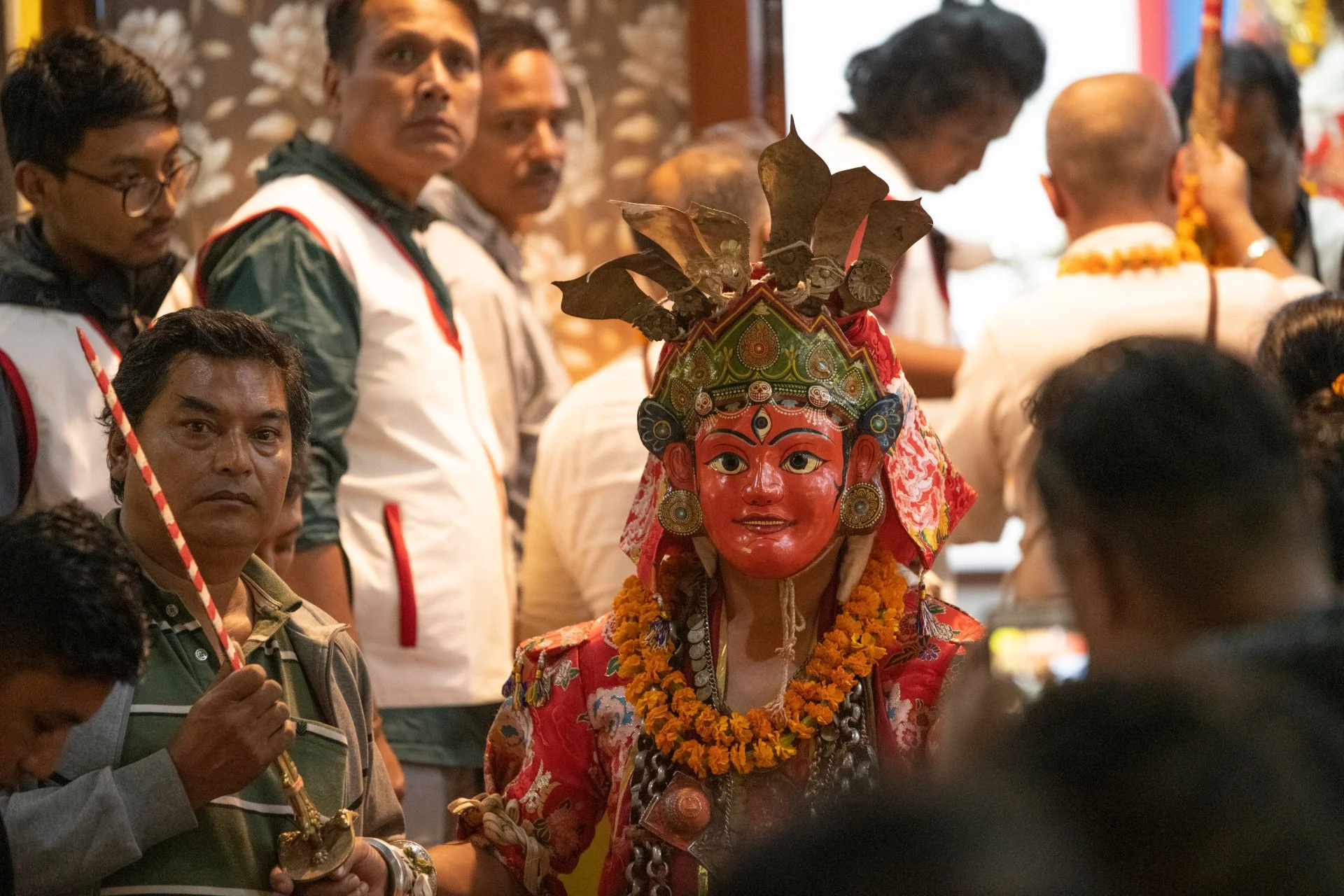
The dance and skit were presented in Trishul Chowk inside the Hanuman Dhoka Palace by the Nardevi Shweta Kali Conservation and Management Committee. Even though the dance is performed annually, the 12-year presentation is unique. It features godly characters who had only passive/dormant roles in the yearly rituals.
The most iconic of all is Su:tha Maju. Su:tha means morning, and Maju means mother in Nepal Bhasa. As per ritualistic traditions, the performances for the day only begin after she (Su:tha Maju) performs at the break of dawn. Locals state that even though Su:tha Maju, commonly referred to as Lokeshwor, is revered in the Buddhist community, the tradition binds all religions, faith and ideals found in this valley. Elders state how the manifestation of Su:tha Maju is an avatar of Nyata Maru Ajima.
The dance and skit last for four days in total. For two days, the artists perform at Trishul Chowk inside the main palace complex of Hanuman Dhoka. The remaining two days are at the open-air stage (Dabali) adjacent to the Gadhi Baithak, in front of Kumari Chhen (House).
Each character presents their opening, followed by the skit of Chandeshwari. The story summarized is as follows- Chandashur Daitya is a powerful demon. He is strong, mighty and fearless. The daitya (demon) falls in love with Chandi- the daughter of Nyata Bhulu Ajima. Ajima learns of this unholy union and tries their best to persuade her daughter. It seemed like nothing worked, but she created a powerful potion to intoxicate and hypnotize her daughter. In her influenced state, she turns on her lover- the daitya. She trades her sword with her mother and delivers a lethal blow killing the demon. After that day, Chandi was known as Chandeshwari- the slayer of Chandashur.
The 12-year celebration features special pujas at the mother goddess temples of Kathmandu valley. The mother goddesses featured in the dance and skit of Nayata Maru Ajima are found in its sister cities as well. These mother goddesses protect the kingdom from supernatural evil and create a tantric shield around the city. Most were established during the Lichhavi Era, and the custom of establishing an army camp or military facility near these goddesses continued till the Mala Era. An example of this can only be seen at Lumadi Ajima, today known as Bhadrakali.
POPULAR ITINERARIES

SIMILAR POSTS


The Dance of Nayata Bhulu Ajima - A Sacred Dance Part I
Mysticism is the greatest suite of Kathmandu. In the labrynth of allies and temples lie symbolism deeper than seen by the eye. One of such mystical elements of the city of Kathmandu is the celebration of Nyatabhhulu at its centre
Nayata Bhulu, a name that only a few ditizens of this valley know the meaning and location of once held high ranks in the sites of Kathmandu. Today, this area is known as Naradevi- one of many change of addresses that occurred after the occupation of Kathmandu Valley by Prithivi Narayan Shah. Nyata means centre, Bhulu means protector. As per Devmala Chronicles, the goddess of Nyata Bhulu was established by King Gunakamadev.
He is credited by numerous chronicles as the founder of the city of Kantipur. Chronicles states that he shaped the city in the outline of a sword- to be precise, the sword of Boddhisatva Manjushree. Historians have long emphasised the need for good research to better understand and preserve this unique culture of Kathmandu. “ As most meaning and symbolism of various temples and monuments in this valley are passed down orally, it is open to being highly twisted or misinterpreted. In the case of Nyatabhulu Ajima, we do not have any concrete inscription, script or cross-citations to create an authentic narrative. The Devmala Chronicle states that the area of Nayatabhulu is the ‘centre’ of the city. But other chronicles state how the city of Kantipur was founded with Kanteshwor Mahadev, today known as Aakash Bhairav, as its centre.” said Shreyashka Maharjan, a sociologist and cultural archivist.
The dance of Nayata Bhulu Ajima is a unique spectacle to behold. It is performed annually. But, once in 12 years- it is performed on a larger scale. This year was the year of the grand presentation. When performed annually, 12 deities are invoked, whereas in the 12-year show, 19 deities are invoked they are as follows:
1. Su:tha Maju (Lokeshwor/ Karunamaya)
2. Nyata Bhulu
3. Bhairav
4. Chandeshwari
5. Ganesh
6. Brahmayani
7. Rudrayani
8. Narayani
9. Kumari
10. Barahi
11. Indrayani
12. Mahalaxmi
13. Simhini
14. Byangini
15. Kumar
16. Chanashur Daitya (Demon)
17. Mahadev (Lord Shiva)
18. Dhwa (Tiger)
19. Khicha (Dog)
Legends state that the temple and goddess were established during the reign of Gunakamadeva, but the performance/ dance was initiated by King Amar Malla. Local experts mention that King Malla held Nayata Bhulu Ajima in high regard and credited her for his military victories against his neighbouring kingdoms. Thus, to honour her, he facilitated various rituals and sacred dances to be conducted annually to memorialise her for countless generations.
We shall explore various facets of dance in the next blog.