
Pahan Charhe - Festival in Nepal
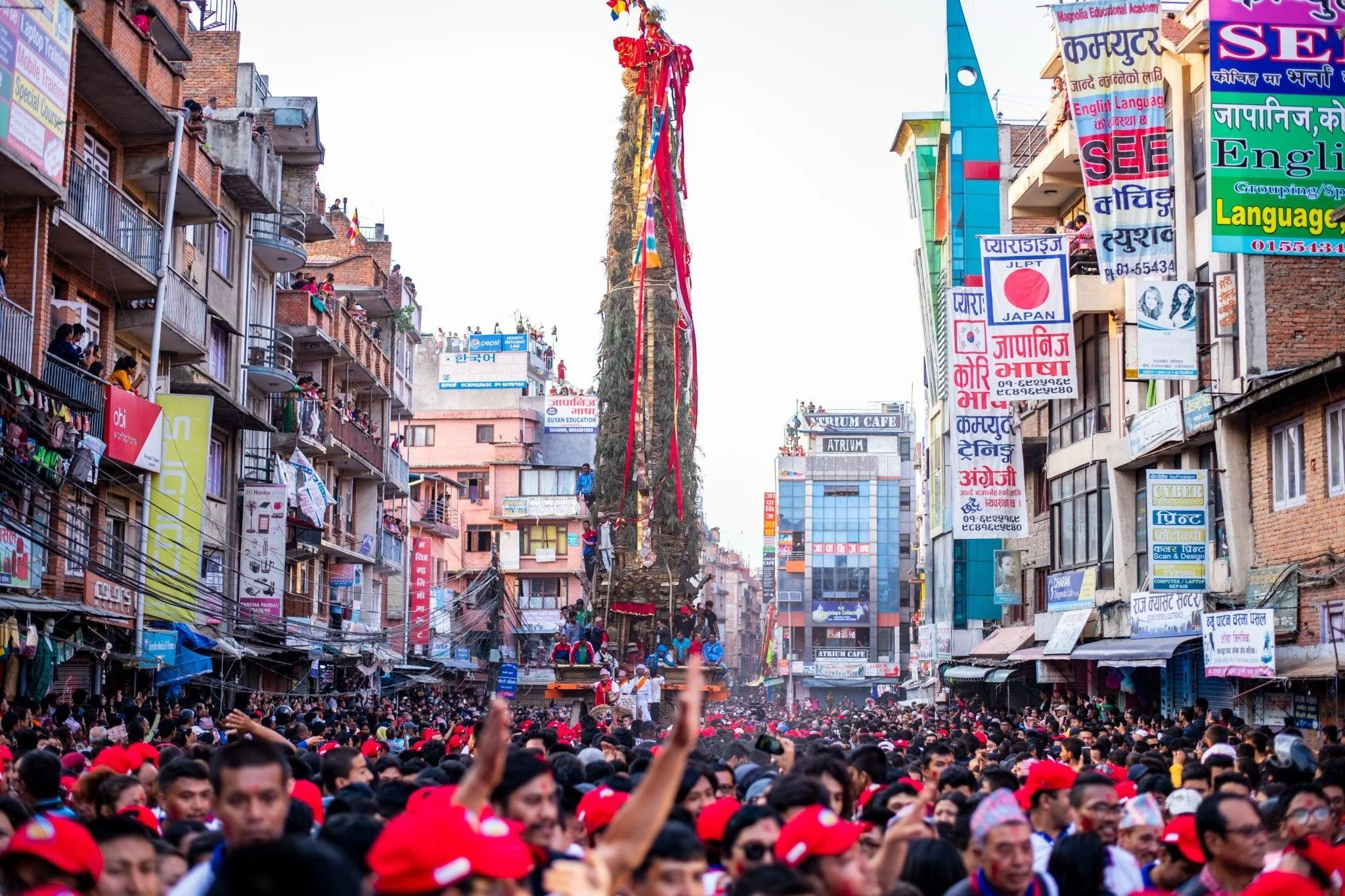
Pahan meaning guests and Charhe meaning on the fourteenth day of the lunar fortnight, the avid tunes of the festival can be heard for three consecutive days in the old towns of the city of Kathmandu. This three-day festival brings together the community in a unique manner and has helped build communal strength and friendship.
Synopsis: In Newar, Bhasa Pahan means to invite and Charhe means on the fourteenth day of the lunar fortnight. The celebration sees the old town centre of Kantipur ( Now Kathmandu) filled with devotees as the palanquin of three mother goddesses are paraded by revellers. This three-day festival brings together the community in a unique manner and has helped build communal strength and friendship.
Pahan meaning guests and Charhe meaning on the fourteenth day of the lunar fortnight, the avid tunes of the festival can be heard for three consecutive days in the old towns of the city of Kathmandu. The festival sees the invitation of beloved guests and members of the family to take part in a magnificent feast prepared for the occasion.
The tradition of Pahan Charhe is commenced a week earlier with an invitation from the mother of the Ajima’s. The festival is also known as Duru Cha Cha Jatra, and once the invitation is received the celebration of Pahan Charhe is commenced exactly a week after.
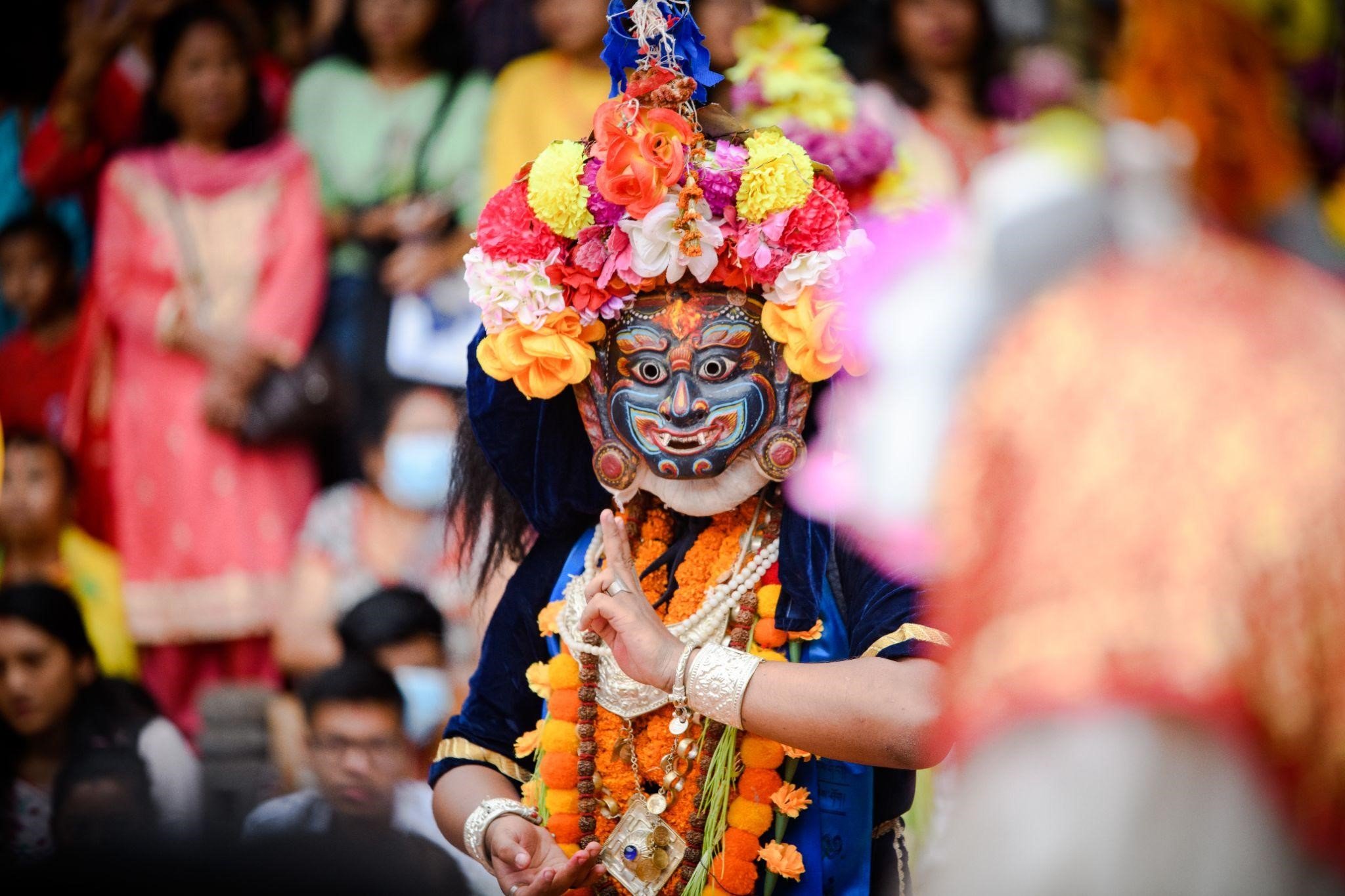
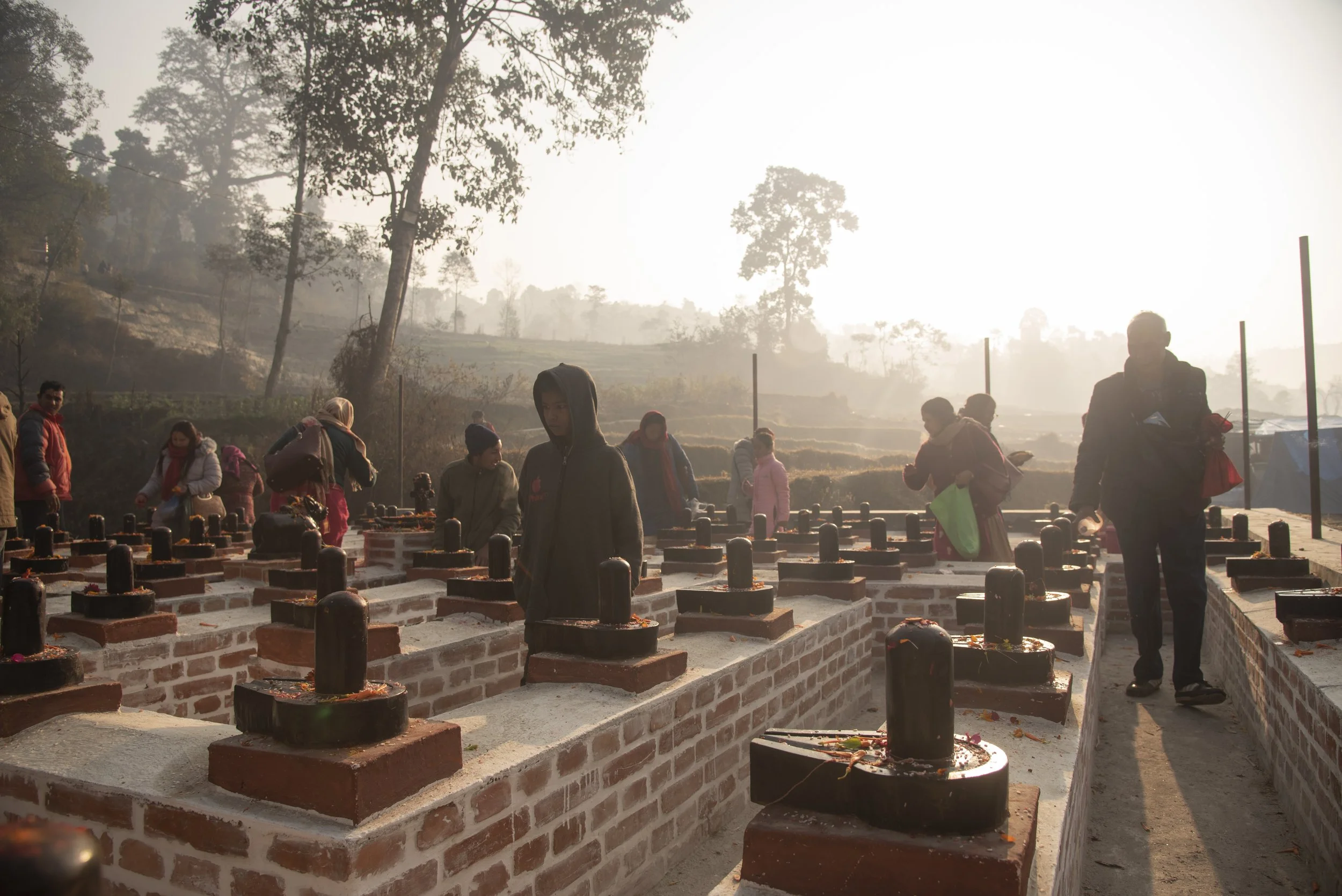
Pahan Charhe is celebrated for three days, the first day sees the worship of the deity of Luku Mahadyah ( Lord Shiva). Luku in Newari means hidden whereas Mahadyah is a local name for Lord Shiva. This day sees members of the household clean their homes and surroundings and make offerings to the deity. At Nyata in Naradevi a special mask dance of the Nyatamaru Ajima is performed. The sacred dance features performers dressed in the traditional colours of the Ajima’s with a mask perform tales of Swetkali. The dance is in an archaic form of storytelling, which starts in the evening and continues through the night.
The Ajima’s are protective goddesses placed by the Malla Kings at strategic locations around the city to form a protective ring. It is tradition to place an army barrack near the temple of the Ajima, even today the army barrack is situated beside Lomari Ajima also known as Bhadrakali. Each Malla city has it’s own version of the protective goddesses, wherein Patan they are known as Asta Matrika and in Bhaktapur; Nawa Durga.
The protective goddesses are symbolized as the shakti (strength) of Male Goddesses. The eight mother goddesses are Brahmayani (The Shakti of Lord Brahma), Maheswari (The Shakti of Lord Shiva), Bal Kumari (The Shakti of Lord Bhairav), Vaishnavi (The Shakti of Lord Vishnu), Varahi (The Shakti of Lord Narayan), Indrayani (The Shakti of Lord Indra) whereas Chamunda and Mahalaxmi are fierce manifestations of Goddess Kali and Laxmi.
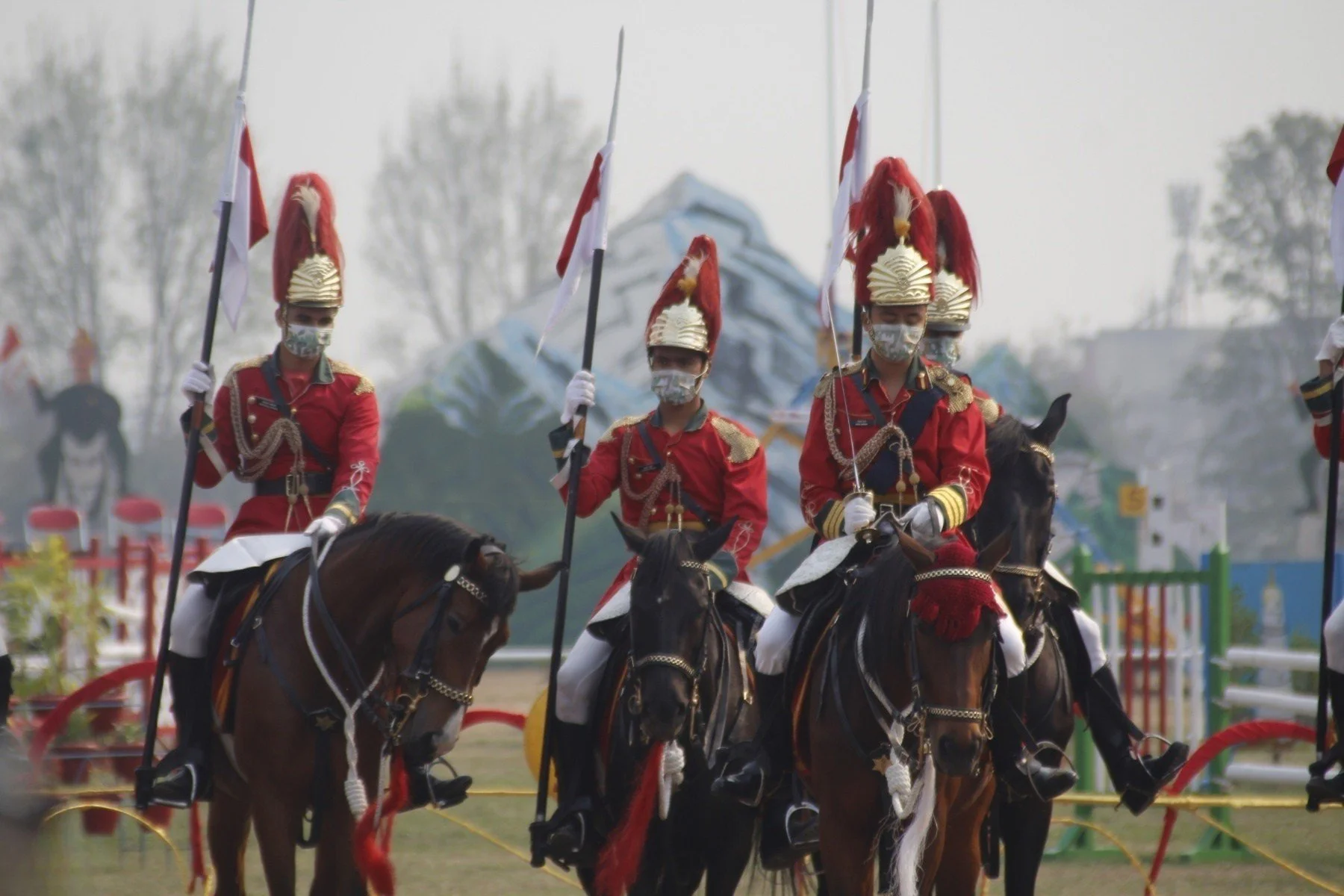
On the second day, which is also known as Dyah Lwakegu is celebrated at the open field of Tudikhel. During when shrines of the Ajima are placed in a palanquin and paraded in their respective locals in Kathmandu. The day also sees the celebration of the annual Ghode Jatra, one of the most important festivals of the Newar Pantheon. The legends of the Gurumapa are stories with which Newar children grow up with and is folklore in the valley.
During the night, the palanquin is taken to Tudikhhel which is followed by an entourage of devotees and traditional Newari musical ensemble. Each community brings forth a flame torch which is exchanged symbolizing the meeting of the goddesses. The palanquin procession of the Ajima was started by King Amar Malla during the Nepal Sambat year 580 (1460AD).
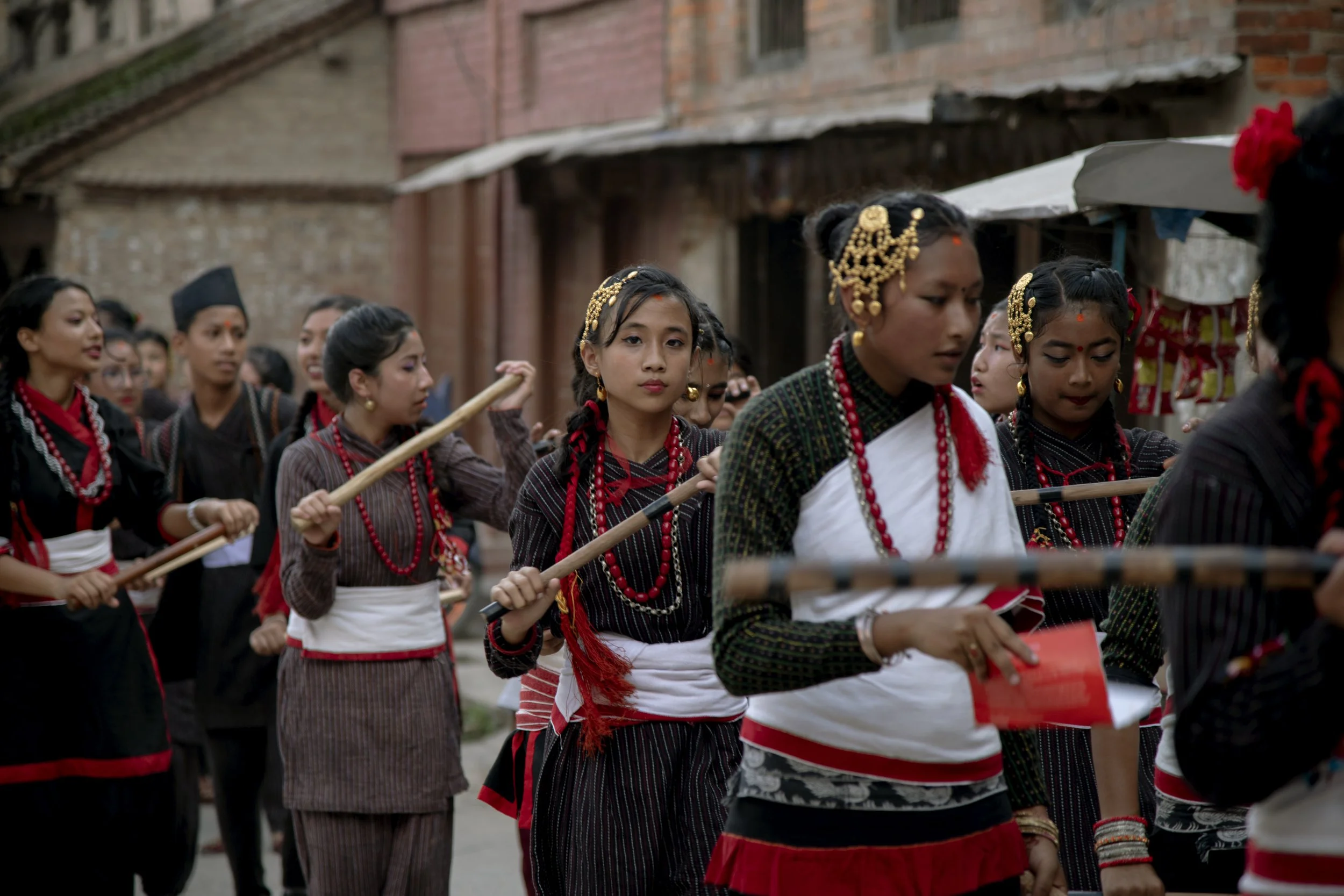
The third and final day of the festival sees the gathering of huge masses at the old city centre of Asan. The palanquins of Lumadhi Ajima(Maheshwari), Kanga Ajima (Varahi) and Tebhana Ajima (Chamunda) are brought in there respective palanquins and paraded in the street. These Ajima are believed to be sisters. The historic market place sees the meeting of the individuals of the respective locales-who all wear coloured hats of red, blue and yellow which are respective of the localities.
During the Dyah Lwakegu ceremony, participants accompanying the shrines exchange flaming torches. Devotees offer traditional Newari rice bread, known as Chatanmari to the deities and during this day can be seen thrown from even the rooftops of the homes in Asan. Traditional seasonal songs are placed the musical ensemble during the meeting of the gods, where participants can be celebrating with avid fanfare and dancing to the beautiful melancholy.
POPULAR ITINERARIES
SIMILAR POSTS

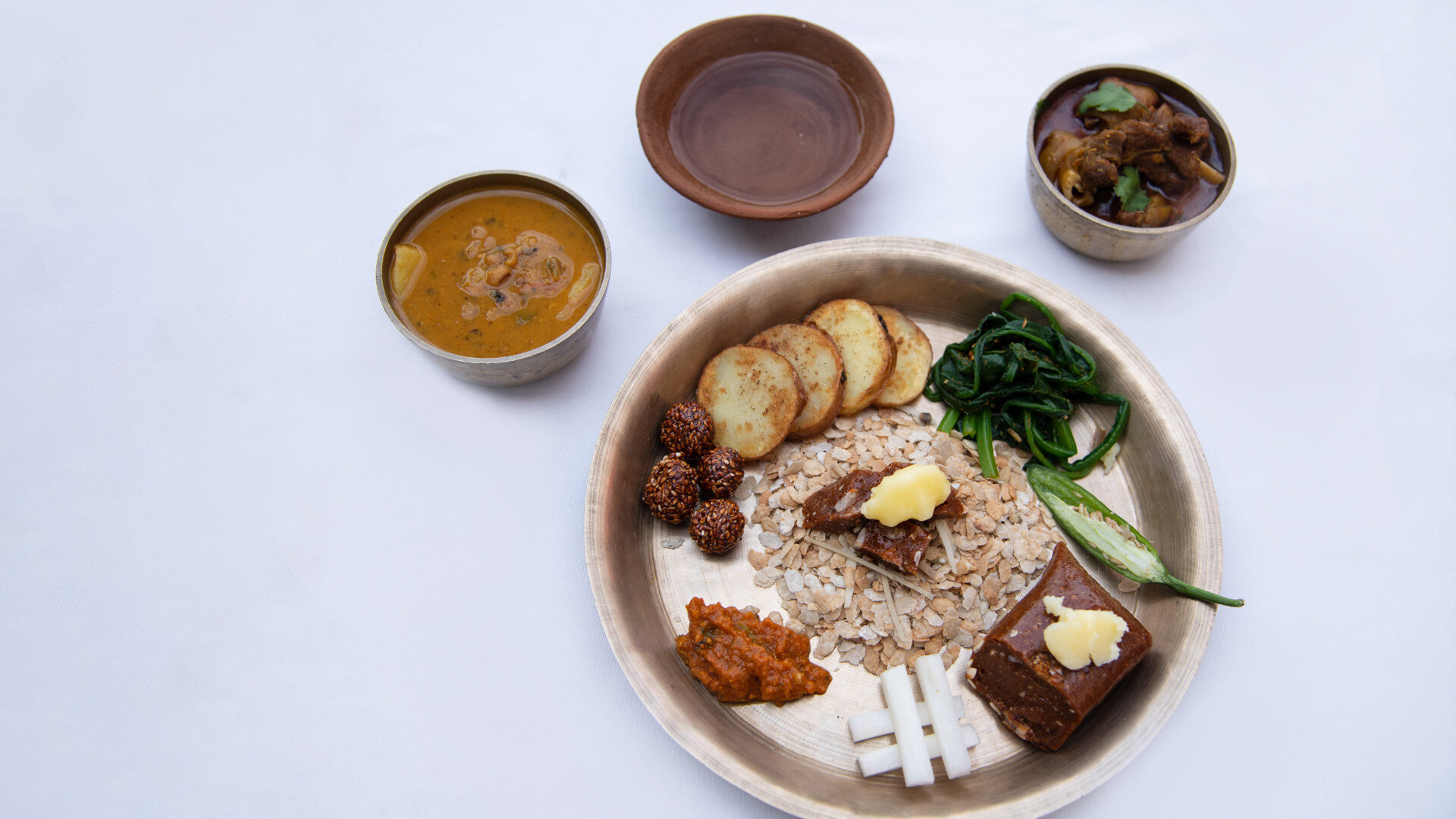
Feasts for Maghe Sankranti
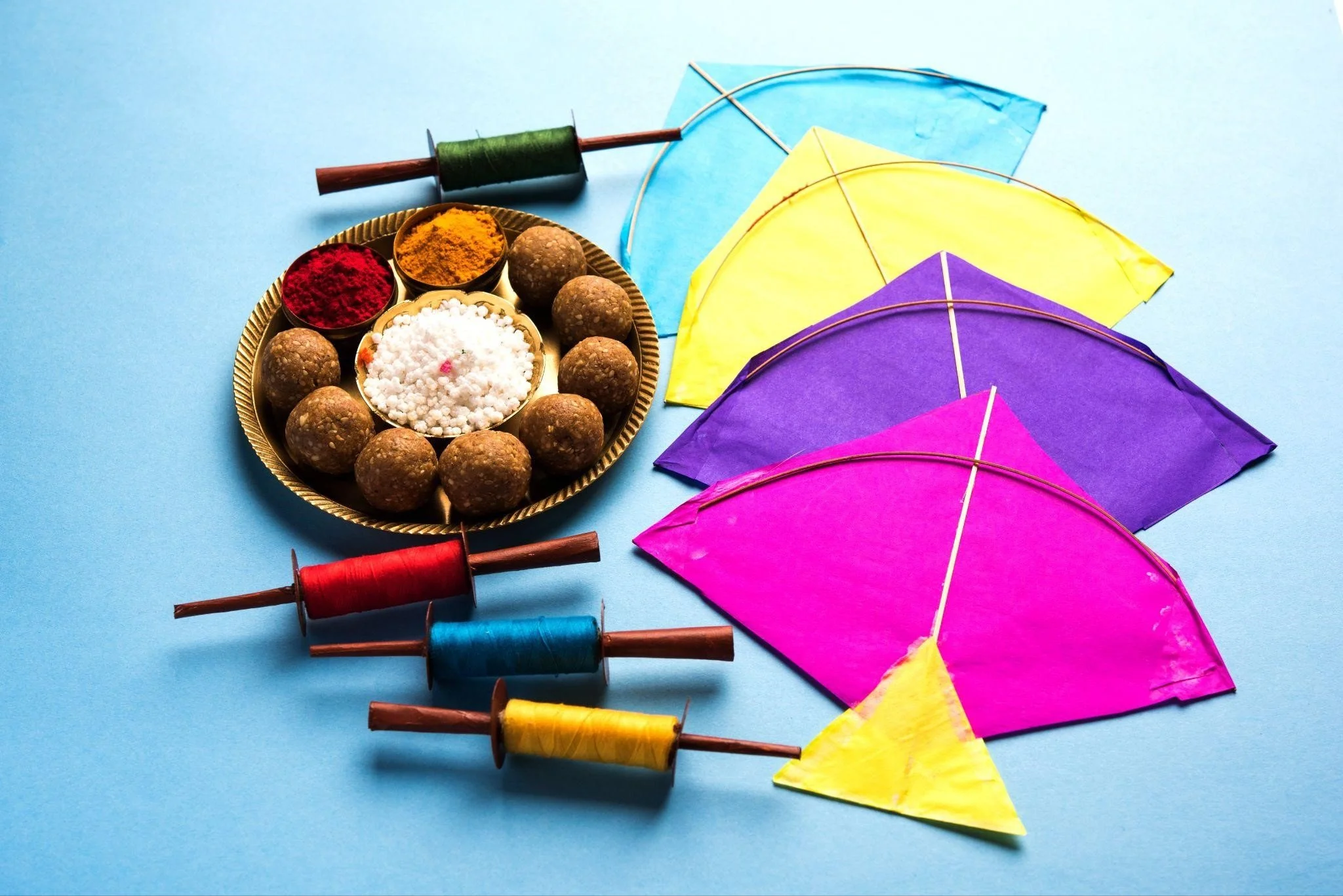
Maghe Sankranti, or Makar Sankranti, is one of the most auspicious religious festivals in Nepal. Celebrated on the first day of the month of Magh (January/February), Maghe Sankranti is typically a day spent with family, basking in the sun, and pampering oneself with food and oil massages - it ensures that one is well fed and nourished until the winter lasts!
Chaaku
Tilauri and Til ko Laddu
Sakhar-Khand, Pidaalu and Tarul
Gheu
Khichadi
Maghe Sankranti, or Makar Sankranti as it is often called, is one of the most auspicious religious festivals in Nepal. Celebrated on the first day of the month of Magh (January/February), Nepalese people celebrate the festival to mark the end of winter into the upcoming spring.
Devotees wake up in the early hours before sunrise and take a bath in many holy rivers, singing devotional songs and offer water to the Sun God, Surya. According to beliefs, the bath purifies the self, the soul and fulfils wishes. People also visit temples, visit their most elderly relatives, friends and family, and give-receive blessings.
Maghe Sankranti is typically a day spent with family, basking in the sun, and pampering oneself with food and oil massages - it ensures that one is well fed and nourished until the winter lasts!
Traditionally, Maghe Sankranti also commemorates the beginning of the harvest season, and is marked with great festivity and with special delicacies consumed only at this time of the year. For the ethnic group of Magars, however, the day is equivalent to their New Year - celebrated with grand communal gathering, and fanfare.
As with any other festivities, people partake in feasts with food items that are most suited and observed for the particular festival. Maghe Sankranti sees a buzz of many popular food items known and loved around the country. Every serving is a mix of colour and texture, and is a treat to the palette. The tempting aromas take over the senses and you could dive in for a bite. Once you dig in, the mix of colours you see on your plate will completely take over you as you bask in the warmth of the mid-January sun. So, let’s take a look, shall we?
1. Chaaku
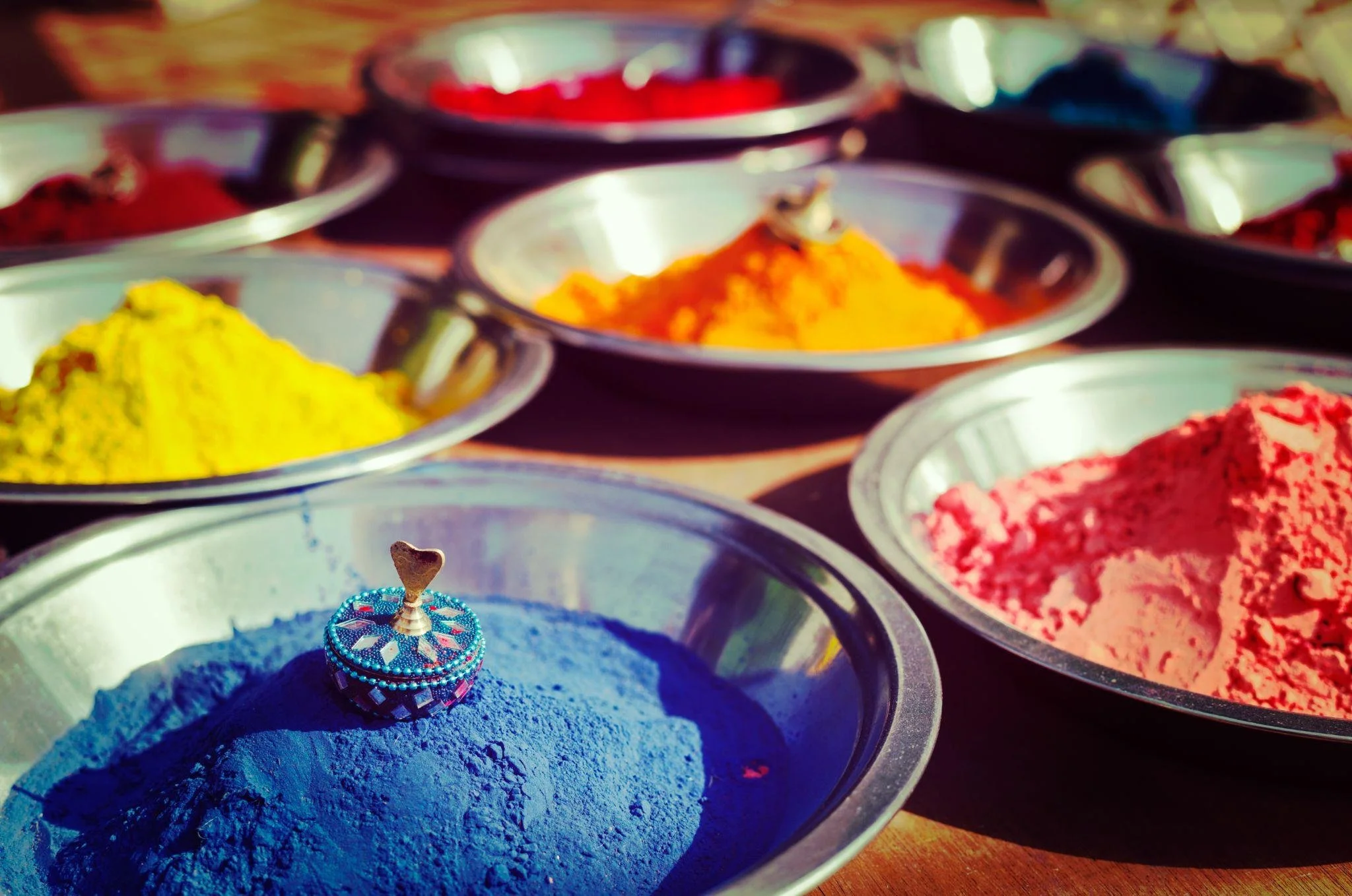
Chaaku is quite famous already. These retreated molasses patties can be obtained in different sizes and are easily distinguishable because of the thick brown colour that it pertains. A lighter variant can also be found which are semi-solid jaggery called Gud, mainly sold during the festival.
2. Tilauri and Til ko Laddu
Tilauri, as the name suggests, is made from iTl (sesame seeds) and sugar, formed into a chewy candy. Tilauri has a light colour that separates it from Til ko Laddu which is generally made with a blend of til, gud and sugar and has a darker colour similar to that of chaaku.
3. Sakhar-Khand, Pidaalu and Tarul
Sakar-Khand or Sweet Potatoes are highly popular during this festival and are noticeable in almost all the markets around town. The streets are abuzz and you come across a number of vendors selling sweet potatoes. Similarly, pidaalu (taro roots) and tarul (yam) are also just as popular. While you are more likely to hear the buzz around sakhar and tarul, you will be able to find all three in the market in almost all shapes, sizes and textures.
4. Gheu
Gheu-Chaaku is arguably the most popular phrase you’ll hear in and around this festival, especially if you’re in a Newari community. Gheu is basically clarified butter and goes on and with all the food items that are eaten during this festival.
5. Khichadi
Focusing on healthy eating on this day of festivities, people partake on khichadi which is a traditional way of cooking rice with black gram daal. Paired with melted gheu-chaaku, it becomes a popular combination while enjoying the feast. Served with traditionally cooked meat, spinach and achaar, it can be considered a typical Nepali khana or meal and is the main course for the day.
Green leaf spinach is also a noted food partaken during this festival. All the food items during the festival focus on healthy eating and are observed for warming up the body, getting good nourishment, and the purification of one’s body.
This festival is believed to bring an end to the ill-omen month of Poush and the day, Magh 1, is also regarded as the coldest day of the year as well as the mark for the start of warmer seasons. The Hindus worship Lord Shiva on the day, offering delicacies like sakhar-khand, tilauri, chaaku tarul and gheu, with the belief that one becomes healthier by consuming such items to mark the occasion.
POPULAR ITINERARIES
SIMILAR POSTS
Yomari Punhi
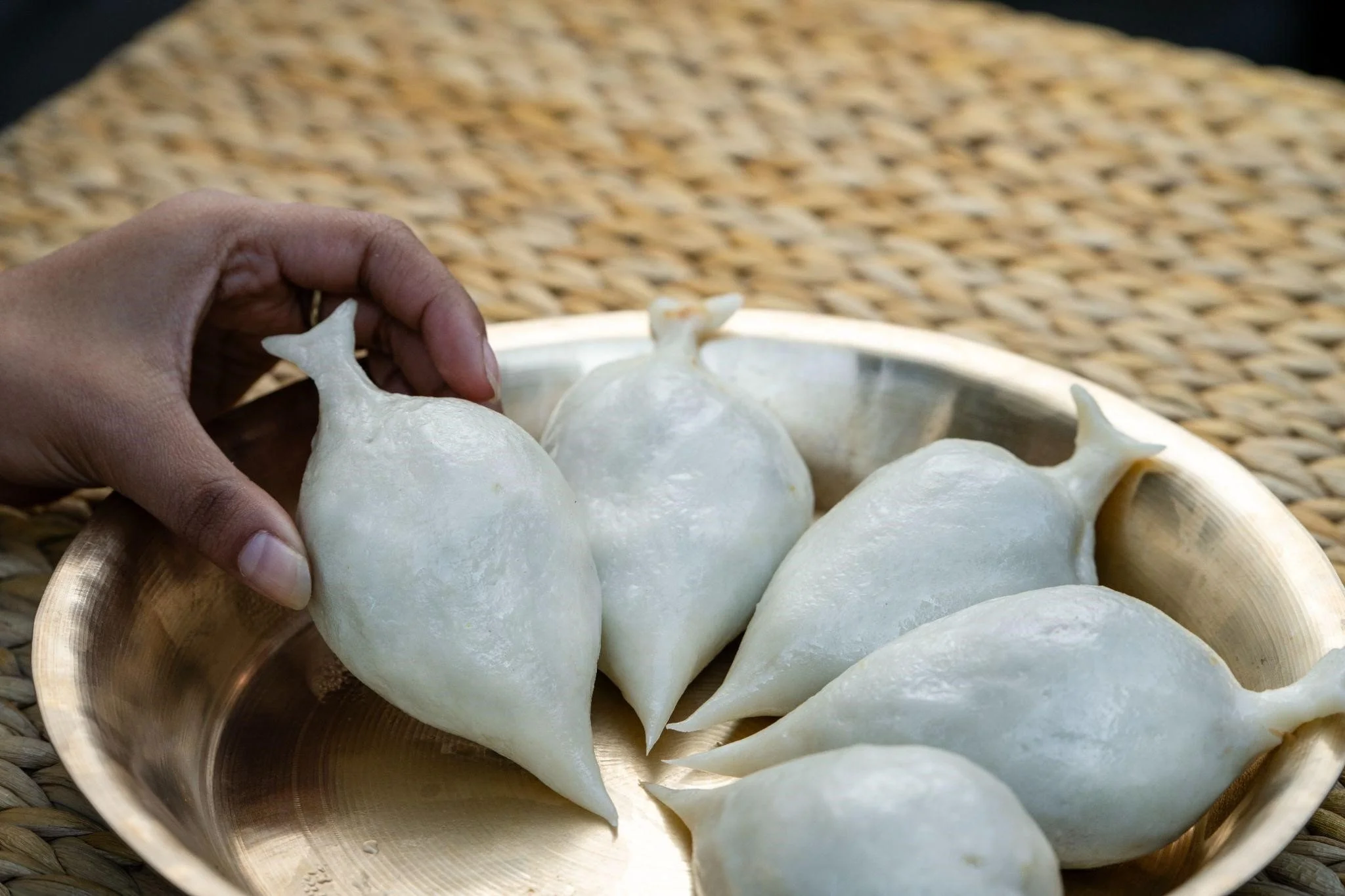
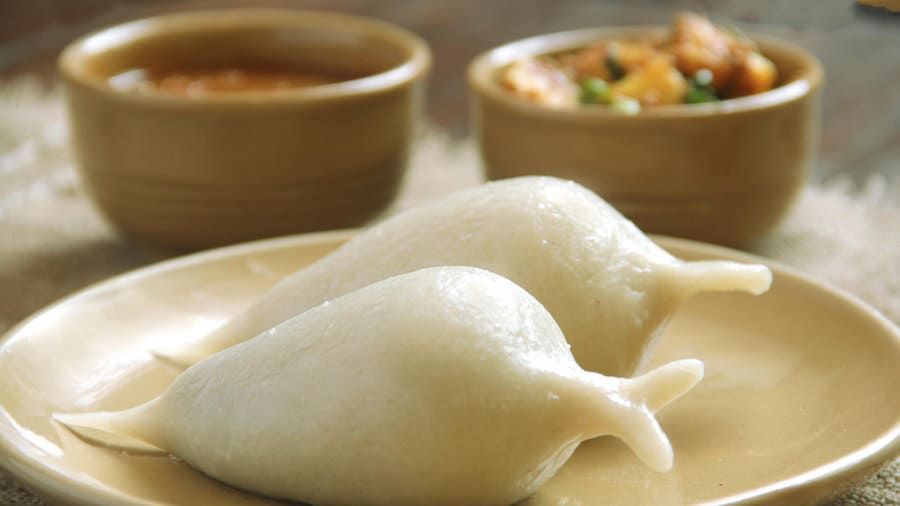
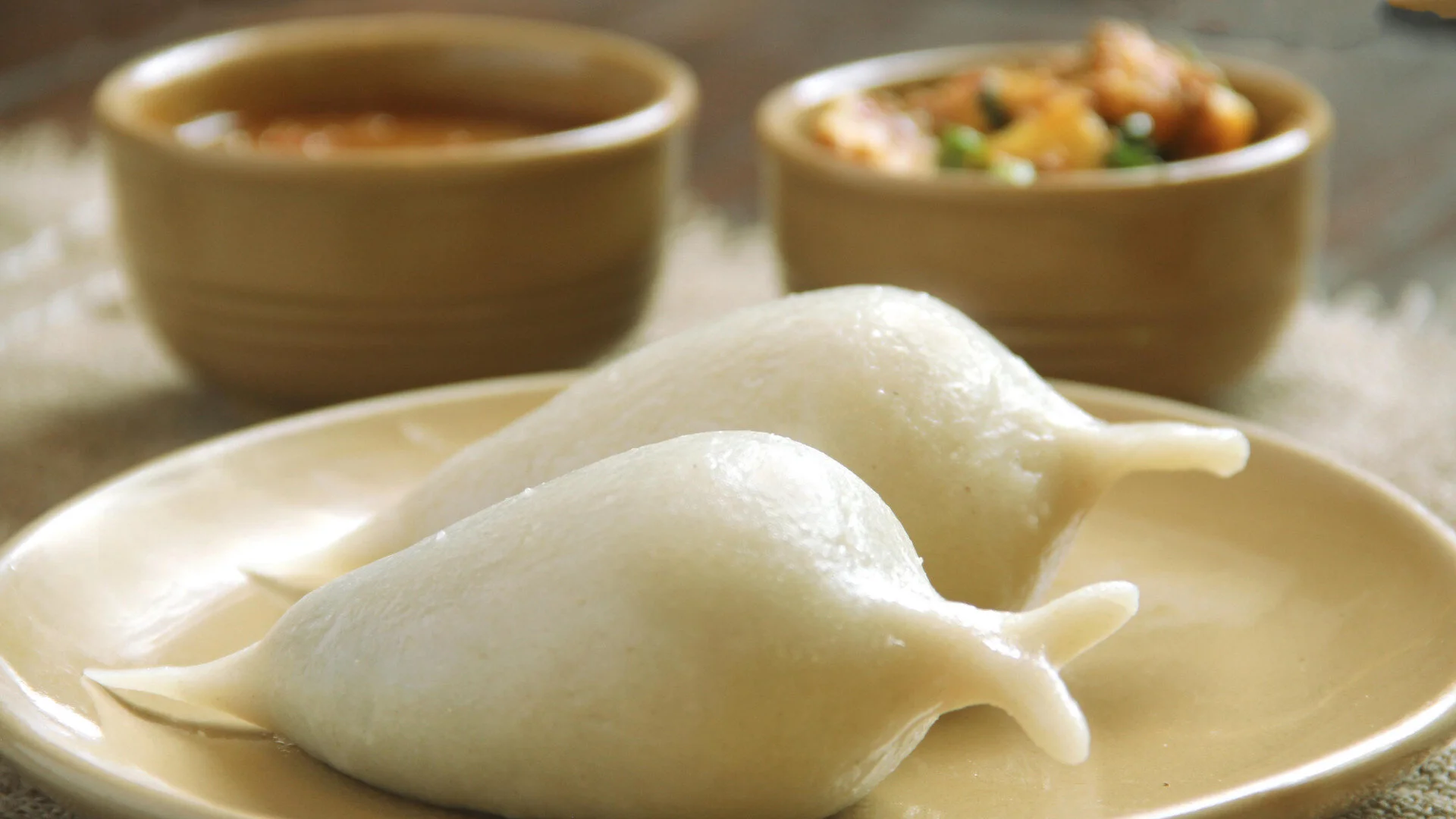
Yomari Punhi, a Newari festival in Nepal is celebrated every year by Newari Communities marking the end of the rice harvest during the full moon day of November/December. It is said that eating Yomari or Yamari, a steamed dumpling made with rice flour with sweet such as Chaku inside takes away the cold.
The following story is based on ancient myths and texts which has been interpreted with additions of details to provide gravity.
As the winds of winter began beating the drums, it became obvious that the upcoming season was to be one of the coldest they would see. As Krita woke up, on a fine morning she couldn’t help but take a fresh breath of morning due, with a light hint of incenses. She went for her morning routine, and as she was about to head out to the Indreshwar Temple for her daily ritual. She cried out for her husband, “You have to wake up now. Today is the end of the harvest, help me out bringing in the grains. They aren’t going to roll themselves in the store! You also need to assist me in the kitchen today, if not then you should make plans to eat at your friend's house today. I can’t do it alone, I hope the harvest is enough to keep us this winter. Wake up!”
With a grunt, Suchandra tries to shrug her off but as Krita pulled the blanket, and as the winds of the fall morning made contact, Suchandra was awake as an owl. Krita left her husband, who looked like he had been hit by a wall of bricks for the temple of Indreshwar.
Along the way, she greeted the elders, took their blessings and heard the words of a celebration of the harvest festival to happen in the evening. She was filled with happiness and said to herself, “A festival that sounds amazing. When was the last time I was at a festival? Oh, When Suchandra and I went to Bhaktapur to see the Biska Jatra. He doesn’t even take me out anymore, he has grown lazy too, well typical of men!” Krita was mesmerized with the thought a festival in town and as she imagined the vibrant streets, the merry music she had a smile on her face. She was so lost in her thoughts, she failed to realize that she had already walked past the temple. Only later to come back to earth, when an elder asked the direction to the temple.
She walked with the elderly gentlemen, as they were headed the same direction. As they reached the temple, she bowed to him and told him that she shall part from here. The elder reached out his hand touched her forehead and said, “Bhagyamani Gui Ma!” ( May you be fortunate!)
As she offered her prayers to the deity she stopped by the local vendor, confused about what to put together for the daily meal. She noticed something peculiar amidst the produces being sold on that very day. The vendor had an assortment of Chaku (Sugar Molasses) and with the evening festivities in mind, she wished to make something new.
She bought a few blocks of Chaku along with a few more products and headed towards home. Suchandra had woken up and had started to prepare to bring in the grains of this seasons harvest. She smiled at him as she stepped inside her home and went towards the kitchen to sort all the produces. She stared at the Chaku as she placed it atop the table and wondered what treat she could whip up with this new ingredient. After placing all the produces, she headed outside to help her husband bring in all the grain.
As if in the blink of an eye, the day had passed by and with a quick lunch they continued taking in all the grain and began inventory. “This year it seems the gods have taken all our fortunes and given it at one go,” said Suchandra with a delightful smile as the grains this year had tripled last years harvest. “Did we cut down someone else's crops too?” Questioned Suchandra.“ Well if we had worked as hard as this year in the previous years, then we could have collected on our fortunes the previous years as well,” said Krita.
As the sun slowly set its way towards the western horizon the evening was soon to approach. The merry tunes of the drums could be heard playing in the distance. Krita is a panic, “What are we to prepare for the tonight?” Suchandra, “Well I don’t know, how should I know!”
Krita left the store in a hurry and made her way to the kitchen and stared at the produces she had collected earlier. Each great but none go together in avid confusion she began checking the stores. She took some rice grains from this year's harvest and took it in a hurry to the mill. She had them grounded to fine grain and wished to make her husbands favourite Chatamari (Rice Crepe). As she began preparing, she couldn’t help but stare at the Chaku she had procured in the morning. She then had an idea! “What if? No, I shouldn’t.”
She called out to Suchandra, “Can you help me in the kitchen? I want to finish early and go watch the festival. Suchandra made his way to the kitchen and Krita asked, “What if we make something different today?” Suchandra amused, “What do you mean by different?” Krita replied, “Can you take that Chaku and have it heated until it turns liquid? I have a thought.”
To which Suchandra replied, “Well if it doesn’t work then I’m be having your thoughts for the night meal.” Suchandra began heating the Chaku and Krita took the rice flour and kneaded it into a dough. She asked Suchandra to grab a dowel and asked him to pour the Chaku into the dough which she had shaped into a triangular and made a hollow in the middle. Suchandra amused didn’t want to get into another conversation began doing what Krita said. As the Chaku reached the rim of the shell she closed the top and had it sealed. She made two horn-like structures, “ These are your horns, the ones that you gain when you have a bit extra alcohol.” said Krita. Suchandra grunting placed two halves of black lentils onto another shell and said, “These are the beautiful eyes that you look at me with every day.” Krita couldn’t help but smile as she placed them onto a steaming basket.
Both had gotten very hungry and with every passing second, they felt like their stomach was coiling up like the body of a snake. “They must be ready, check them I’m very hungry” cried Suchandra. “ No they need more time, the shell wouldn’t even have hardened.“ said Krita. “Just a few minutes longer, your patience will be rewarded.”
In a short while, Krita opened the lid of the steamer and stared at a beautiful shell’s filled with delicious sugary goodness. Suchandra in a haste tried to grab one and have it devoured but Krita stopped Suchandra and said, “Not until we present it to Annapurna Devi. The only reason we get to have these treats is because of the great harvest we had this year. It’s all because of her blessings.” Krita took two of the shells and placed it in a leaf plate and went up to the pooja room. She got to her knees and placed the treats at the foot of a beautiful ideal of Annapurna and bowed to hear and offered her prayers.“ May you bless us, with a good harvest of grain every year.“ After lighting a bunch of incenses she came down to the kitchen and saw Suchandra’s hungry face. She rushed to pick up two shells and had it placed on a leaf plate and gave it to him. “My dear husband, your patience has been rewarded. Here you go.” Suchandra in the blink of an eye took a big bite of the shell and as he chewed the molten molasses dripped from the side of his lips. His frown turned into a smile and he exclaimed, “Yomari, Gajau Sau Mari!!” ( Such a delicious bread)
It is believed that Krita and Suchandra were the ones who first conceptualized the delicious treat of Yomari. Which today is enjoyed by the people of Nepal in the Punhi (Full Moon) which marks the end of the harvest season.
POPULAR ITINERARIES
SIMILAR POSTS
Ga: Pyakhan: The Dance of The Asta Matrika’s
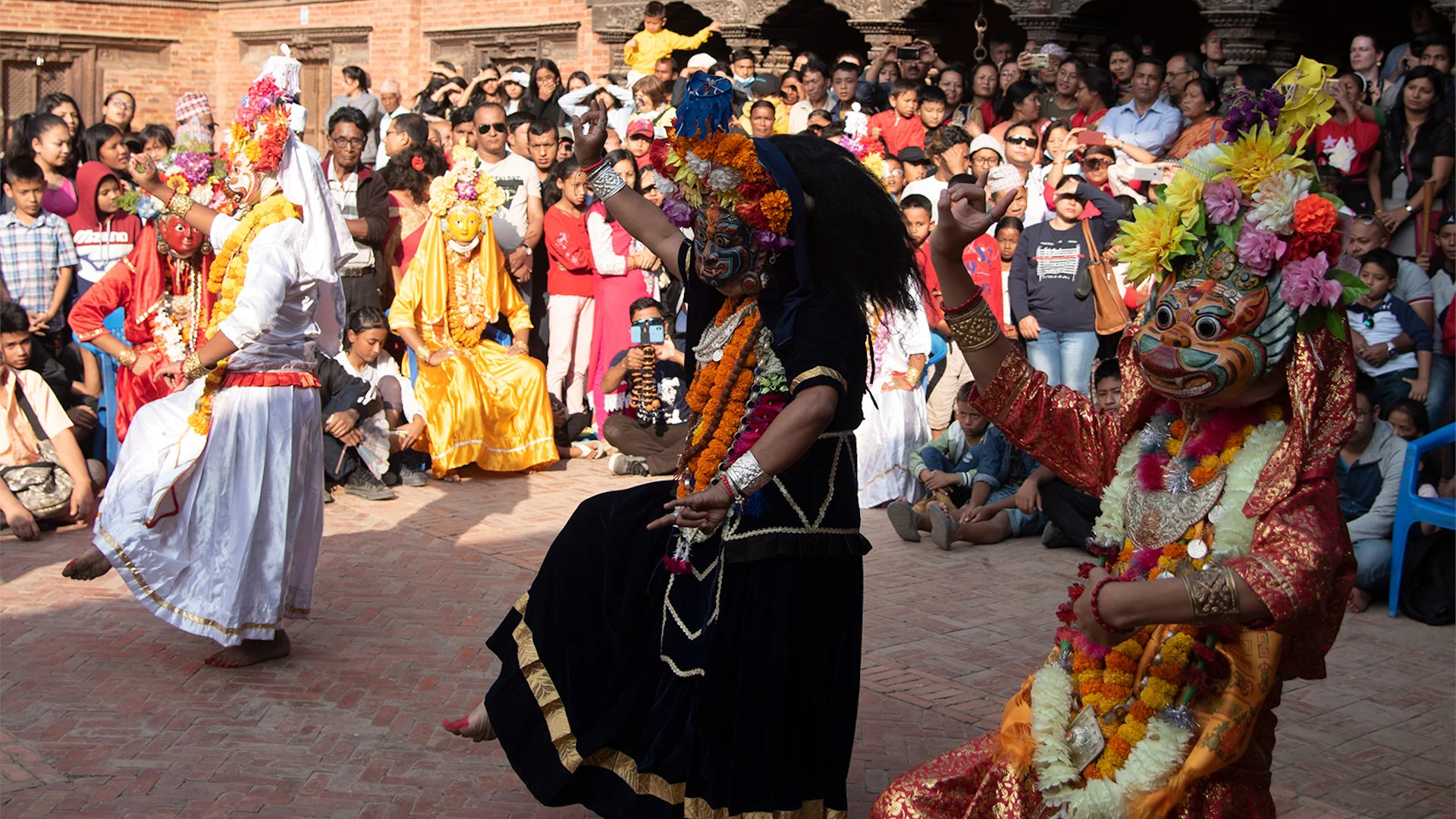
Ga: Pyakhan in Patan(Asta Matrika Dance) is popular among the locals of Patan. The dance of Eight Mother Goddesses, deities of Hindus, is performed by male Buddhist dance during the Nepalese biggest Dashain festival. The dance is staged in the royal court of Mulchowk, inside the Patan Durbar Square of Lalitpur. It is believed that the dance is performed as a worship of the deities to bring the prosperity and fortune to the people.
350 years ago King Sri Nivasa Malla as he sat down by the window of his palace at Patan Dubar Square is believed to have noticed something peculiar. On a starry night he began hearing the tranquil melody of pauju ( Anklets) slowly approaching, and from a distance he saw a group of individuals dancing towards the palace. As he sat in wonder, who they might be? As they approached close, he could not fathom the beauty that his sights beholds. The group which displayed a beautiful dance was no other than the Asta Matrika’s ( Eight Mother Goddesses). Who danced there way into the court of Mul Chowk. King Sri Nivasa Malla, ran to the court to take blessings and witness their divinity but as he reached the palace square the Matrika’s had already ascended.
The “Gaan Pyakhan” is staged in the royal court of Mulchowk, inside Patan Durbar Square, Kartik Dabali and Nakabail Tol. “Gaan” translates from Newari as “Group” and “Pyakhan” translates to “dance”. The dance begins from the night of Ghatsthapana and is brought to a close during the night of Ekadashi.
According to legends, the King’s priests advised him to incorporate the newar pantheon so that they might not take offence. Thus, the dance features thirteen deities, eight mother goddesses ( Brahmani, Mahesvari, Bal Kumari, Vaishnavi, Varahi, Indrayani, Mahakali and Mahalaxmi), and five newar patron deities (Bhairav, Simhini, Vyagrihi, Lord Ganesh and Lord Kumar).
The goddesses are embodied by select individuals who have observed sacred rights and measures of purity. The performers first visit the shrine of Vajrasattva and take on the threefold refuge—Buddha, Dharma and Sangha. After which they take blessings from their teacher and present an offering. After all the performers have completed the ritual, the musicians play the opening tune following which the teacher instructs them in the dance in front of the temple of Nrityeshwara, the Lord of Dance. They then observe Upasadha (fasting) for a complete day and engage in meditation.
The Gaan Pyakha stands out from other masked dances of Kathmandu Valley in terms of the individuals who perform the dance. Most masked dances are performed by subjected lower castes of the society whereas the Gaan Pyakha is performed by the highest order of Buddhist castes (Bajracharya and Shakya).
It is a tradition passed down through generations, an art form first learned through observation of their grandparents and parents. Traditionally the next generation starts from the age of eight which is still continued to this date; to later be initiated by the chief priest and taught the ancient form of “Charya Nritya”, an ancient tantric form of spiritual meditation where the performer visualizes himself as the deity. It is symbolized by dresses with the color of the deity and various ornaments. The final piece is the mask itself, created in the image of the deity. The masks themselves have minute symbolic details in relation to the deity.
It is believed that the dance of Asta Matrikas is performed to remove various obstacles—the eight great fears (Water, Lions, Fire, Snakes, Elephants, Thieves, False Imprisonment and Ghosts). The worship of the deities is thought to bring prosperity and fortune to the king and his people.
The inception of the Asta Matrikas in the pantheon of the Gods and Goddesses of Nepal Valley(Kathmandu, Patan and Bhaktapur) has multiple origins. One of the many legends associated is how the Asta Matrika’s were the guardians of the mother of Avalokitesvara Karunamaya also known as Rato Matsyendranath. He was brought from Kamakhya,Orissa by King Naradeva, Acharya Banudhata and Ratnakar Jyapu after the Nepal Valley faced a severe drought. Her mother the Queen refused to give away her son and after he was brought to the valley by a form of trickery. She followed and brought her guardians and an army. Knowing the immediate threat to the valley by her rage, Banudhata cast a spell trapping the her in the tree which stands tall at Lagankhel, Patan. After which nothing is known of the Matrikas but it is believed that they choose to stay in the valley to guard their Queen.
Times have changed since the inception of the Gaan Pyakhan; the Malla kings were overthrown by the Shah's but the tradition still continued. However, as the modern winds swept in, it became harder to sustain such archaic traditions. After the fall of the monarchy, many such cultural dances faced near extinction, as the King always bore the cost.
SIMILAR POSTS
The Tales of Sikali Festival
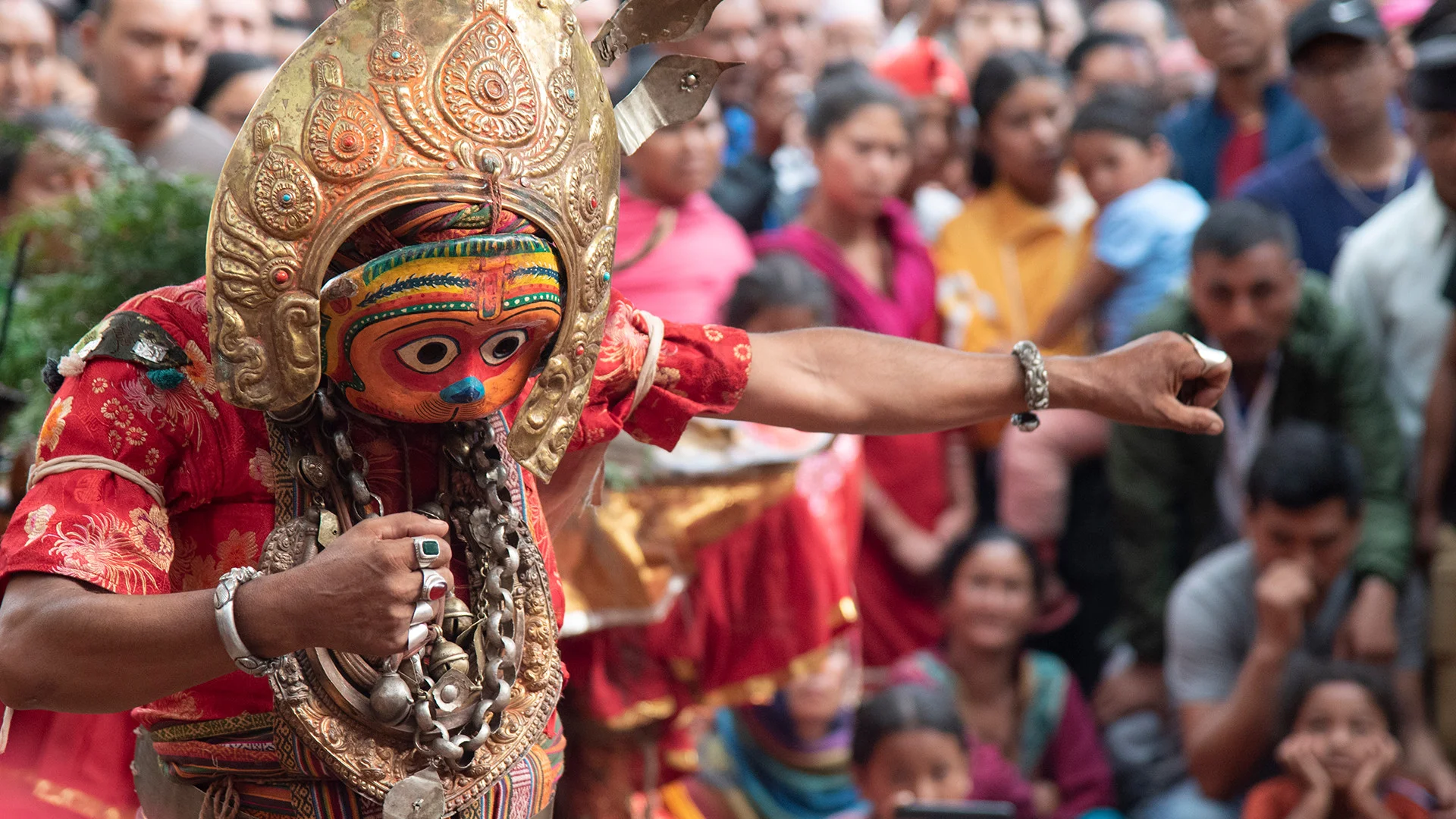
While the entire nation prepares for the celebration of the biggest festival Dashain, local of Khokana village located to the south of Lalitpur gears up for the festival of Rudrayani known as Sikali Jatra. Festival is celebrated by a section of the ethnic Newari community with a skit presentation in a form of archaic storytelling with traditional music and individuals dressed in a godly attire adorned with the masks of deities and demons.
As the entire nation prepares for the grand celebration of Dashain, the village of Khokana located south of Lalitpur gears up for the festival of Rudrayani. Popularly known as “Sikali Jatra”, the celebration trumps even the great festival of Dashain. The citizens of this once great kingdom celebrate the Sikali Jatra instead of Dashain.
A celebration of a total of five days, which begins from Ghatasthapana and concludes on the day of Fulpati. The celebration is centered around the patron deity of the town of Khokhana, the goddess Rudrayani commonly known as Maheshvari. She is believed to be the Shakti of Lord Mahes(Shiva) also known as Maheswar. She is also a form of goddess Parvati is known by many names such as Rudrayani, Shankari, Shivani and Mahesi which are derived from the names of Lord Shiva Rudra, Shiv, Shankar and Mahesh.
The festival and the cultural dance depicted during the day of Fulpati is believed to be linked with the origin of the city of Khokhana. The city is believed to have been founded by King Amar Malla during the 15th century of the Medieval Malla Era. The Malla during their reign established various temples which were dedicated to the Matrika’s (Mother Goddesses), to protect there individual cities for various epidemics, illnesses and to protect their kingdom. The temples of the Asta Matrika’s were placed in eight cardinal directions on the border of each kingdom.
The goddess Rudrayani in the Newar pantheon is worshipped as one of the Matrika’s. It is believed that the town of Khokana came into existence after the establishment of the temple. King Amar Malla had migrated the Maharjan’s and Dangol’s who resided in Pachali Bhairav to the Khokhana for catering and maintaining the temple. During the foundation of the Kingdom, the city was known to be as Jitapur.
The current name of Khokana is derived from the Newari words, “Kho:” which means to weep and “Kana” means to tell. Legend has it that once, a Maharjan priest of Pachali Bhairav of Kathmandu fainted due to high cold fever. After which the Vaidya feeling his cold body pronounced him dead and thus he was taken to the bank of Bagmati to be cremated. His body was accompanied by his wife who was to place in the pyre as “Sati”.
When the pyre was just alighted, a heavy storm broke which caused huge rains to occur which caused the people who had gathered during the cremation and arrangements to run to shelter leaving the pyre. As the pyre burned, the priest became conscious. The people of the community didn’t allow him and his wife to enter the city as they feared a bad omen. The couple then ran weeping all the way and settled in Kudesh; (Ku meaning Bad and Desh meaning country) which is believed to have been the north-west of present Khokana. It is said that the Goddess Sikali Devi blessed them and a new settlement was established. After a while, the people from the opposite bank of the river began harassing them and for their safety, they shifted towards high ground east of Kudesh. This settlement started by the weeping couple is believed to be the origin of Khokana. Today the place known as Kudesh is a ruin and due to the lack of archaeological expedition, this place has been lost to time.
During the festival of Sikali, on the final day which aligns with Fulpati, a special skit is performed by the elders of the community. The skit is presented in a form of archaic storytelling with traditional music and individuals dressed in godly attire adorned with the masks of the deities and demons. The day before which, the deities are taken to the temple of Sikali in avid fanfare, which gathers a huge crowd to witness the spectacle and take blessings of the deities.
Due to the strict norms and regulations of the community, and a lack of research the festival is prone to lose much of its heritage with the passing generation. With all the knowledge of the rites and process in the minds of the Thakali (Eldest) and the norms forbidding the young to directly participate. The great festival of Rudrayani, which holds huge cultural values is slowly facing the same faith as many masked dances in the valley.
Currently the Sikali Jatra is celebrated twice in the lunar cycle, first during Gai Jatra after which in the five days of Dashain which begins from Gathasthapana and ends on Fulpati.
SIMILAR POSTS
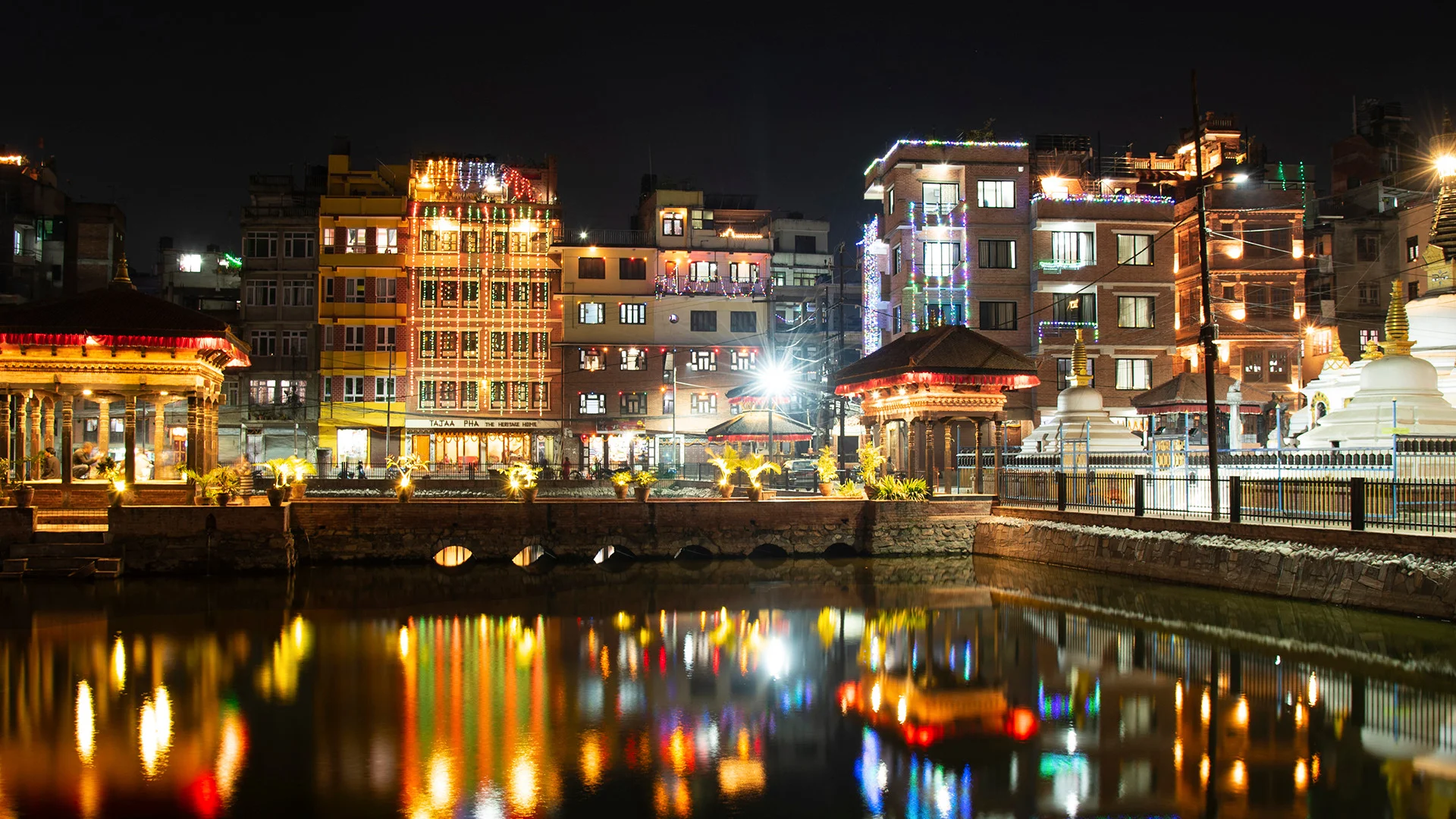
Places to fathom this Tihar
Tihar festival or the festival of Lights is Nepals' second-biggest festival after the Dashain festival. Tihar is considered to be one of the most fun-filled and celebrated festivals in Nepal. And, the festival falls under the best tourist season with the fantastic weather. One can take a tour of the Kathmandu valley and witness the majesty of the city during Tihar.
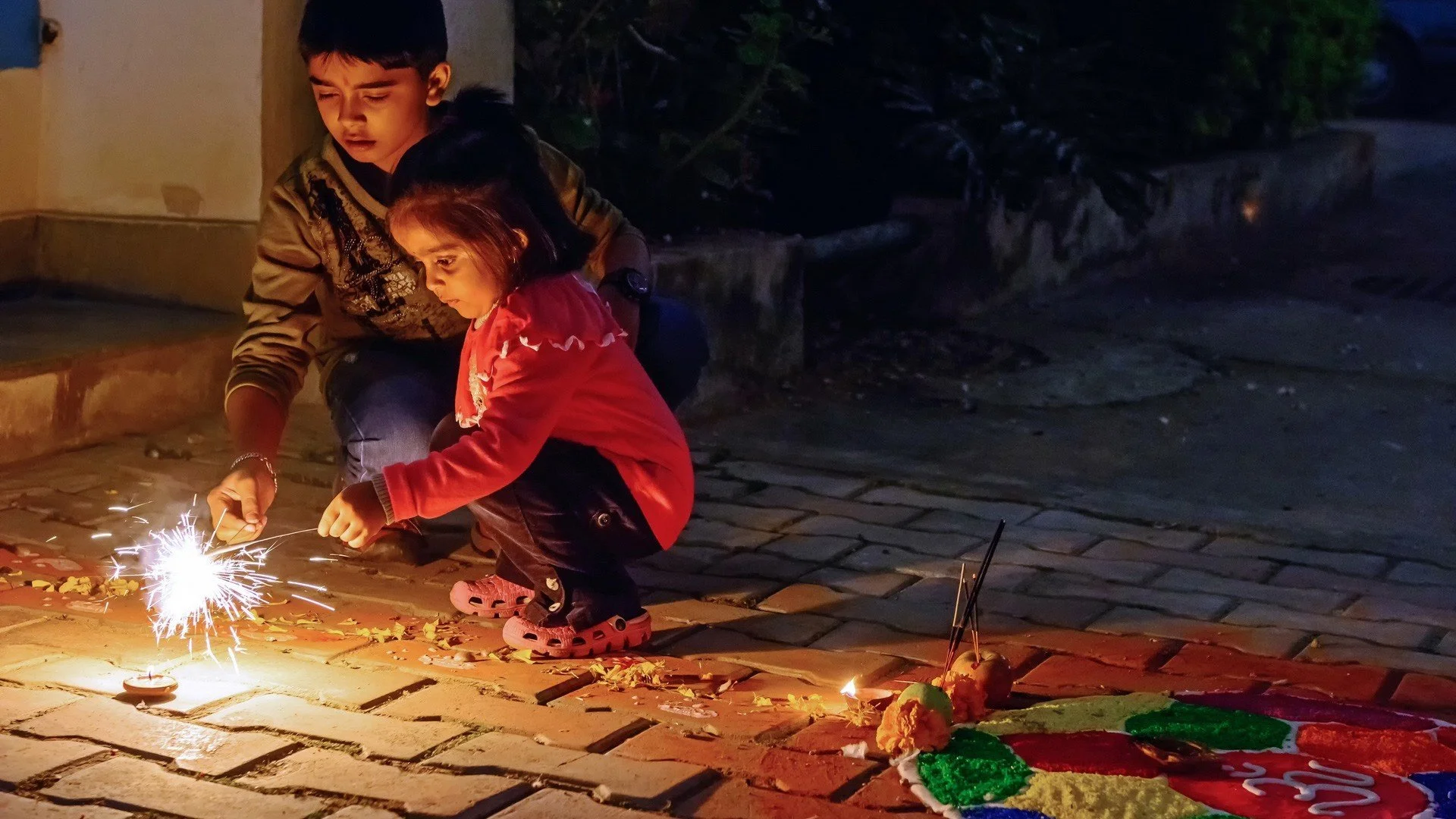
Tihar is also known as Deepawali or Yamapanchak, which is celebrated for a total of five days according to Hindu mythology. Tihar in Newari is known as Swonti which directly follows after Dashain (Mo:ni) and is celebrated in avid fan fair. During when the animals and birds such as crows, cows and dogs are worshipped as avatars of the gods. Households create beautiful Rangoli’s (Mandala) at the porch of homes and light Diyo (Oil Lamps) to welcome the Goddess Laxmi who is believed to be the Goddess of wealth and prosperity.
The five major days of Tihar are Kaag Tihar during when the crow and ravens are worshipped and provided offerings of dishes placed at the roof of homes. Devotees believe that the offerings help avert grief and death in their homes. During the second day, the dogs are worshipped and offered garlands, tika and delicacies acknowledging and cherishing the bond and relation between dogs and humans. The third day is known as Gai Tihar and Laxmi Puja. During the morning of this day, devotees worship the cow (Gai) which signifies prosperity and wealth in Hinduism. In the evening the Goddess Laxmi, the Goddess of wealth is worshipped and thanked for the blessings and benefits bestowed onto the families by offering Diyo (Oil Lamps) in all gateways to the home such as the doors and windows to welcome prosperity and well-being. The fourth day is known as Govardhan Puja, during which the Ox is worshipped according to core Hindu Doctrine. The followers of the sect of Vaishnavism (Lord Vishnu) worship abound of cow dung (Gover) whereas the Newar community on the night celebrate Mha Puja (Self Worship).
The final day of Tihar is known as Bhai Tika or Kija Puja in Newari. It is observed by the sisters applying tika to the forehead of their brothers and placing sacred oil on their forehead and wishing long life and thanking them. According to Hindu Mythology, it is believed that Yamaraj (God of Death), visited his sister Goddess Yamuna on this day. She applied the auspicious tika on his forehead, garlanded him and offered delicacies. Before departing, Yamaraj gave a special gift as a token of his affection and in return Goddess, Yamuna gave him a lovely gift which she had made with her own hands.
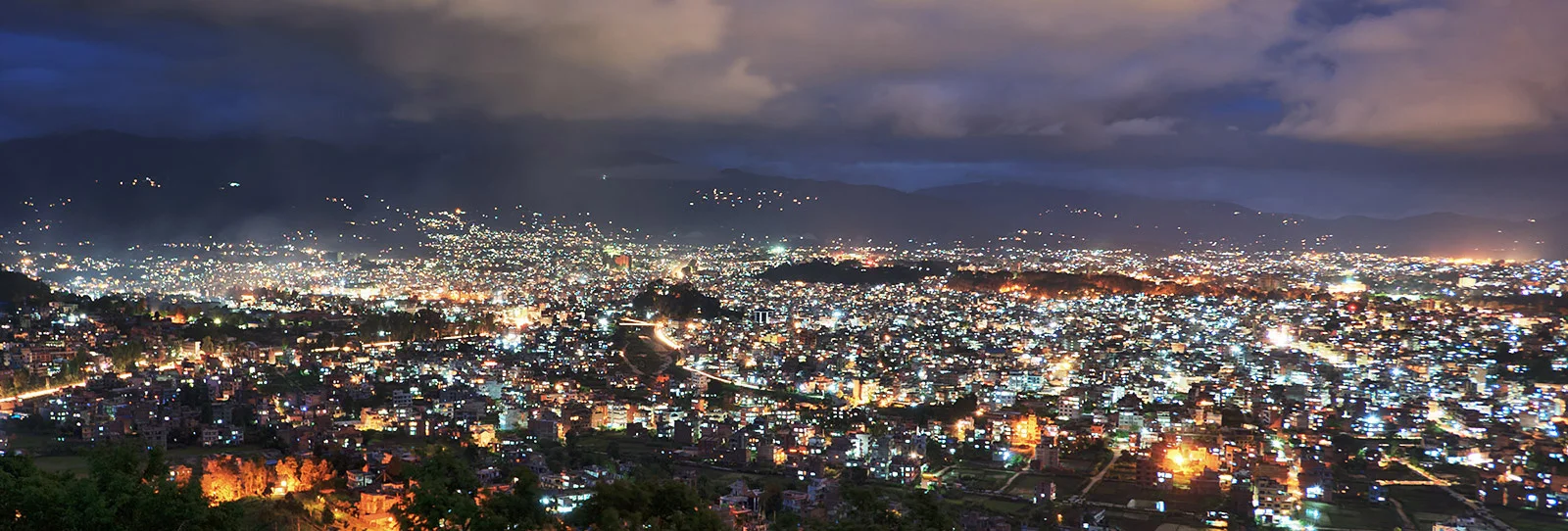
The festivities of Tihar holds many memories for the citizens of Nepal. The festival of lights sees the nation light up with festive lights and the sounds of children playing deusi and bhailo just brights up even the darkest days. Especially in the urban centres like Kathmandu Valley, the majesty of the festival of lights turns the city into an avid display of lights all around. With string lights hanging from the exterior of homes, to do's (butter lamps) placed in and around the houses the totality of the lights in display creates a scene to fathom.
1. A View of Kathmandu from Swayambhunath
The stupa perched at the hill of Padmagiri is a beautiful destination to overlook the valley of Kathmandu and witness the majesty of the city during Tihar. The place offers a beautiful panoramic view of the city which you can enjoy with a cup of tea. As the sun sets the city lights up in all its glory and you get to witness the beauty of the valley.
It is believed that at the ending years of Dwapar Yuga, an Acharya named Santikar who is also known as Sant-Sri saw that the Kali Yuga was approaching, during which mankind would be utterly sinful. So, he covered the light of Swayambhu with stone and built a chaitya and temple over it. Entangled with this same legend is another fascinating the legend, it is believed that Sant Shri who built the chaitya also built 5 rooms surrounding the chaitya named after the 4 elements and one the soul called Santipur, where he locked himself and stayed in the state of divine meditation. He thus entered a mystic state, achieving immortality and vowed to stay in the room and emerge when the valley of Kathmandu truly needed him.
2. The pond of Pim Bahal
The pond of Pim Bahal which is locally known as the Jag Maru Puku ( Pond without a foundation) is a treat hidden inside the beautiful city of Patan ( Lalitpur). Located on the way to Patan Durbar Square, the pond saw great community effort in restoring the pond to its original state after the great earthquake of 2015. The beautiful reflections of the lights of the homes surrounding the pond bring forth a new dimension during the festive season of Tihar. One can enjoy a great stroll at Patan Durbar Square and take a brief walk to the pond, which features several pati’s (Resting Spots) and catch their breath while being surrounded by its cultural magnificence.
3. A Stroll in New Road
The heart of all trade in the city of Kathmandu, the street of New Road during the festive season of Tihar turns into a beautiful display of lights for one to fathom. Stopping at New Road gate and talking a walk through the streets to Kathmandu Durbar Square, is a definite treat to the eyes with all the beautiful dangling lights form homes with the sounds of children playing deusi and bhailo.
4. A Drive in Kathmandu
If you have a rented vehicle then talking a drive through Kathmandu is a must in Tihar. The festivities lighten up the traffic and a drive around the city is a great way to witness the magnanimous display of lights around the city.
5. The Town of Kirtipur
The town of Kirtipur perched at the eastern hill lock is a town rich with Newar culture and heritage. It also offers a beautiful panoramic view of the city of Lalitpur and Kathmandu which are bound to have you tantalized during Tihar. One can experience a great day strolling around the city and experiencing Newari hospitality to the finest and be treated to a beautiful view of the city in the late evening hours.
SIMILAR POSTS
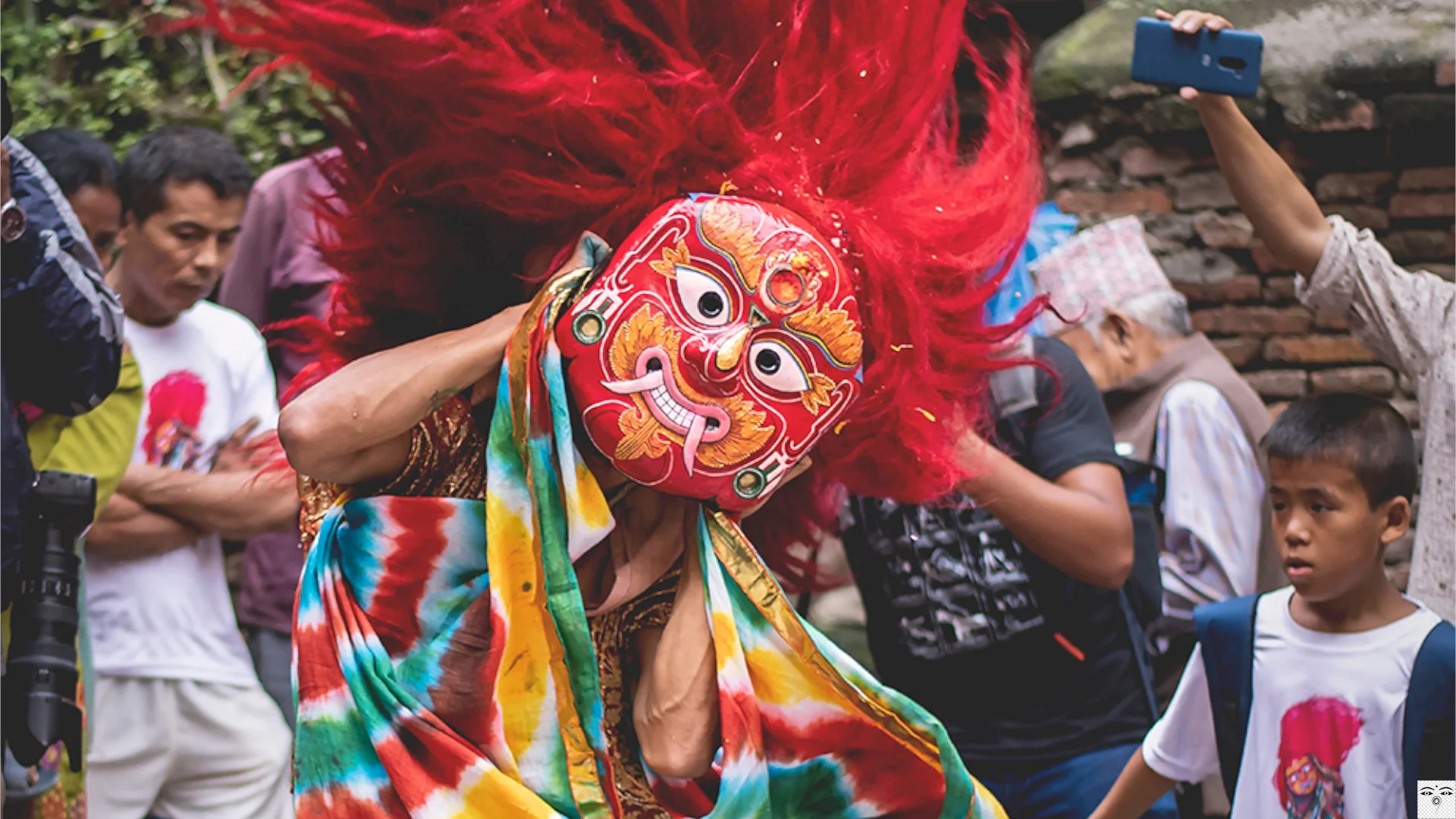
The Legend of Majipa
Majipa Lakhey in Newar mythology is the protective deity of all children in the Valley. During the annual festival of Indra Jatra, the dance of Majipa Lakhey is performed by the clan of Ranjitkars of Kathmandu with a traditional drum (Dhime) and a pair of Bhusya (pair of cymbals) with straps to fasten around the wrists. Devotees during the dance performance try to manage a touch the Lakhey’s rich display to take the blessings.
The celebration of Yenya Punhi, commonly known as Indra Jatra is an amalgamation of numerous festivities.From the dance of Phulakisi ( Indra’s White Elephant), to the chariot procession of the Living Goddess Kumari, along with Lord Ganesh and Bhairav. The spectacular eight days of Indra Jatra, brings together elements from all over the valley of Kathmandu in the unique celebration dedicated to Lord Indra.
Among such great celebrations is the festival of Majipa Lakhey, commonly known as the peace loving Lord Bhairav. As the Indra Dhoj ( Pole of Indra) is erected at Hamuan Dhoka Square, which marks the beginning of Yenya Punhi, the night before an which an auspicious puja is done to evoke the spirit of Majipa Lakhey. The next day the mask of Majipa Lakhey is adorned by a devotee and thus begins the dance of Majipa Lakehy.
In the folklore of the Newar Deities passed on from ages, Lakhey’s are normally considered demon’s who terrorize the people with ill activities. They are normally associated with destruction of farms, stealing children and terrorizing and frightening the citizens. But Majipa Lakhey is the antonym of what we consider a traditional Lakhey. The tales of Majipa Lakhey has been passed down from generations to generations, and with every passing age the love for the deity grows. It is believed that the Lakhey had fallen in love with a girl known as Majipa. Thus, the Lakhey took the form of a human and entered the then Valley Kingdom of Nepal to see his beloved. Majipa later on discovered that the man who she was in love with is a Lakhey, and warned the locals and thus the Lakhey was captured and taken into the Kings Court. The then King after deliberation and careful thought, then made a proposal to the Lakhey, that he will grant him a place in the city if he vows to preserve and protect the children of his kingdom from other demons and participate in the annual Yenya Punhi. The Lakhey agreed to the terms and is believed to have been given residence in the locality of Majipa.
Thus during in the annual Indra Jatra, the dance of Majipa Lakhey is performed by the clan of Ranjitkars of Kathmandu. The dance of Majipa Lakhey is quite unique, unlike other traditional dances which have an essence of Chariya Nritya ( Buddhist Dance Form), or a Bol and Bhaka ( Lyrics recited with Music). The dance of Majipa Lakhey during Indra Jatra features a traditional drum (Dhime) and a pair of Bhusya (pair of cymblas) with straps to fasten around the wrists. The instruments are normally played by the youth of the Ranjitkar clan as well. The Ranjitkars of Majipa tole state that, one does not require to train for the dance of Majipa. It is something that we all have inherited in our genes.
The customary costume of the Lakhey, constitutes of a glorious mask with stunning Abir( Traditional name for red colour). The costume features a traditional red bhoto( blouse)with golden embroidery and a full length skirt. The signature of the Majipa Lakhey is the piece of cloth that is wrapped around and inside the Lakhey’s costume. Coloured in the shades of the rainbow, the cloths ends are griped by the Majipa Lakhey during the dance. This leads to a beautiful display such as of the spreading of the feathers of the peacock. This is normally what the flocks of photographers gathered are normally there to photograph.
During the dance, the Lakhey grips the cloth between his figures and during the dance, the cloth ( dyed with lines of the rainbow) creates a image of wings. Which in association with the sound of the Ghanta ( Bells) worn as a belt bring forth a majestic scene. The dance of Majipa has another interesting character, locally known as Jyalicha( Teasing Child), the muse of Majipa Lakhey. The two in an avid display of cat and mouse tease each other during the dance, chasing in an attempt to capture the child or trick the Lakhey.
The Majipa Lakhey is worshipped by all, devotees try to manage a touch in between the Lakhey’s rich display to take blessings. The dance of Majipa during the Yenja Punhi begins from Majipa Tole, which is taken around the old city routes of Kathmandu. During the main day of Indra Jatra, Majipa Lakhey entertains the crowds of devotees and worshippers who flock to the Durbar Square for the blessings of the Kumari and to witness the chariot festival.
Text By: Shreyashka Vikram Raj Maharjan & Photographed By: Suraj Patrabansha
SIMILAR POSTS
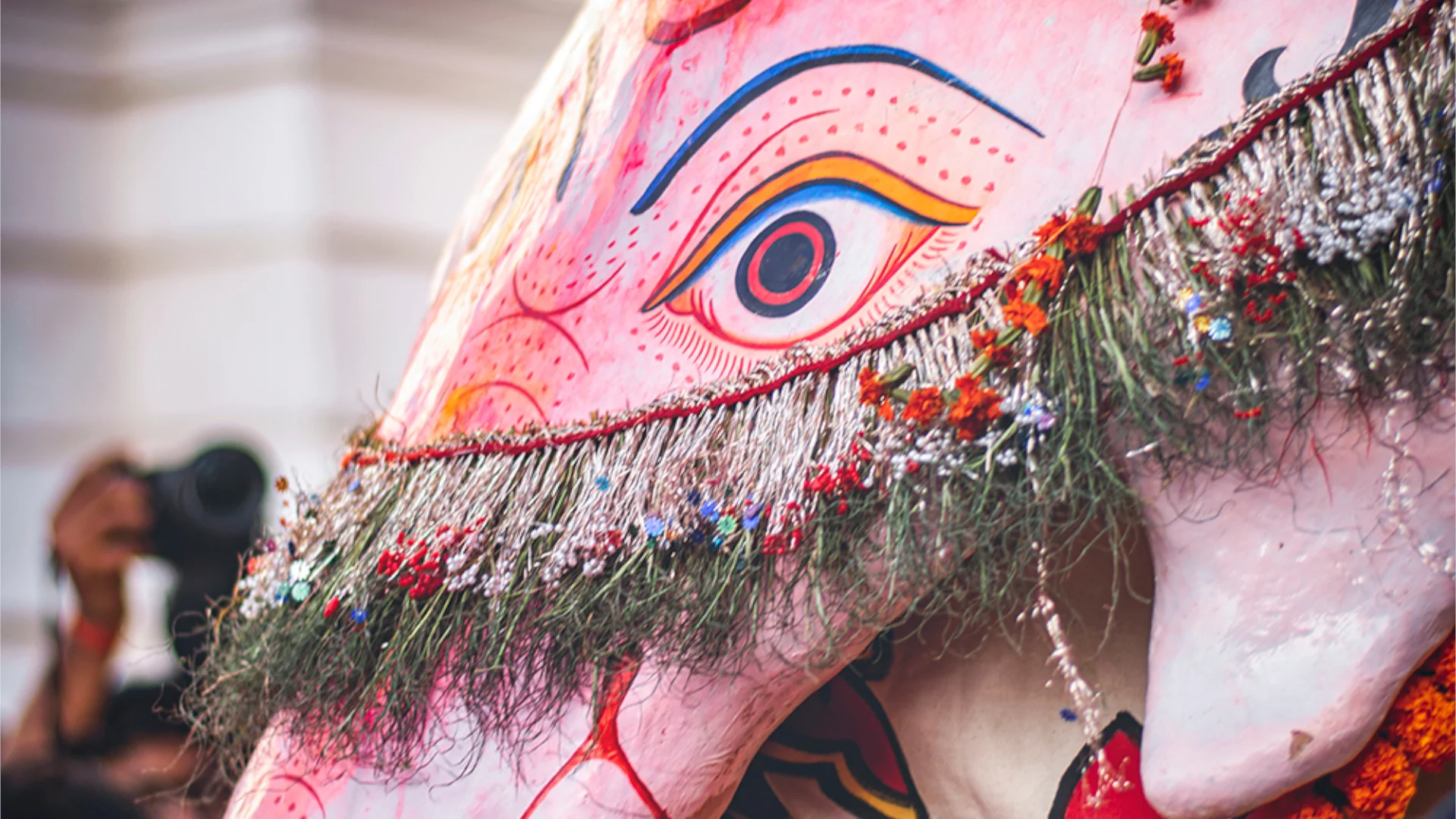
The Festival of Indra
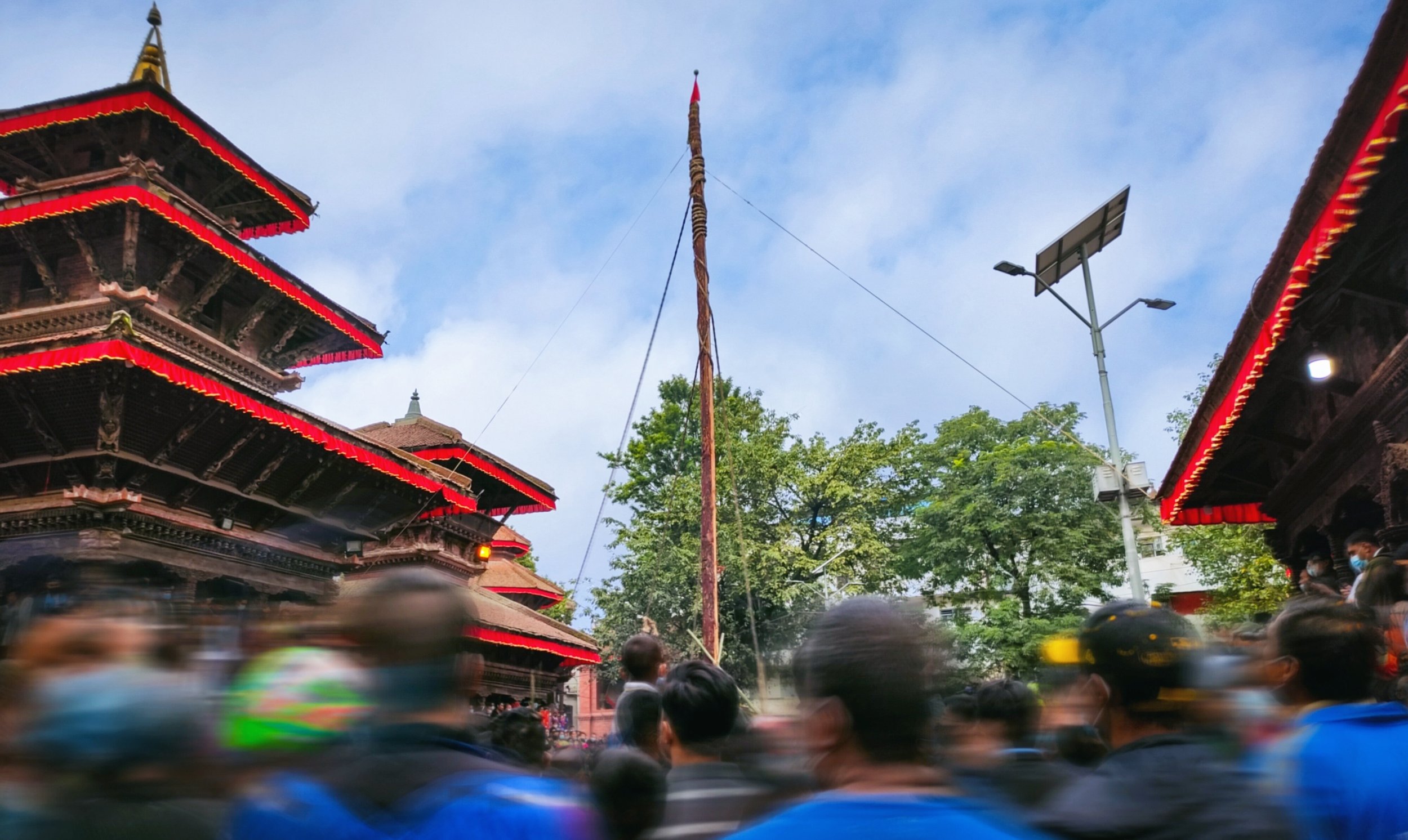
Indra Jatra, one of the highly celebrated street festival in Nepal marks beginning of the festival season and the beginning of a tourist season in Nepal. The festival is celebrated in the oldest town Basantapur Durbar Square or Hanuman Dhoka in Kathmandu by the local community with huge arrangements. The chariot of Kumari, the Living Goddess, is taken out in procession through the streets. People wear masks of various goddess and exhibit by dancing in the streets on music played with traditional musical instruments.
Indra Jatra
With the sound of the marching band, amid the busy hustle of the morning crowd at Basantapur Durbar Square. A group of revellers slowly gathers. As the band plays its final salute, the rope tied to the yahsi(Pole), the revellers muster their strength and in a great cheer, and as the yahsi makes its ascend three muskets are raised high, the Gurkha Paltan fires the aerial salute commencing the festival of Indra.
Regarded as the biggest festival of the then Kingdom of Nepal Valley, the true origin of the festivals are still debated. But this festival is believed to be founded during the Lichhavi Era by King Gunakamadeva, the founder of the city of Kantipur (Kathamandu). The celebration of Indra Jatra is made of three different series of rituals: Kumari Jatra, Indra Jatra and Bhairava Jatra. Each have their own legends and ceremonial components but as a whole, turn the centre of Basantapur Durbar Square into a grand affair. The square is a sight to behold from the break of dawn till midnight, as the chariots of Kumari, Ganesh and Bhairava make there way through the inner city of Kathmandu. Every street comes to life with masked dances, merry music during the eight days of festivities.
According to legends, it is believed that the mother of Lord Indra required a Parijat( a white flower) to perform a ritual. For which Lord Indra descended to earth in search of the flower. He disguised himself as a commoner and while trying to take the flower out of the lawn of a Jyapu(Farmer). He caught Lord Indra and held him captive blaming him of trying to steal. Lord Indra was imprisoned and not allowed to go back to heaven.
The mother of Indra grew worry some as her son hadn’t returned from Earth. Phul Khusi(The Vahan of Indra) descended upon Earth to find his master and wondered around the streets of Kathmandu. During when a great festival was occurring in the Kathmandu and after hours of searching, Phul Khusi found Lord Indra. Phul Khusi took the news to heaven after which, his mother descended from heaven to free her son. She requested the villagers to release her son, but didn’t heed to her words. Only after Lord Indra reveled his true form. The mother of Indra made a promise to the villagers to give in return a final rainfall for their harvest to prosper and she would lead them to the gateway to heaven.
Accepting the conditions the villagers freed Lord Indra and let him go with his mother, a group of villagers followed them to the outskirts of Kathmandu to find the doorway to heaven. But Lord Indra’s mother tricked the villagers by putting forth a large mist which left the villagers confused and in dismay as Lord Indra and his mother went to heaven. To commemorate this event, during the celebration of Indra, a Dagi (Procession) takes the same path every single year. “The circumambulation of the city is performed in order to reach heaven in the Dagi’s footsteps to meet the dead relatives. The families scatter grain by the wayside so that they would not forget the way home. One finished, they throw what remains of there offerings in a place called Bhuta Satta, near Kasthamandap, and wash their faces at Maru Hiti fountain. Afterwards, they either return home or go to bathe in Indra’s Pond ( Yamki Da), which is located on a hill 12 kilometers west of Kathmandu.
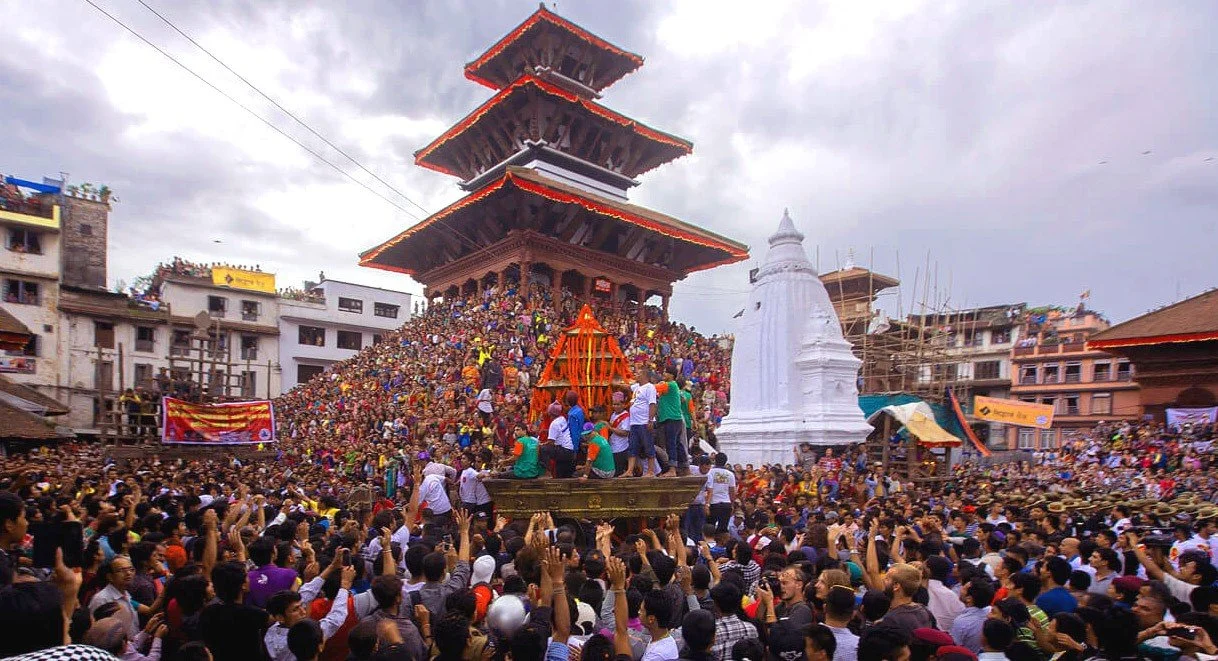
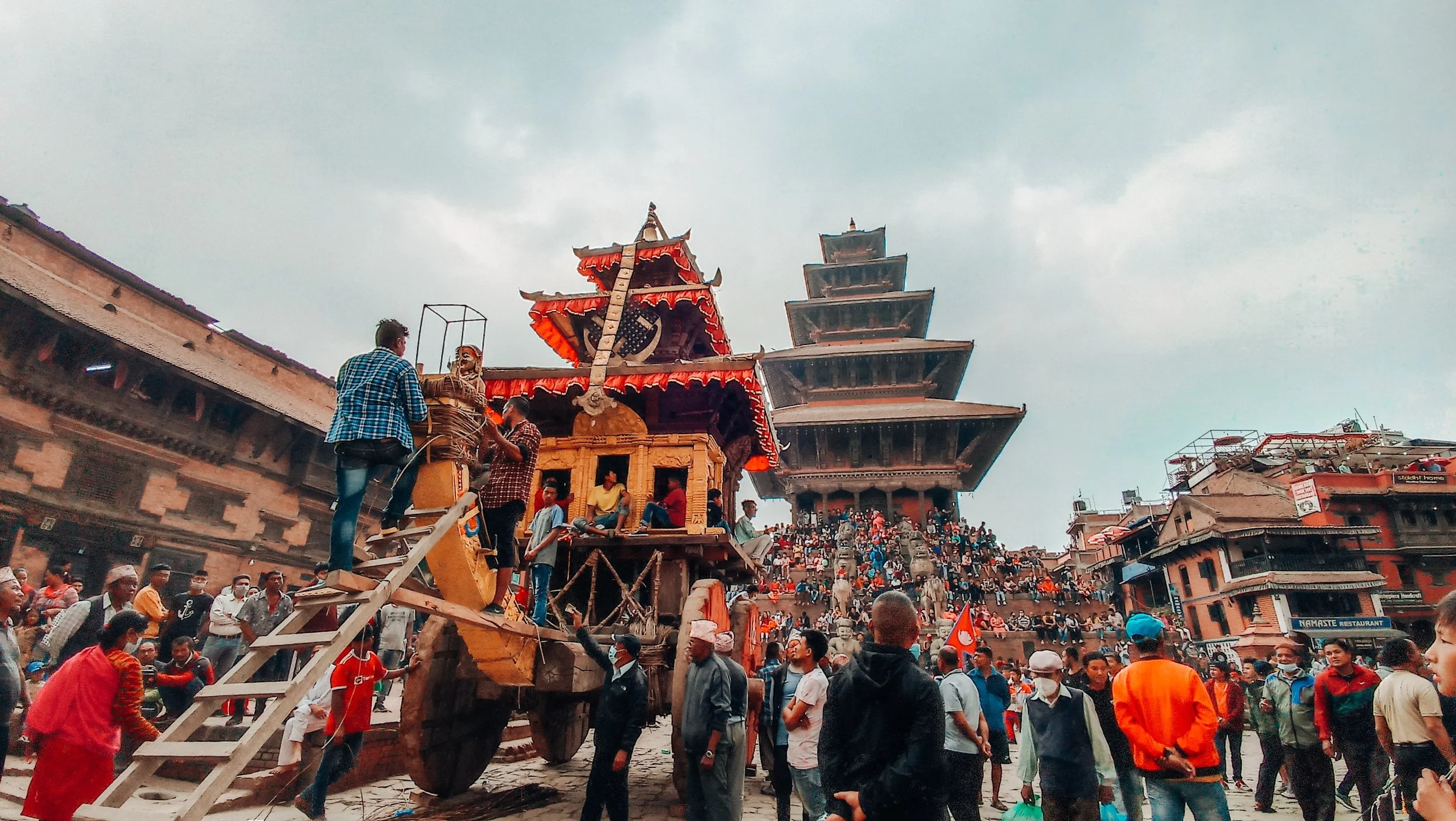
The festival of Indra Jatra is a feast to all senses, the air is scented with the smell of incense, and the sound of drums and traditional instruments tranquil once ears. For the eyes, one can behold the procession of Living Goddess Kumari along with Lord Ganesh and Lord Bhairav. The chariot is pulled for three consecutive days. The first day is known as Kwaneya during when the chariot makes its way from Basantapur, Maru, Chikanmugal, Jasidewal, Lagan, Bhimsensthan, Baru and ends at Basantapur. The second day is known as Yenya Punhi on which the chariot procession begins from Basantapur to Pyaphal, Nyata, Tengal, Nhyaokha, Nhaikan Tol, Asan, Kel Tol, Indra Chowk, Makhan and ends at Basantapur. The final day of the procession is known as Nanichaya, the chariot is pulled by revellers from Basantapur to Pyaphal, Yatkha, Nyata, Kilagal, Bhedsing, Indra Chowk, Makhan and ends at Basantapur.
During the festival of Indra, various idols and masks of goddess are taken out of their normal abode to be exhibited to the people. The most prominent of which are the Sweta Bhairab mask and the idol of Akash Bhairab. Similarly an image of Indra is displayed at Maru and Indra Chowk. Various forms of dances such as of Lakhe Aju, Mahakali Naach, Halchowk Bhairab, Phul Khushi, Devi Kyakhan are performed on specific days and nights of the festival.
SIMILAR POSTS
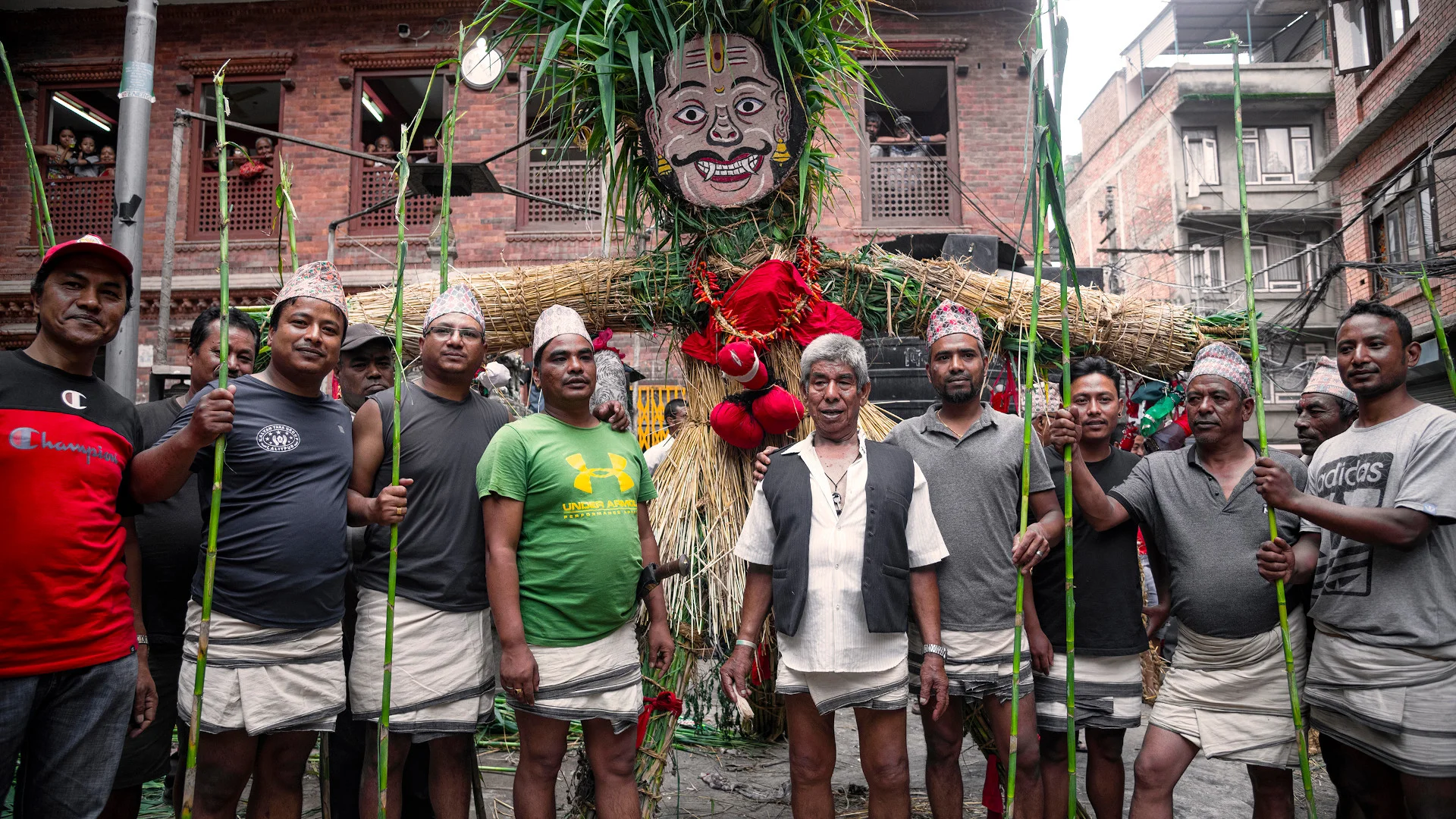
The Tales of Gatha Muga
A unique festival celebrated by the Newar communities in Nepal, Gatha-Muga or Gathe-Mangal is an ancient festival celebrated to chase away the evil spirit and usher the good fortune every year on Shrawan Shukla Chaturdashi of the lunar calendar.
On Shrawan Shukla Chaturdashi of the lunar calendar, a unique festival is celebrated by the Newar community. The festival has many names, but in the common tongue is known as Ghantakarna, but various Newar settlements call it with a different name. In the city of Bhaktapur, it is called Gatha Muga, whereas in Kathmandu and Lalitpur it's called Gathe-Mangal.
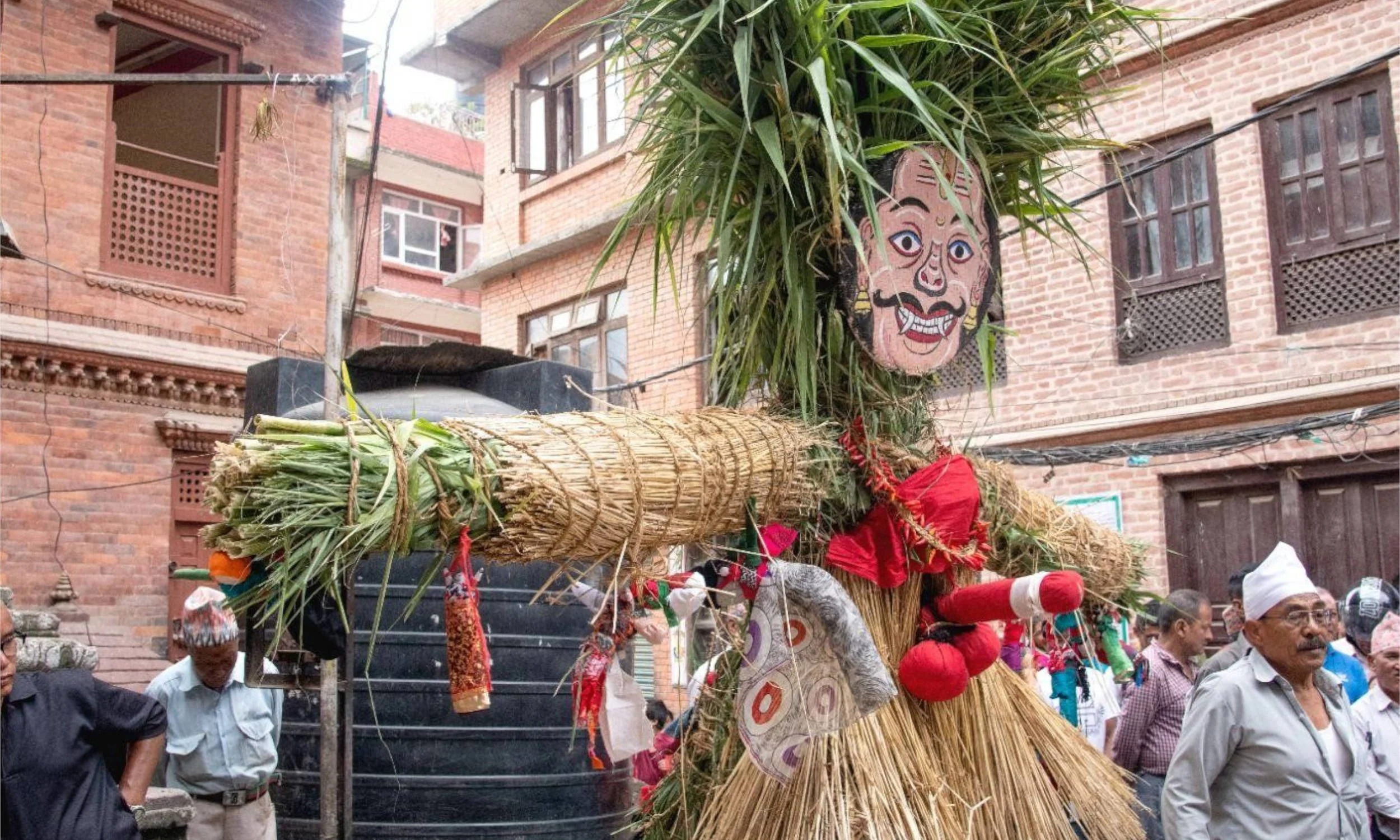
Each name aspired from a different legend which shared closer bonds with certain religions. The commonly used name of Ghantakarna refers to an ancient South Asian Raksasa (demon) who according to Mary Anderson, “Was so corrupt that he vilified the gods themselves, defiled and destroyed homes and fields, roaming the land, stealing children, maiming the weak, killing and devouring his captives. His depraved sexual orgies and unspeakable excesses with his countless wives horrified the pious people”(1971,72). Locally Ghanta refers to bells whereas Karna is ears thus during the festival effigies of the demon Ghantakarna are made out of bundles of straws from the old harvest and large ears are named from either leaves or local sieves( nanglo’s).
In Bhaktapur however, the festival is known from a completely different name and has a different legend associated with it. “Gatha Muga: was a man who believed in karma, and not in the power of gods. He loved the poor people and sat at the crossroads where he took money from the rich to give to the poor. If the rich people refused to give money to him for this purpose, he would kill them. He also lived without concern about pollution. As he lay dying he hung bells on his ears, so as not to hear the gods’ names called out. After his death, as he was not associated with any religion, no one was willing to cremate him, and his body was left at a crossroad. But then people joined together to donate money for his cremation, and they called a low caste man to perform it. Many people followed this procession because he had always protected the ordinary people.” Levy,1990, p.520
Personally photographing this festival, I have to say the most elaborate festivities are done in Bhaktapur. Where the effigies of Gatha Muga at times tower higher than eight feet, with great attention to detail. Each neighborhood constructs own representation and at times, it’s like a competition for the size, complexity, and elegance. Primarily made of bundles of straws it is masked and painted with fangs. Some go even further to dress the effigies, but none miss placing bells on the ears and placing a phallus, and two circular fruits representing testicles. Many historians and scholars have stated how the festivities and its representations were used to make the people aware of sex education. Such can be seen in the tudals (struts) as well, as during that era there was no form of formal education and due to the conservative nature, parents normally didn’t pass the knowledge to their children. Thus festivals were used as a medium to make the younger generation aware of the elements of reproduction.
In the cities of Kathmandu and Lalitpur, the common legend which even I grew up associating with the festival is of how the farmers during the season of the plantation, took help from the evil spirits and demons to plant their fields. A task which took farmer days was completed by the demons in a matter of hours. The demons needed a lot of food and the farmers realized that they would not be able them throughout the year. Demons began becoming hungry and wreaked havoc, destroying houses, stealing children and destroying farms. Thus, the farmers had enough and collectively chased the ghosts down to the river and they were never seen again. During this day, I remember huge iron nails being hammered down in the main door of our old house. The years and years of nails accumulated had now become a huge hump. Thus, to symbolize the day it is believed that Gathe Mangal is celebrated.
The legends surrounding the festival of Ghatakarna might differ in various settlements but the end of these brightly painted is the same in all. It is known as Bha Kayegu which refers to processions accompanied by shouting victorious phrases. As the sun sets, these effigies are dragged, beaten and taken to the nearest river to have them burnt. Procession goers wash their faces and eyes in the river for purification and bundles of straws are burnt in the crossroads to purify it of evil spirits and demons. In some neighborhoods, a communal feast is prepared to celebrate the day.
SIMILAR POSTS
Mataya: A Journey of Light
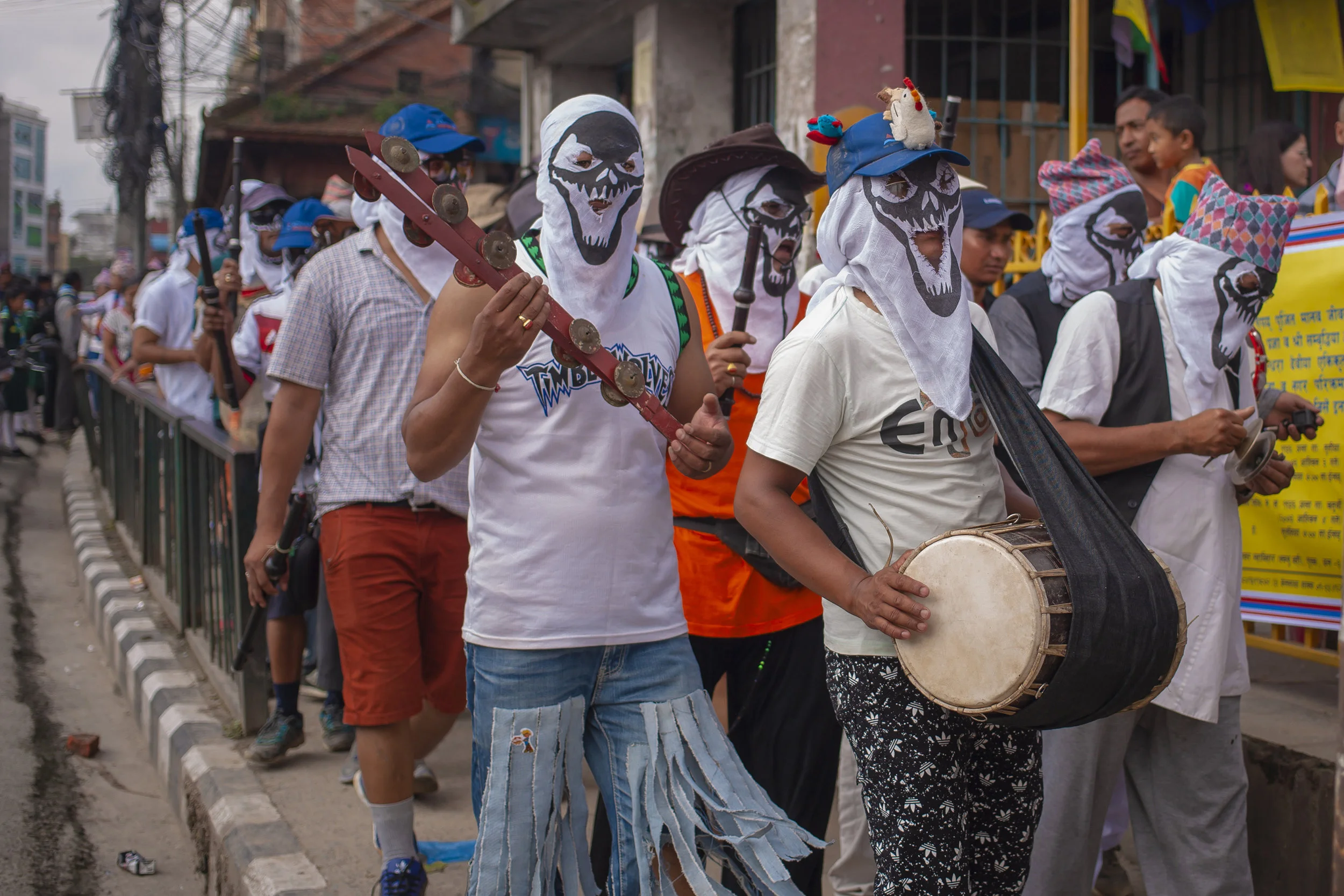
The festival of Mataya is one of the most important festivals in the Newar community in Patan. A unique Buddhist festival, during when men and women in a comical attire carrying candles and torches, traditional musicians playing merry rhythms walk to almost all the temples, stupas and monasteries in and around the old city of Lalitpur.
It was a very early morning, and my mother woke me up to show me something magnificent. I was still half asleep as she pulled me out of bed and took me to the lachi(Square) at Pulchowk. As we reached the square, I remember a huge crowd had amassed. For a child I couldn’t conjure up why they had gathered.
A few moments later, still sleepy I heard an unfamiliar sound approaching towards us. It was the sounds of paujus (anklets). As the beautiful steps got closer the traditional tunes of dheme drumed in the distance. In a split second, I saw this long procession heading towards us. I wasn’t asleep anymore I was wide wake with excitement. I saw these gentlemen clad in daura and women in the traditional Haku Patasi( Newari Dress) and what followed had me smiling and laughing. Men and women dressed up in my then, little vocabulary weird and funny. Men with masks, some dressed as women,some as gods and some in a crazy mix of all. I asked my mother, “ What is this?” and she looked at me and said, this is Mataya. The next thing I remember I saw this man running towards me who had this crazy mask on, and I being the child ran as fast as I could.
The festival of Mataya also known as Neyaku Jatra, is one of the most important festivals in the Newar community in Patan. Mata in Newari means light and ya means a scared journey. Celebrated normally in the month of August in the Gregorian calendar. It is celebrated the day after, the auspicious festival of Gai Jatra. This year Matya shall be celebrated on 17th of August 2019. It is believed that the festival of Mataya was established the Lichhavi King Gunakamadeva, who is also believed to have been the King who founded the city of Kantipur( Kathmandu).(Wright, 1877, 155)
The festival of Mataya is a unique Buddhist festival, during when individuals walk to almost all the temples, stupas and monasteries in and around the old city of Lalitpur. The festival every year amasses an attendance of thousands with individuals carrying candles and torches, traditional musicians playing merry rhythms and men and women who dress in comical attire.
According to Min Bahadur Shakya, Director- Nagarjuna Institute of Exact Methods,” The preparation for Mataya begins on the first day of Gunla. After mid-night on this day a group of hundred people with nava bajan( traditional Newari instrument) gather and follow the exact path that they are to follow on the day of Mataya. They don’t finish the whole route on a single go, but gather every night for the upcoming days and mark the shrines and courtyards with vermilion, husked rice and coins as they pass by. This event is called Bogiwonegu(To Give Offering). During the day of Matya individuals gather at the lead locality from where Matya is to begin and start their journey. They walk the entire route in one day, and some choose to make the journey bare foot. They offer their prayers at the shrines marked and present offerings.”
Members of family stay show their support by offering them refreshments and various communities place stalls to offer water and refreshments to the attendees. It is roughly estimated that the devotees visit 1400, 1500 local and private shrines during Matya.
According to a local legend, it is believed that once Sakya Muni Gautam was in deep penance to attain Nirvana when the jealous Maras came to distract him. They had disguised themselves in various forms and some were in the form of fierce looking demons while some were beautiful damsels. They tried to tempt the muni but he overcame the Maras and achieved Nirvana. It is also believed that the Maras later came to Lord Buddha and confessed their sins and worshiped the lord.
For this years edition of Mataya, it is being organized by Haku Bahal Tole which is west from the cross roads of Patan Durbar Square. The festival shall normally begins before the crack of dawn at around 4 AM and make their way to the shrines marked during Bogiwonegu. It is a beautiful sight to behold, with merry music, comical dancers, and the energy is exhilarating.
SIMILAR POSTS
The Legend of Bhoto Jatra
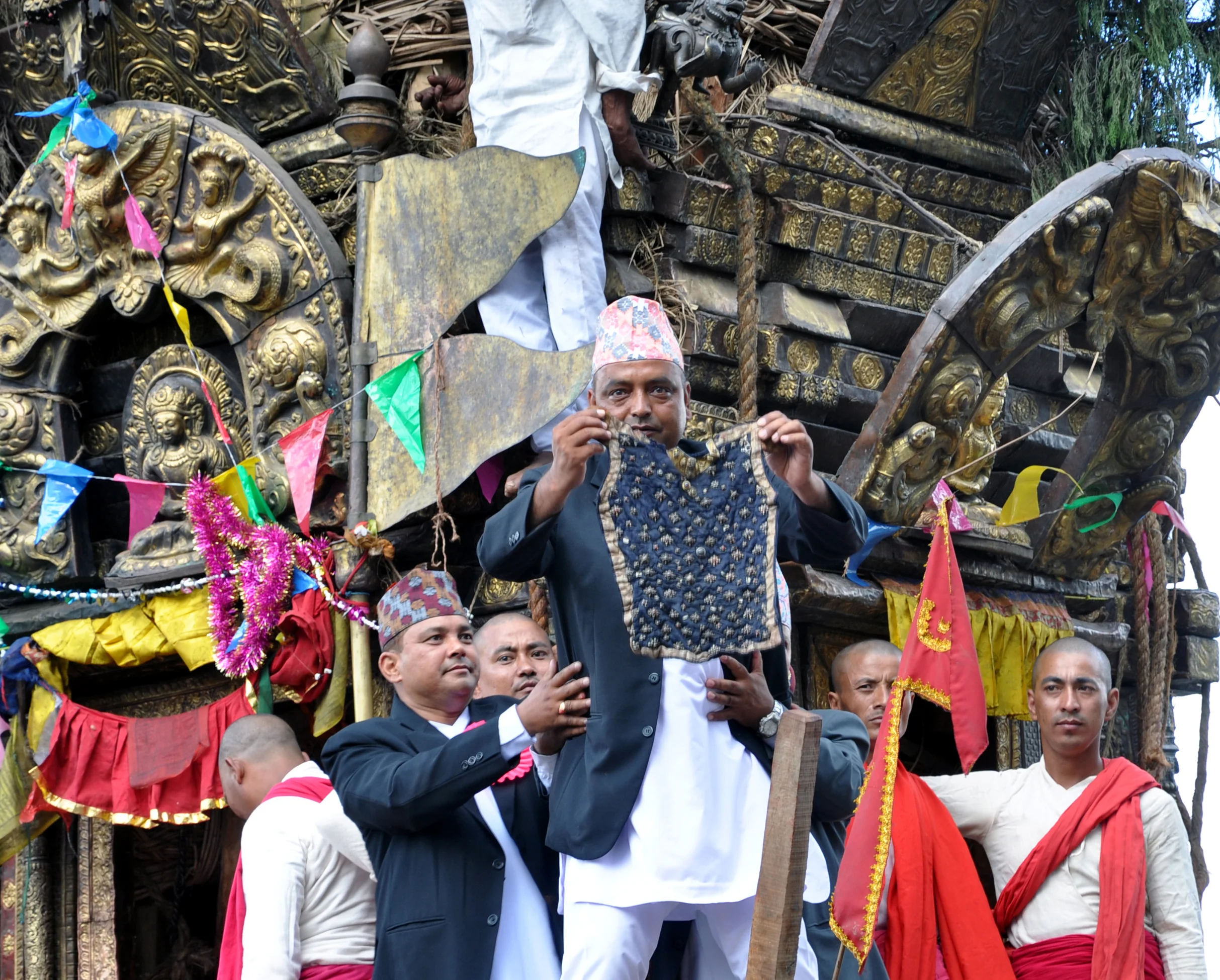
The legend of a jewel-studded vest (Bhoto) that came into possession of a priest when no one came to claim with evidence to whom it belongs. Today, the same Bhoto is displayed ending the month-long celebration of Rato Matsyendranath Festival in Lalitpur. And it is said, Bhoto is shown every year to the public as of an announcement to claim for it.
The annual festival of Rato Matayendranath, dubbed the longest chariot festival is the world is drawn to a close with the infamous bhoto jatra. The chariot begins its journey after the construction of the chariot, which is when pulled by revellers through the ancient roads of the city of Lalitpur.
Once the chariot festival reaches its final destination in the Jawalakhel, where it is placed for four days for religious observance. The bhoto is shown to a to the crowd, which is believed to rid all those who see it of there sins. It draws a large crowd, with from dignitaries to layman, from all over Nepal.
"According to legends, one day a Baid (Physician) of King Harisinha - deva of the Lichavi Dynastyc was preparing to bathe in the water at the junction of Bagmati and Bishnumati. When he was accosted by the King of Snakes (Karkotak) who in the form of a Brahman(Priest) was seeking for a Baid to cure a malady with which his Rani’s (Queen) eyes were affected. The King being satisfied with the physician entreated him to go to his house and see a patient. The Baid, after finishing his ceremonies and bathing, went with the Brahman. They arrived at a pond, at the south-western corner (of the valley of Kathmandu), a thousand bow shots beyond Chaubahal(Chabahil). The pond was so deep, and the water so black, that it was frightful to look at. It was shaded by trees, large fish played in it and it was covered with waterfowl. The King told the Baid to shut his eyes, and in a moment he jumped with him into the water, and they arrived at the Durbar (court) of the Nag-raj ( Snake King) in Patalpuri. The walls of the palace were of gold. The windows of diamond, the ragters and beams of sapphire, the pillars of topaz adorned with rubies. The darkness of the subterranean palace was dispelled by the light emanating from large jewels in the heads of the Nagas. They entered the palace, and saw the Nagini, sitting on a throne studded with jewels of several sorts, shaded with three umbrellas of white diamonds, one above the other and surrounded by beautiful Naginis. King Karkotak assuming his proper form, took the Baid by the hand, and gave him a seat near the throne. He himself mounted the throne, and showed the patient to the Baid. The Baid, having examined her eyes, took out a drug from a bad which he carried at his waist, and having rubbed it on a clean stone, applied it to the eyes which were instantly cured. King Karkotak gave the Baid a handsome present and a dress of honour, and having expressed his gratitude, made him a promises that his descendants would be good curers of eye- diseases. The descendants of the Baid, accordingly, were renowned as a good eye doctors Hari-sinha - deva, having been made acquainted placed to reside in, near Sesha Narayana ( On route to Chobar)." Wright, 1877, 178-179
The Baid wore the vest at all times but one day, while he was working in his farm he got very hot and took off the Bhoto and placed it down. At that moment, a ghost stole the Bhoto which bestowed its wearers great strength reeked havoc to the citizens of Patan. During the final day of the chariot festival of Rato Matayendranath, the ghost was causing trouble which attracted a huge crowd. The Baid heard the commotion and went to see what was happening and was shocked to see it wearing the bhoto. He immediately began to quarrel with the ghost stating that the bhoto was his property and that it was given to him by King Karkotak. As they quarrelled they were suggested to take it up to the King and Lord Karunamaya.
The King gave each a chance to prove that the bhoto was their possession but, both failed to show substancial proof. Thus the King decided that, until the rightful owner of the bhoto comes back with proof that it belongs to them. It would remain under the protection of Lord Karunamaya and it would go where ever he went. And every year the bhoto would be shown to the onlookers after the chariot reaches Jawalakhel, when one could contest for the bhoto.
Till this day, after the chariot of Karunamaya (Rato Matsyendranath) reaches Jawalakhel and on the fourth day. The bhoto which is kept with Karunamaya, is unsealed and shown to the onlookers. Devotees from around the country come to bare witness the Bhoto, which is believed to rid its onlookers of all sin.
After the ceremony the bhoto is resealed with a lal mohar (Red Stamp) and taken to a safe undisclosed location by the Guthi of Karunamaya.
Similar Posts
Kartik Naach : An Archaic form of story telling
This particular act carries a message that anyone who tries to do ill and harm others, s/he is punished and no one escapes justice. A story of a powerful demon king had a son. The son refused to acknowledge his father as supreme lord of the universe and claimed that Lord Vishnu was all omnipresent
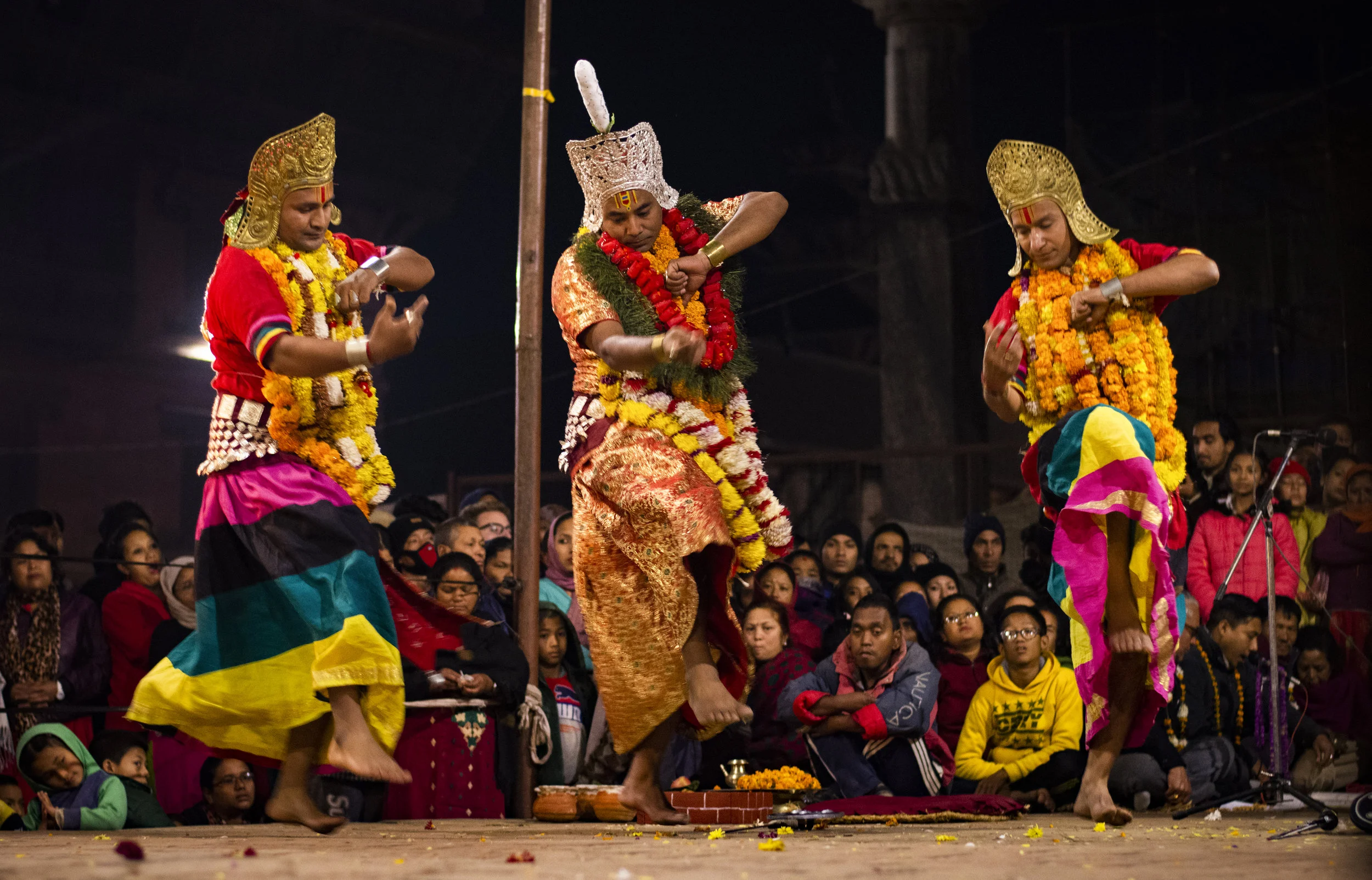
Dubbed the longest Naach(Dance) in the world "Kartik Naach" has been entertaining the crowds that gather in Kartik Dabali on the chilly nights of Autumn for more than 376 years. Siddhi Narsingh Malla, staged the first ever performance in 1641 AD (1728 B.S). During his era, Kartik Naach lasted for 15 days which was extended to 25 days by his son Srinivasa Malla and to 27 days by his grandson Yog Narendra Malla. But nowadays, due to lack of proper funding it is only performed for 10 or 12 days according to the astronomical charts.
This dance has faced many hurdles and obstacles such as during the revolution of 2007 B.S(1950 AD), the dance was only performed for two days. Before which it was performed for the complete 27 days, only two acts were shown till 2037 B.S the dance of "Barahi and Narasimha". In 2048 B.S (1990 AD) the dance was lengthened to 8 days with the help of different groups and individuals. In 2070 B.S(2013 AD), two more days were added and again in 2071 B.S (2014AD) it was extended to a 12 days.
The main crowd puller is on Kartik Krishna Pakshya Trayodashi Tithi, when the Narasimha avatar is staged where Narasimha an incarnation of Lord Bishnu who is part a fiery lion with the body of a human kills the demon Hiranyakashyapu. This particular act carries a message that anyone who tries to do ill and harm others, s/he is punished and no one escapes justice. According to Bhagwat Purana, Hiranyakashyapu was a powerful demon king and had a son Pralhad. The son refused to acknowledge his father as supreme lord of the universe and claimed that Bishnu was all omnipresent and described the benevolence of the deity. The demon king became angry and tried to kill the son. All his efforts went in vain. One evening Hiranyakashyapu asked his son if his god was there in the pillar. Upon hitting the pillar, out came Narasimha, an incarnation of Bishnu, in the form of half-man and half-animal. The deity then killed the demon with his nails keeping him in his lap, standing on the threshold at dusk.
This year, it shall be staged on 2nd of November ( 16th of Kartik). Kartik Naach as 11 more acts this year which started form 24th of October with the act of Sudhama and shall end on 4th of November with the Act of Dadhi Leela.
A Brief History
During the reign of Siddhi Narsingh Malla, relating the legend, a great misfortune befell on the land. It was as if the city had lost its luster. No amount of pujas and yagyas seemed to restore the original splendor of the city. Downhearted, the king consulted with his learned gurus. They advised him to invoke Narasimha, the ferocious, wrathful and blood thirsty incarnation of Bishnu, to help him solve the problem. But there was a catch—invoking Narasimha to his aid demanded a hefty price—narbali, the ritual sacrifice of a man, which had to be performed annually, without fail.
The King was skeptical. Surely, none would gladly put their life on the line, not even for the Gods. His gurus, Haribansha Rajopdhayay and Bishwanath Rajopdhayay, suggested an alternative , one that would avert disaster and, most importantly, spill no innocent blood. They would invoke the gods through Tantrik means, with strong spells, a form of symbolic narbali.
A brilliant idea struck the king; to stage a play. The play would symbolically offer the gods their desired narbali, it would be a good education for the people. He wrote the complete play by himself . The theme revolves around Narasimha, the wrathful god, who was called forth to divert the disaster.
Times have changed, since the golden era of the Malla Kings were spells and magic averted and lifted misfortune, Nepal is in a tunnel of transition from a traditional to a modern society. During the struggle for economic and individuals prosperity, we have lost allot of valuable historic traditions, rituals, culture and literature. The rise of globalization and technology has changed the way we view the world and western influence has charmed us with its appeal. Which is leading us to a complete white wash of our cultural identity, archaic traditions like the Kartik Naach are in much need of the peoples attention and support as this is not just a dance , but a peak into the culture and history of the people of then Nepal.