The Festival of Rato Matsyendranath
The legend of a giant chariot festival began with the Kingdom that drought for years causing misfortune and chaos as a result of disrespect to Gorakhnath. And, how Matsyendranath through devout and prayer, guru of Gorakhnath protected the valley with rain for the harvest, pulling the chariot and celebrating the coming of Lord Karunamaya.
Rato Matsyendranath Festival in Nepal
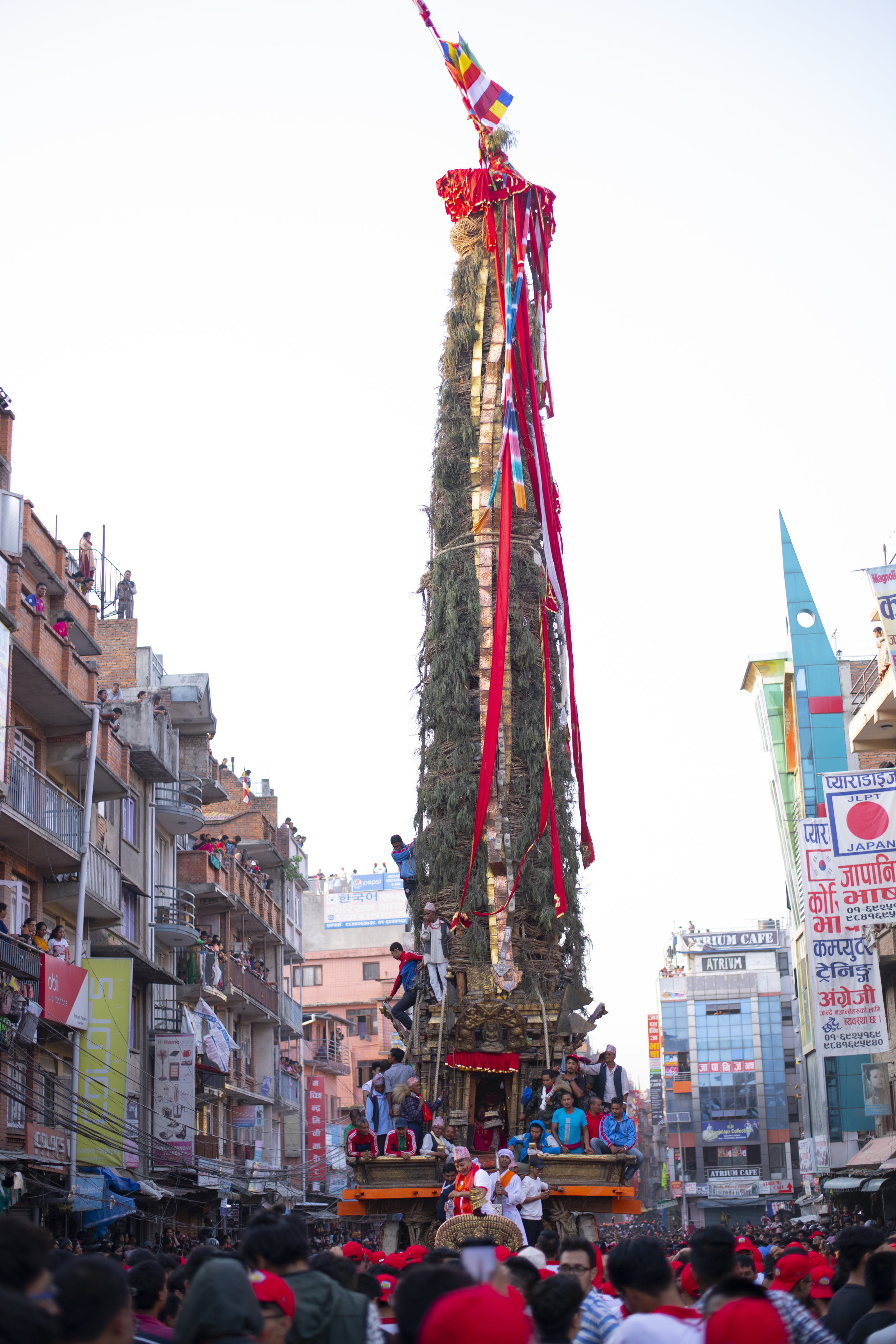
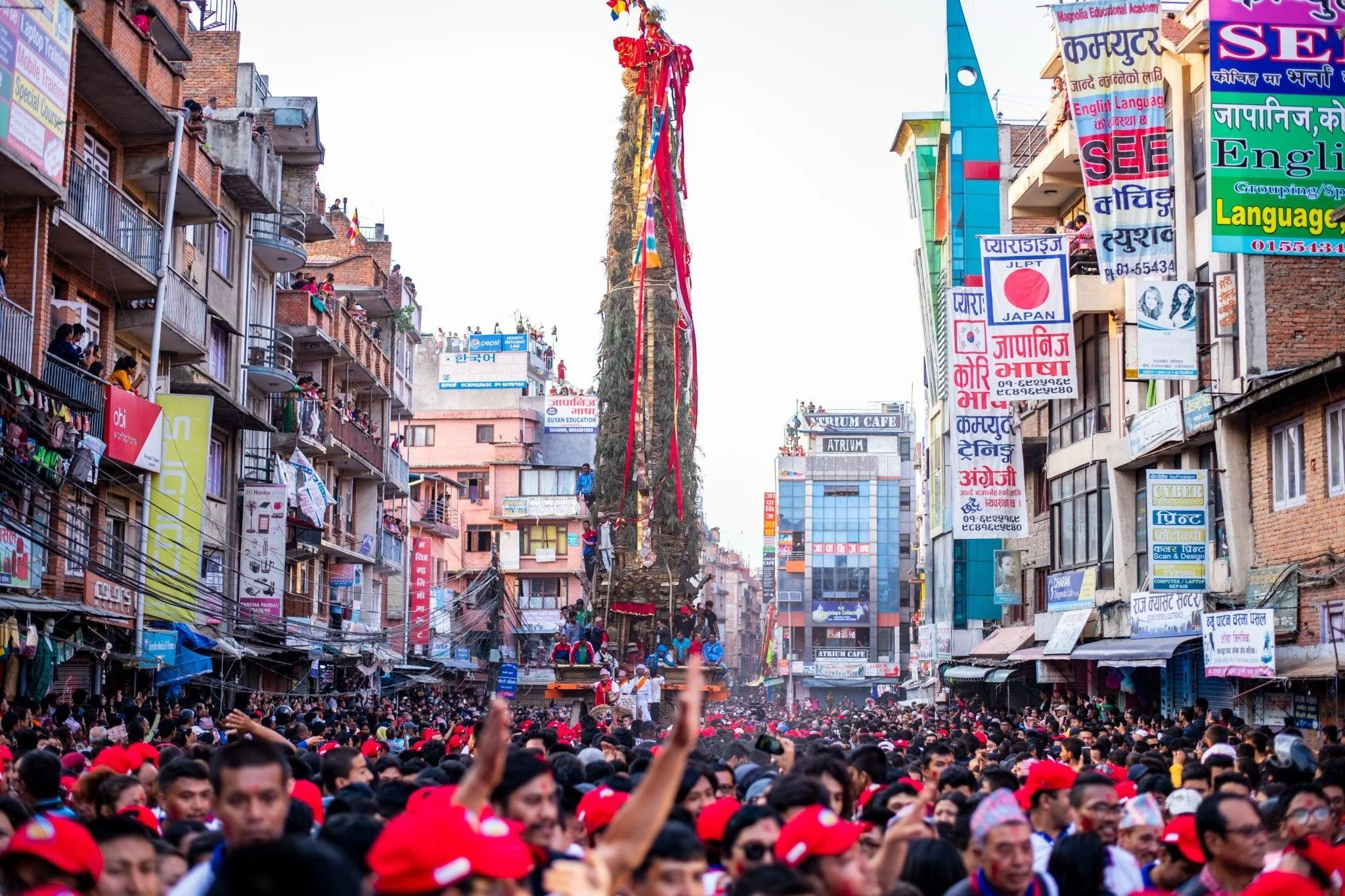
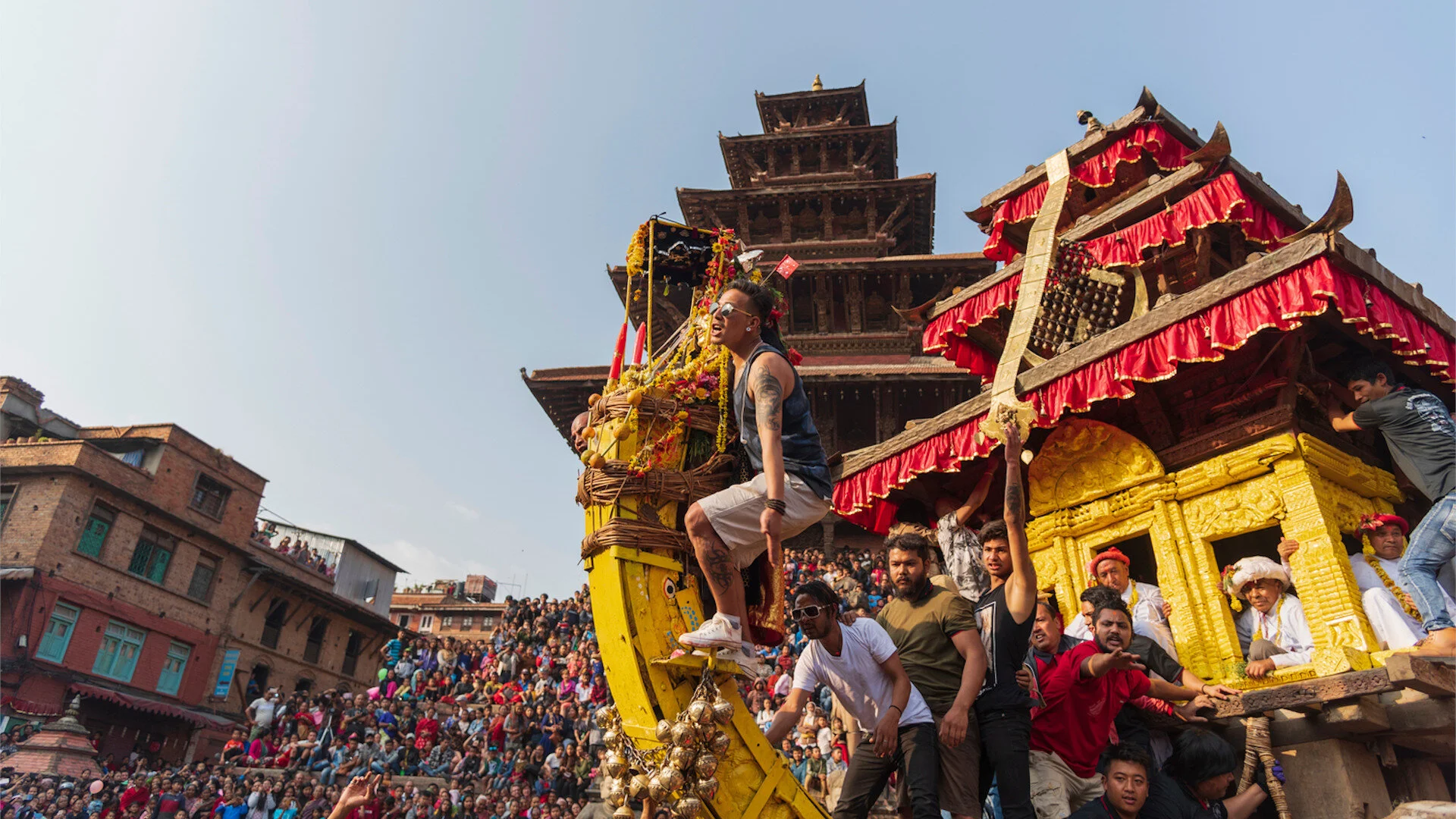
As you look up at the pinnacle you can't help but marvel at the feat of architecture that is achieved every single year. You can't help but fathom and hold a breath when the revellers put all their hearts and strength to pulling the chariot to the words of, "Haste Haiste."
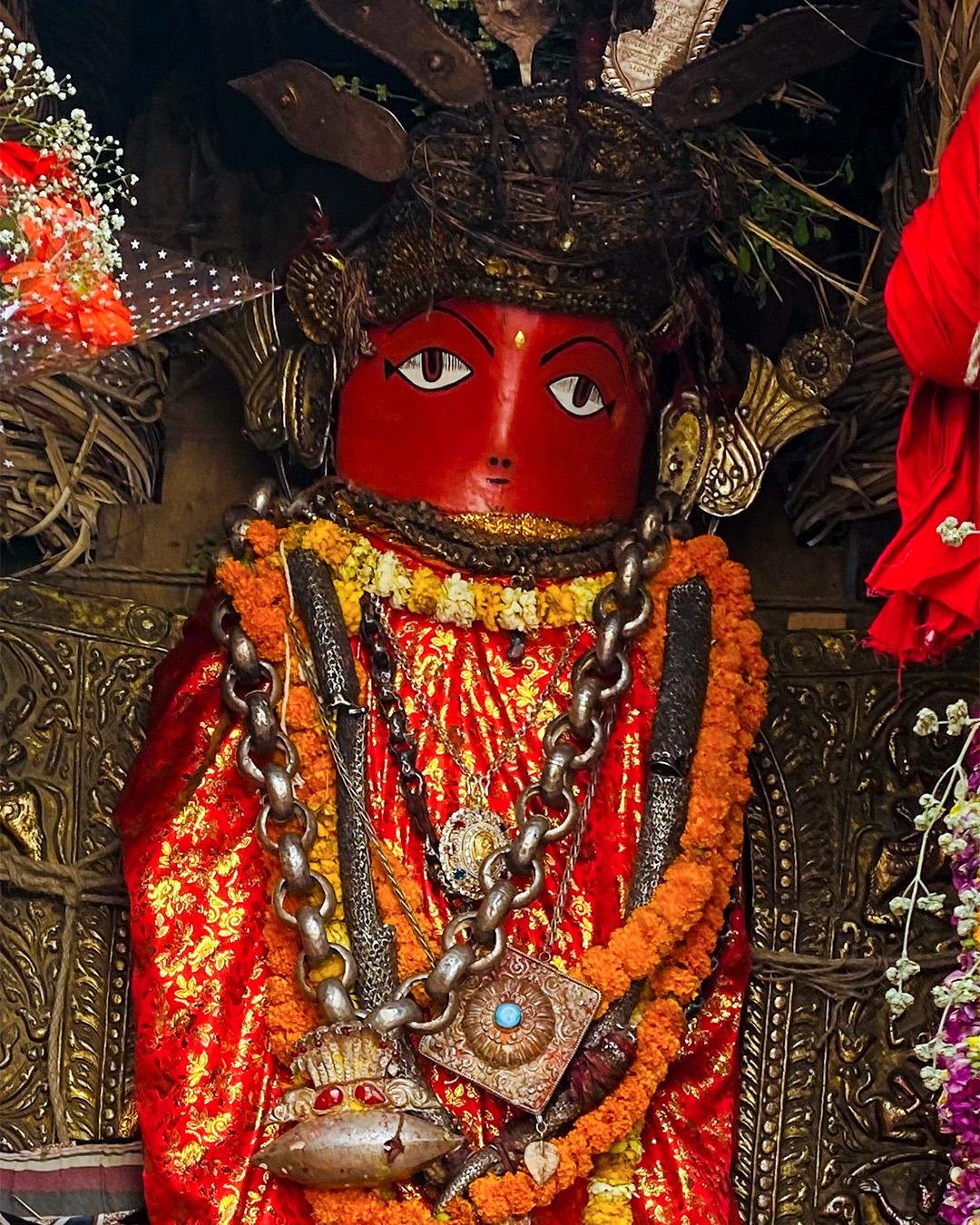
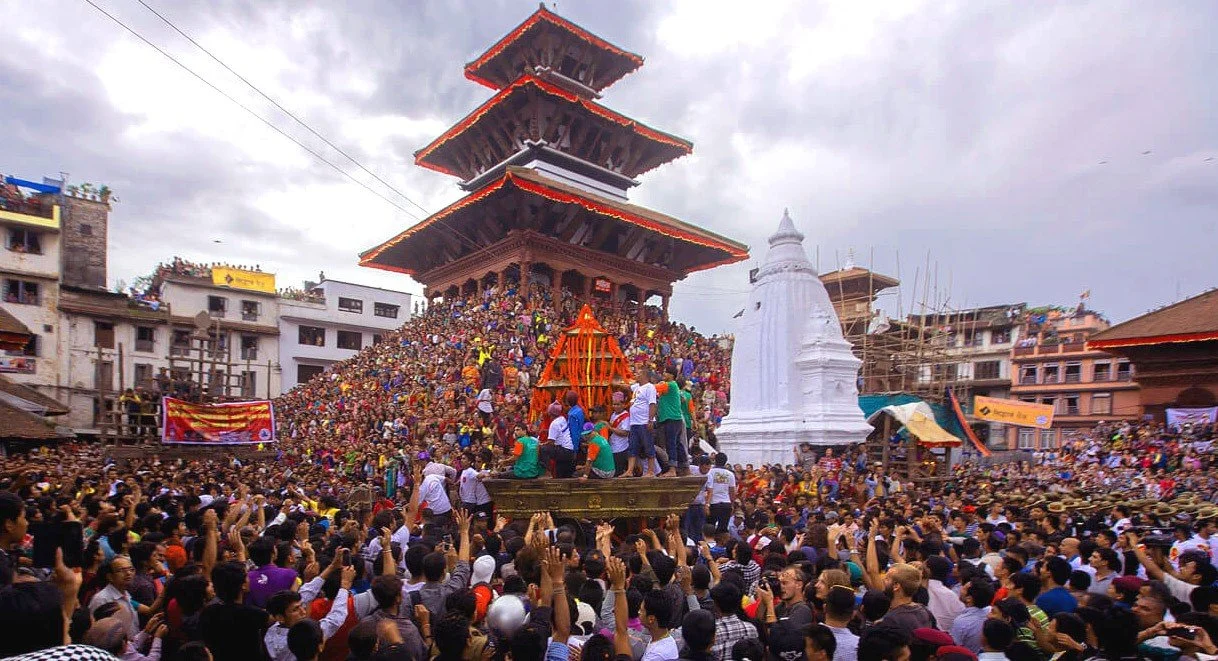
The annual chariot festival of Rato Matsyendranath in Nepal, dubbed the longest chariot festival is the biggest chariot festival for the people of Lalitpur. The deity known by various names in various regions and religious doctrines, Bunga Dyo(God of Bungamati), Matsyendranath(In Hinduism), Aryavalokiteswara Padmapani(In Buddhism) and Karunamaya(In Newar Pantheon) is celebrated as the god of rain, protector of the city and lord of prosperity.
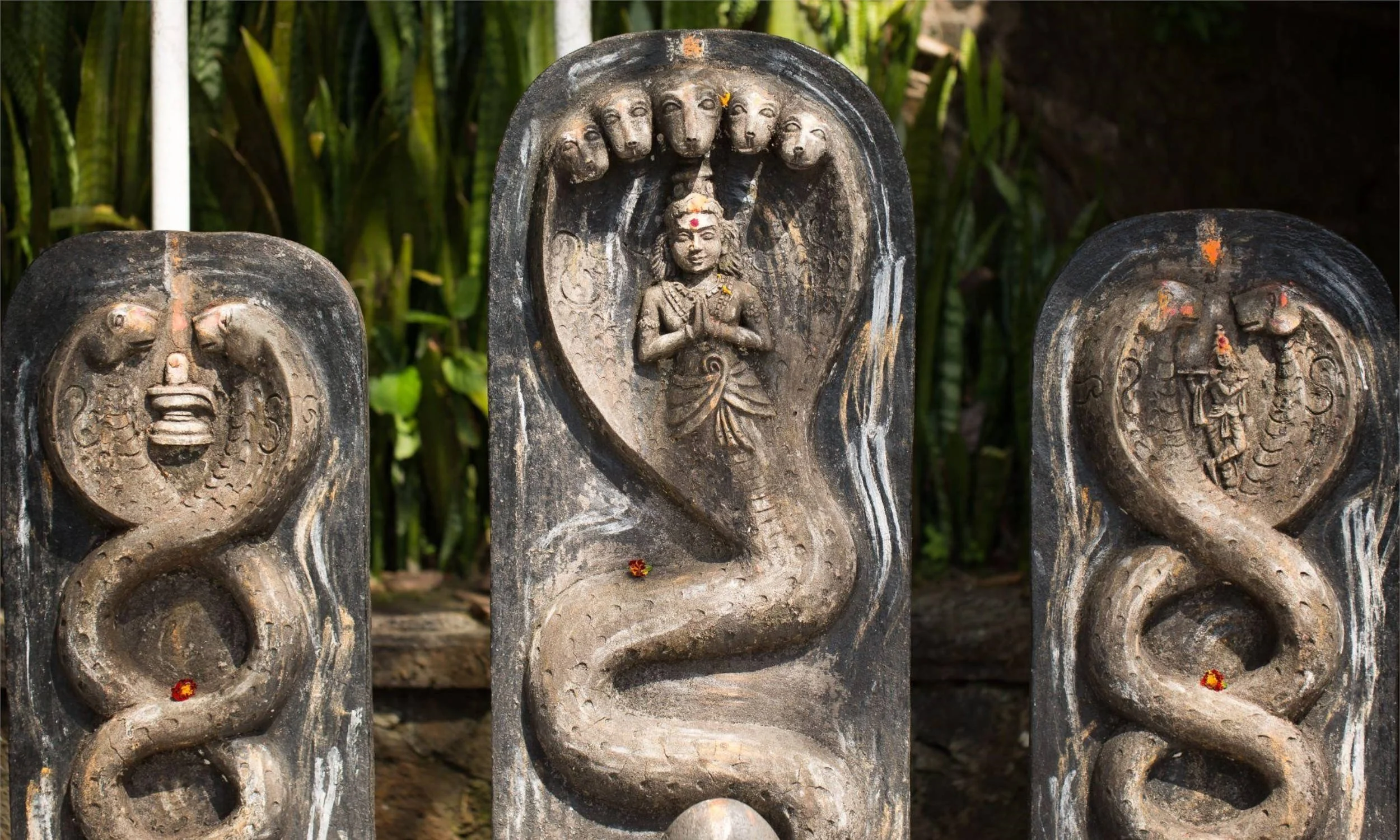
The origins of the chariot festival is entangled with a great tale of devotion, endevoured to relieve the kingdom of a drought that had stricken the city for twelve years. One of the best documented legends, the tale of bringing Karunamaya to the valley kingdom of Nepal dates back to the Lichhavi Era. During when, a drought which had caused great chaos and misfortune caused by the disciple of Karunamaya, Goraknath who had been meditating atop the naags(Snakes) to achieve great blessings from Karunamaya.
King Baradeva, son of Narendradeva struggled to relieve his kingdom. With every measure taken and none yielding the gift of rain. The King then left his court in secret, disguised as a commoner to listen to his people. He eavesdropped upon the elders to know his people’s pain and if the elders had a way out of this. One night, the King went to Triratna Bihar where an Acharya named Bandhudatta lived. The King eavesdropped upon the conversation he was having with his wife. The wife asked, "Acharya, what is causing this great drought? Is there no remedy?" to which the Acharya replied, "The only one who is able to put a stop to this is Aryavalokiteswara, who resides in the Kapotal mountain; and he can be brought only by the prayers of the ruler of the country. Now the Raja is young and foolish, and the old man his father, Narendra-Deva is living in a lonely Bihar because he and his son do not agree."
"There was still hope, not all was lost." The King went back to his palace, and the next morning he went to visit his father at Ak-Bahal in Bhatgaon. King Bar-Deva must have hesitated for some time, for he was to meet his father who left the riches of the Kingdom for a life of meditation and harmony. He sat with him and told everything he had heard at Triratna Bihar. "We must act now. I may be a King by the crown but you are my father. This is your Kingdom, if not for me then for the people you must."
The Acharya was summoned to the palace. He was asked to relieve the distress upon the Kingdom for which the Acharya promised he do everything in his power. But, he would not be successful without his Yajamana(King) for which Narendra-Deva left with the Acharya. The Acharya instructed King Bara-Deva to take a large supply of offerings and halt at a spot south of Patan where they will find a Dolana Tree. Here they were to perform great ceremonies and offerings, starting with one thousand and then up to ten million.
As the Acharya foresaw the journey ahead, only one element remained, for which he performed a purascharana (prayer) reciting the mantra one crore times. The winds must have howled and the sun beamed away from trees as Jogambara-Gyana-Dakini appeared. The goddess pleased promised to offer her assistance. The Acharya then ascended the hillock upon which Gorakh-Natha was in devout meditation and was performing Nag-sadhana (bringing the Nags under his control). He freed Karkotak Nag from his grasp. And thus they began the journey to bring home the Aryavalokiteswara- Matsyendranatha, in the native dialect called Karunamaya - the Lord of Compassion.
Encountering many frights placed along the way - bad terrain and high rivers - the Acharya took assistance from Karkotak Nag riding on its back to overcome the mighty rivers. When they reached Kapotal mountains the Acharya performed purascharana to invoke Aryavalokiteswara. They then came to know that Aryavalokiteswara resided in the home of a Yakshini (Demon Queen) who was known as Gyana-Dakini. The Acharya recited mantras to summon Aryavalokiteswara, but just as he was about to go to Bandhudatta, his mother prevented him. Aryavalokiteswara thus transformed himself into a large black bee and entered into the kalas. As the party was about to leave, Gyana-Dakini, with numerous gods, yakshas, and devils, attacked Bandhudatta who called upon the gods of Nepal for assistance. The Queen thus gave into the gods of Nepal and let the party leave for the valley of Nepal.
The kalas, in which Aryavalokiteswara resided, was carried by four Bhairava, Hayagriva, Harisiddhi, Lutabaha, and Tyanga. They entered the valley through Kotwal Dwar where the valley had been drained by Boddhistva Manjusri, whereupon the back of Karkotak Nag they crossed the grear river. Thereafter plentiful rain fell in Nepal, as they moved towards the valley center. At a certain spot Harisiddhi Bhairava in the shape of a dog barked and said, "Bu"" which the Acharya explained to the King to mean "Birth-Place." Thus in consultation with the King they built the city of Amarapur (Bungamati) where he placed the kalas in a temple. They assigned priests and plentiful land for the maintenance of the city and the temple.
They then made their journey to Lalitpattan (Lalitpur) when they decided to institute a rath-jatra with an image of the god. The image created from the earth from Hmayapido mound (across Balaju) is believed to be the chaitya of Swayambhu that was built from the same mound. After this they took the image to Amarapur (Bungamati) to worship it and then the spirit of the god was transferred to the image.
Bandhudatta Acharya then established all the rites of worship. He stated that the image of was to be brought from Amarapur (Bungamati) and to be placed facing the northern hemisphere and kept in Tirtha Bihar (Te Bahal) The image was to be bathed on the 1st of Chait Badi and be kept in the sun on the 8th. On the 12th and 13th the das-karma was to be performed. On 1st of Baisakh, Sudi was to be placed on a rath and taken around the city of Lalitpattan (Laitpur) and later be taken back to Amarapur (Bungamati).
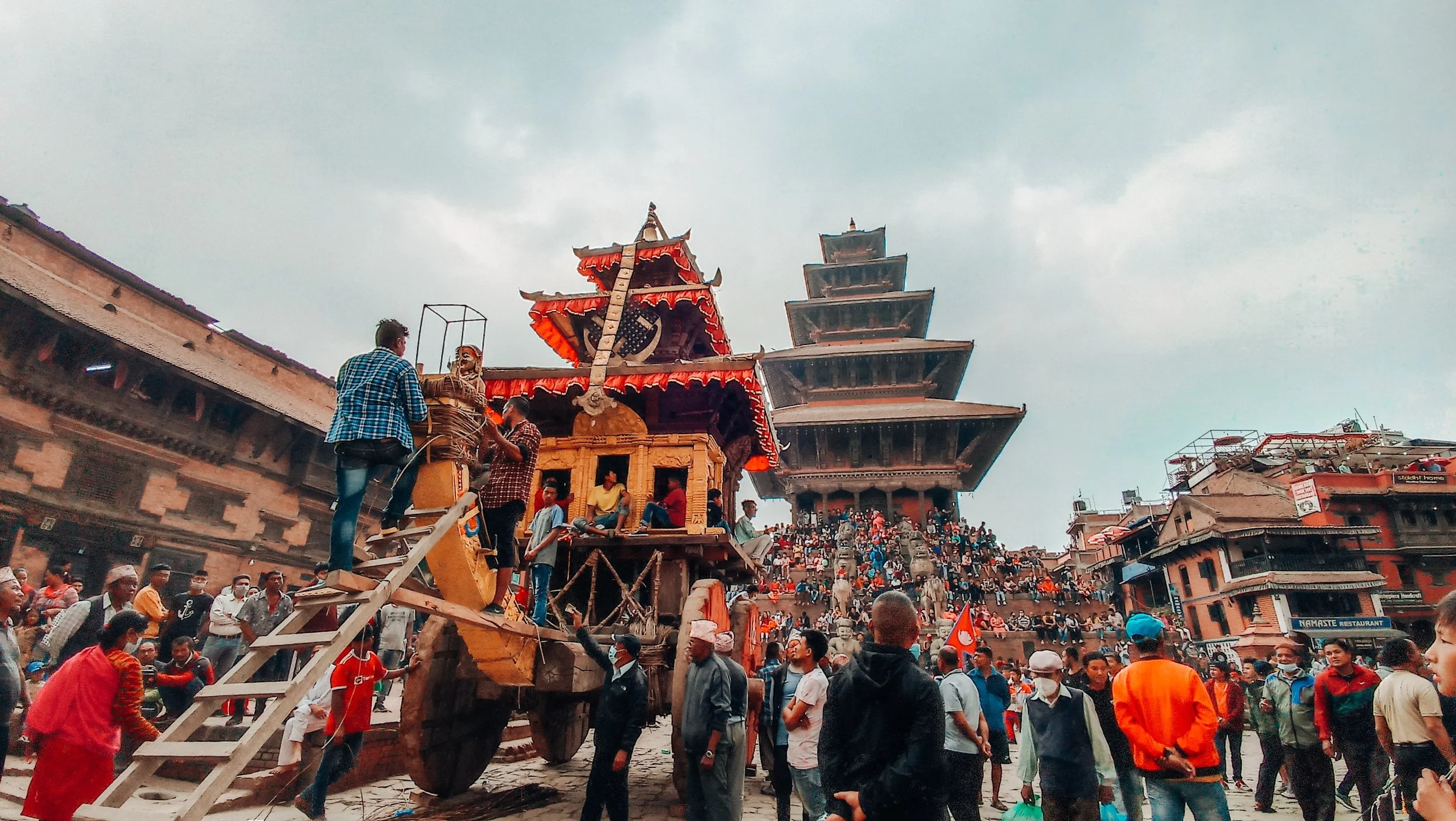
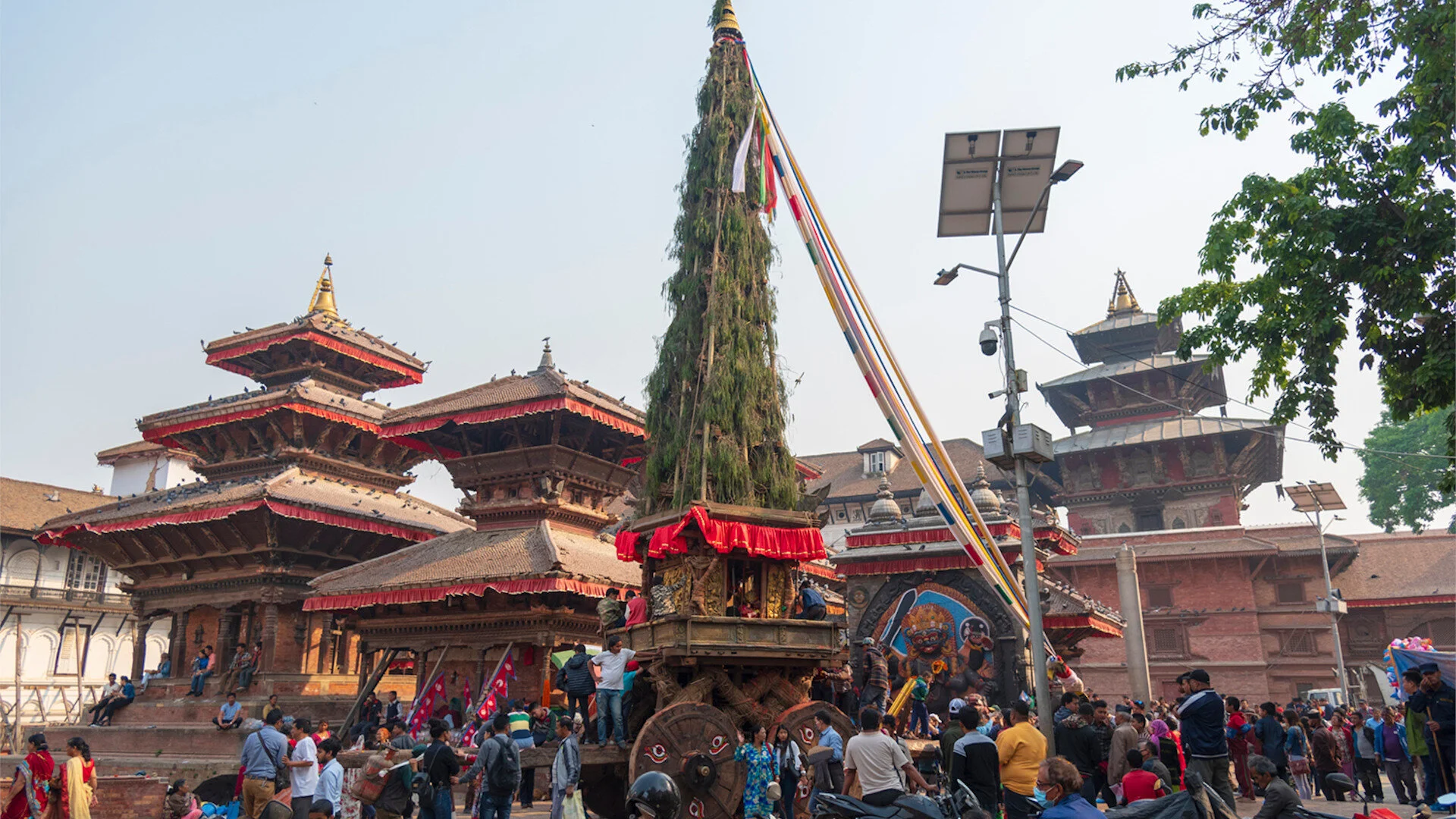
Thus began the festival of Karunamaya. Today known as Rato Matsyendranath, the festival is still conducted still upon the very set of instructions issued by Bandhudatta Acharya. The rath (chariot) is a marvel of architecture symbolizing the elements of how Aryavalokiteswara was brought into the valley of Nepal. The four wheels represent the four Bhairavas that carried the kalas from Kotpal (the mountains near Kotwal Dwar) to the valley. The Gyo Si, or Dhoma (longinsh piece of wood protruding outward) represents Karkotak Nag, upon the back of which all obstacles are overcome. On the forehead of Karkotak Nag is a bronze face of Hawo Grawo Bhairava who is believed to ward away all obstacles during the chariot festival. The image of Karunamaya is placed at the center of the chariot atop which is a log of sal (pine) held by traditional rope with a wooden joint core. It is said to symbolize the Shikhara temple of Karunamaya at Bungamati. The pinnacle is topped by a Ba: Mwo (circular base created with traditional rope) atop of which the Swayambhu yantra is placed.
Worshipped as the Lord of compassion and rain, the chariot festival of Karunamaya begins from Baisakh Chaturthi and is dubbed the longest chariot festival in Nepal. Devotees flock in numbers to worship and take part in the chariot festival from all over Nepal. The festival ends with the ceremonial display of a Bhoto and the image of Karunamaya is placed in a palanquin and taken to Bungamati. This is where Karunamaya resides for the next six months after which the image is brought to Patan and placed in Te Bahal.
The love and compassion shown by Karunamaya through the protection of the valley and provision of plentiful rain for the harvests is returned by the people of the valley through devout worship and prayer. It is not just a festival for the gods but also a medium of communal gathering and celebration which has helped built strong communal bonds between communities of Patan. In turns they pull the chariot of Karunamaya through the passages of the city of Patan, celebrating the coming of the Lord and rejoicing in the grace of Aryavalokiteswara Karunamaya Padmapani.
Similar Posts
5 Newari Cultural Dances
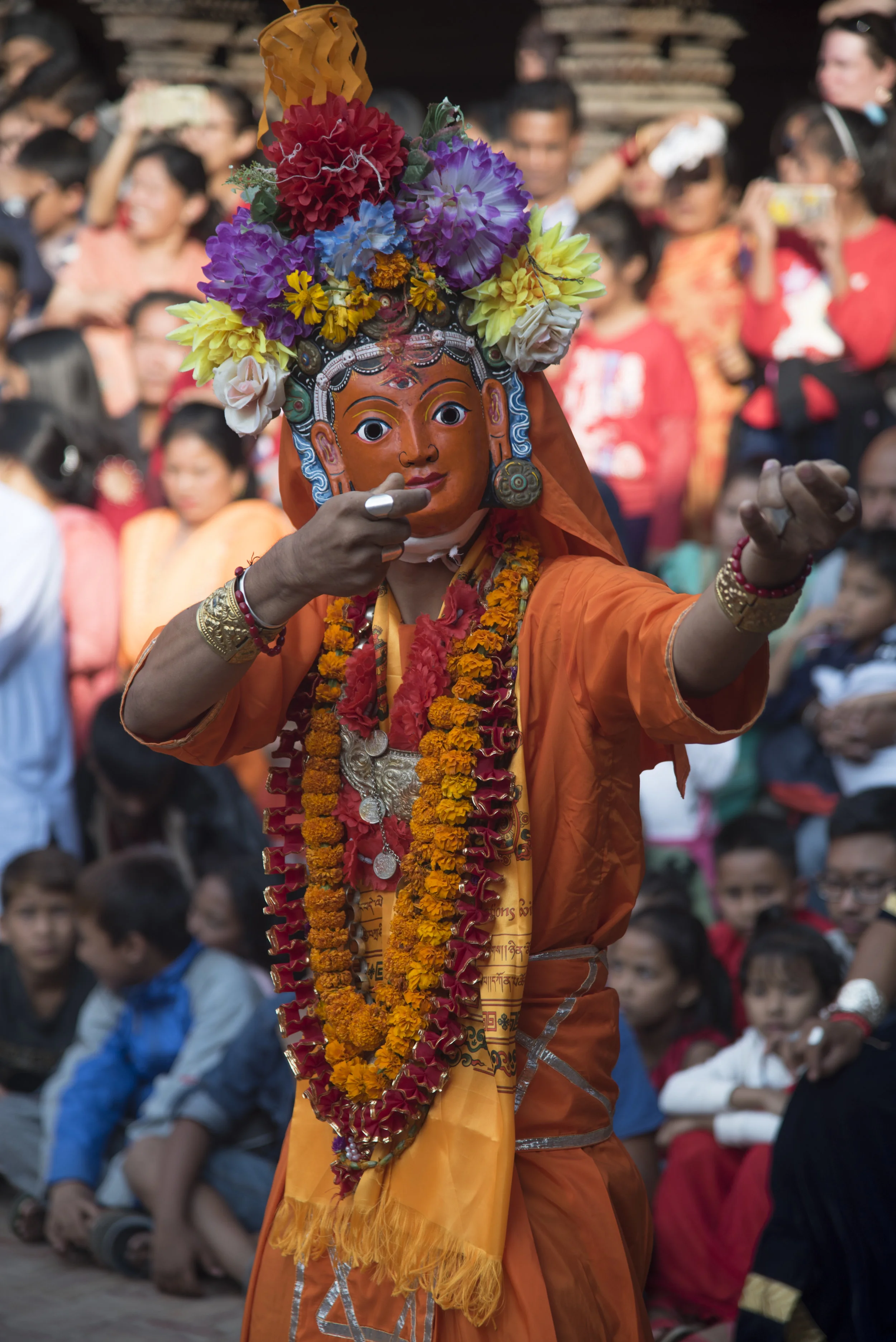
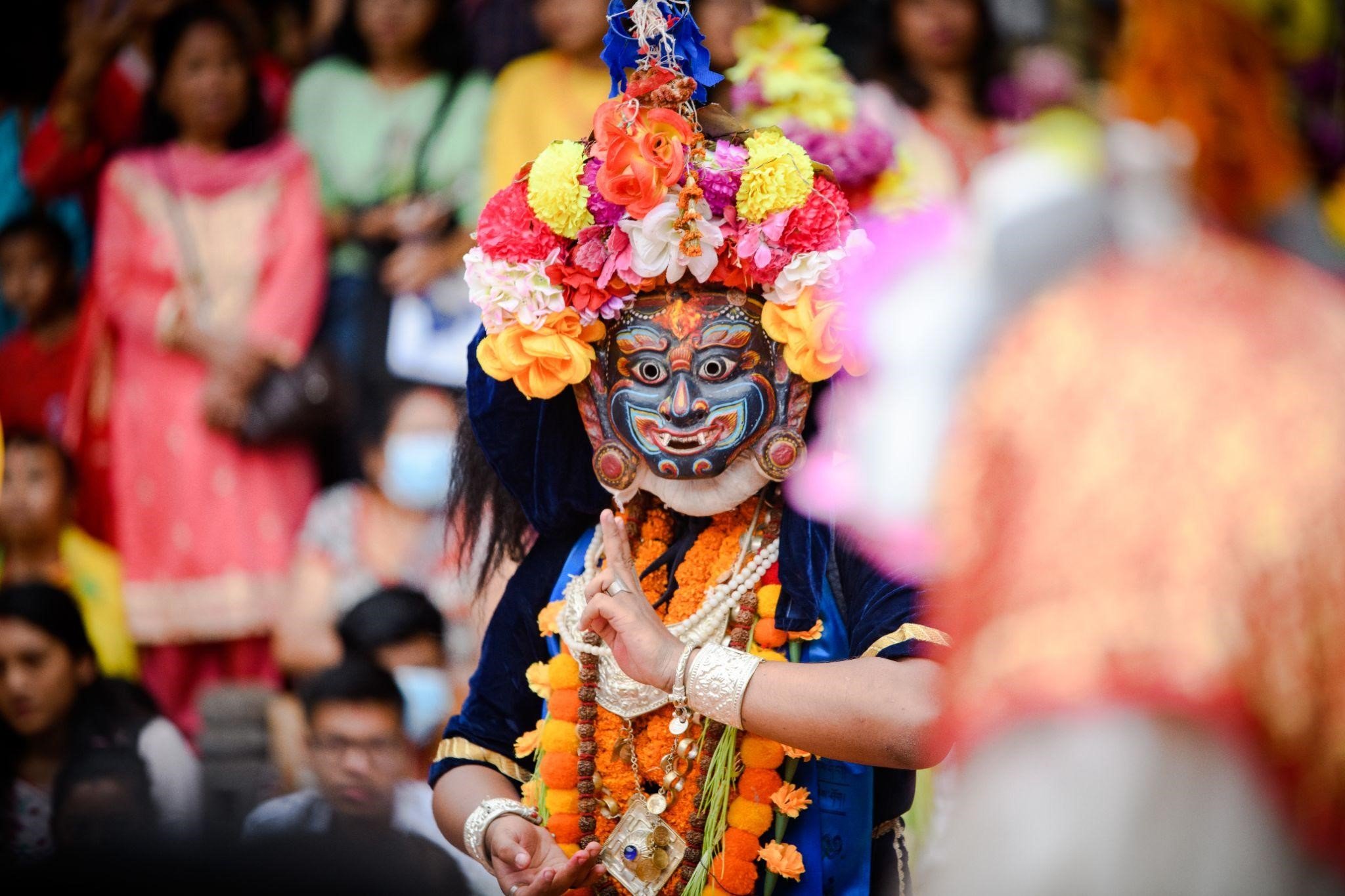
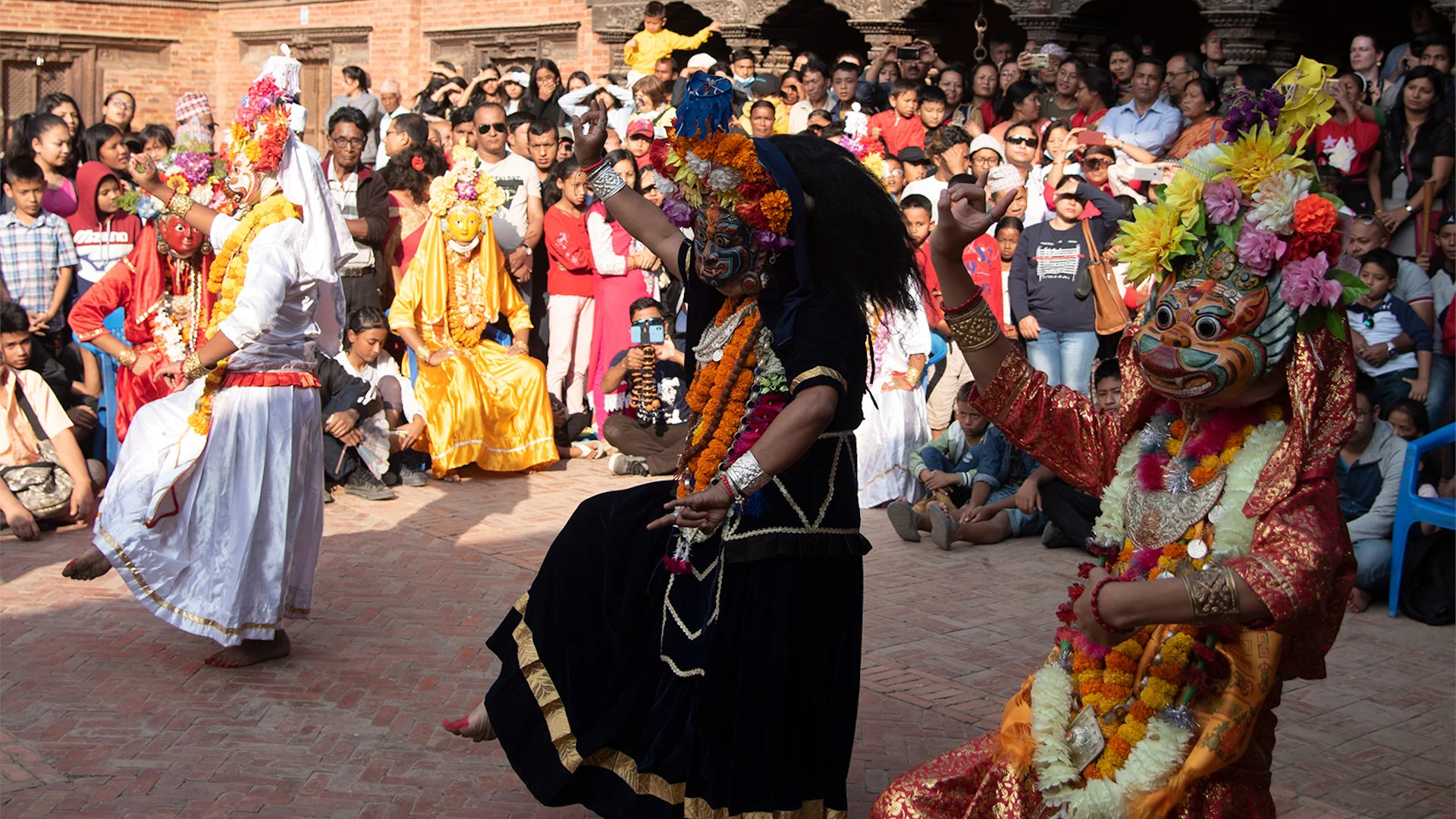
The Newari Culture of the 3 Kingdoms of Bhaktapur, Patan and Kathmandu are centuries old and have various elements to them. One of the most crucial elements of Newari tradition is the masked dances of various Gods and Goddesses which are celebrated differently in all parts of the valley. Their history is contained only with the locals and some have already been lost to time, in today’s modern world most just cherish these events temporarily and, in the moment, not bothering to understand its symbolic history and importance.
The Newari Culture of the 3 Kingdoms of Bhaktapur, Patan and Kathmandu are centuries old and have various elements to them. One of the most crucial elements of Newari tradition is the masked dances of various Gods and Goddesses which are celebrated differently in all parts of the valley. There history is contained only with the locals and some have already been lost to time, in today’s modern world most just cherish these events temporarily and, in the moment, not bothering to understand its symbolic history and importance.
Financial constraints, lack of manpower, governmental negligence and general neglect is a constant struggle for the masked dancers and insitutions who bear the responsibility to continue this age old tradition. Here are 5 Newari cultural dances and there symbolic importance:
Harisiddhi Nach
Harisiddhi Naach is the “ First Mask Dance” of the then kingdom of Nepal. It was commenced by Vikram Aditya himself and carried on by his successors. Today the dance is performed by the priests at the temple of Harisiddhi. The dance is taken around the three kingdoms (Kathmandu, Patan, Bhaktapur) once in 12 years. Annually the dance is performed twice on the day of Yomari Purnima and Holy Purnima.
The dance is performed in the community square known as Lachhi and is viewed by the locals and onlookers who have flocked from all parts of the valley.
Asta Matrika Naach
Asta Matrika Naach in the common tongue its called Gaa: Pyakha ( Group Dance) is a symbolic annual dance that occurs in the inner core of Patan. It was commissioned by Sri Nivash Malla who saw the Asta Matrika’s performing in the royal court of Mulchowk, he consulted with priests and his guru’s and learned that it is a sign of good fortune and a blessing of the mother Goddesses. Thus, he entrusted land to 3 guthi’s for the sustenance of the dance which is to be performed every year.
2 out of the 3 guthi’s left the accord and now it is only performed by the Nakabhail Tol, it takes place during the festival of Dashain in Mulchowk, Kartik Dabali and Nakabhail Dabali.
Nava Durga Naach
Said to have started 200 years ago during the Malla era, the Nava Durga Naach is an essential part of the people of Bhaktapur. Every year in the month of June according to the astronomical charts the ashes of the old Nava Durga masks are thrown into the river. The new masks are commissioned after a meticulous Tantric rite in July, the new masks are ready by the month of September. The masks are then exhibited in the Ya Che( God House) on the first day of Dashain.
On Astami Sukla, the members of the Gatha caste come to steal the masks and its said that back in the day they left some payment. They take the masks and attach a gilded copper bindi thus completing the mask. They perform in the 24 Tols of Bhaktapur and the last performance is given in the southern side of the durbar square at Ikshyu Tol.
It is believed that the Nava Durga dancers begin to grow weak from this time forward. Later, the Nava Durga dancers circumnavigate Bhaktapur on the city’s procession route and then return to their shrine late in the evening
Kartik Naach
During the reign of Siddhi Narsingh Malla, relating the legend, a great misfortune befell on the land. It was as if the city had lost its luster. No amount of pujas and yagyas seemed to restore the original splendor of the city. Downhearted, the king consulted with his learned gurus. They advised him to invoke Narasimha, the ferocious, wrathful and blood thirsty incarnation of Bishnu, to help him solve the problem. But there was a catch—invoking Narasimha to his aid demanded a hefty price—narbali, the ritual sacrifice of a man, which had to be performed annually, without fail.” The King was skeptical. Surely, none would gladly put their life on the line, not even for the Gods. His gurus, Haribansha Rajopdhayay and Bishwanath Rajopdhayay, suggested an alternative , one that would avert disaster and, most importantly, spill no innocent blood. They would invoke the gods through Tantrik means, with strong spells, a form of symbolic narbali. A brilliant idea struck the king; to stage a play. The play would symbolically offer the gods their desired narbali, it would be a good education for the people. He wrote the complete play by himself . The theme revolves around Narasimha, the wrathful god, who was called forth to divert the disaster.
Khokana Naach
Sikali Jatra or Khokana Jatra is celebrated during Dashain for 5 days. The people of Khokana are the only in the valley who don’t practice the ritual of tika and jamara as the Sikali jatra falls during this time.” Dashain is celebrated as good conquering over evil, in Kokhana it happens literally, on the first day of the festival 3 buffalo’s are sacrificed at the Sidhali temple. Varipus rituals are performed everyday and on the last day the Goddess Rudrayayni comes out to battle demons in a elaborate atmosphere of traditional instruments, inscents and locals and enthusiasts watching on as she conquers evil.
POPULAR ITINERARIES
SIMILAR POSTS
The Chariot Festival of Seto Matsyendranath
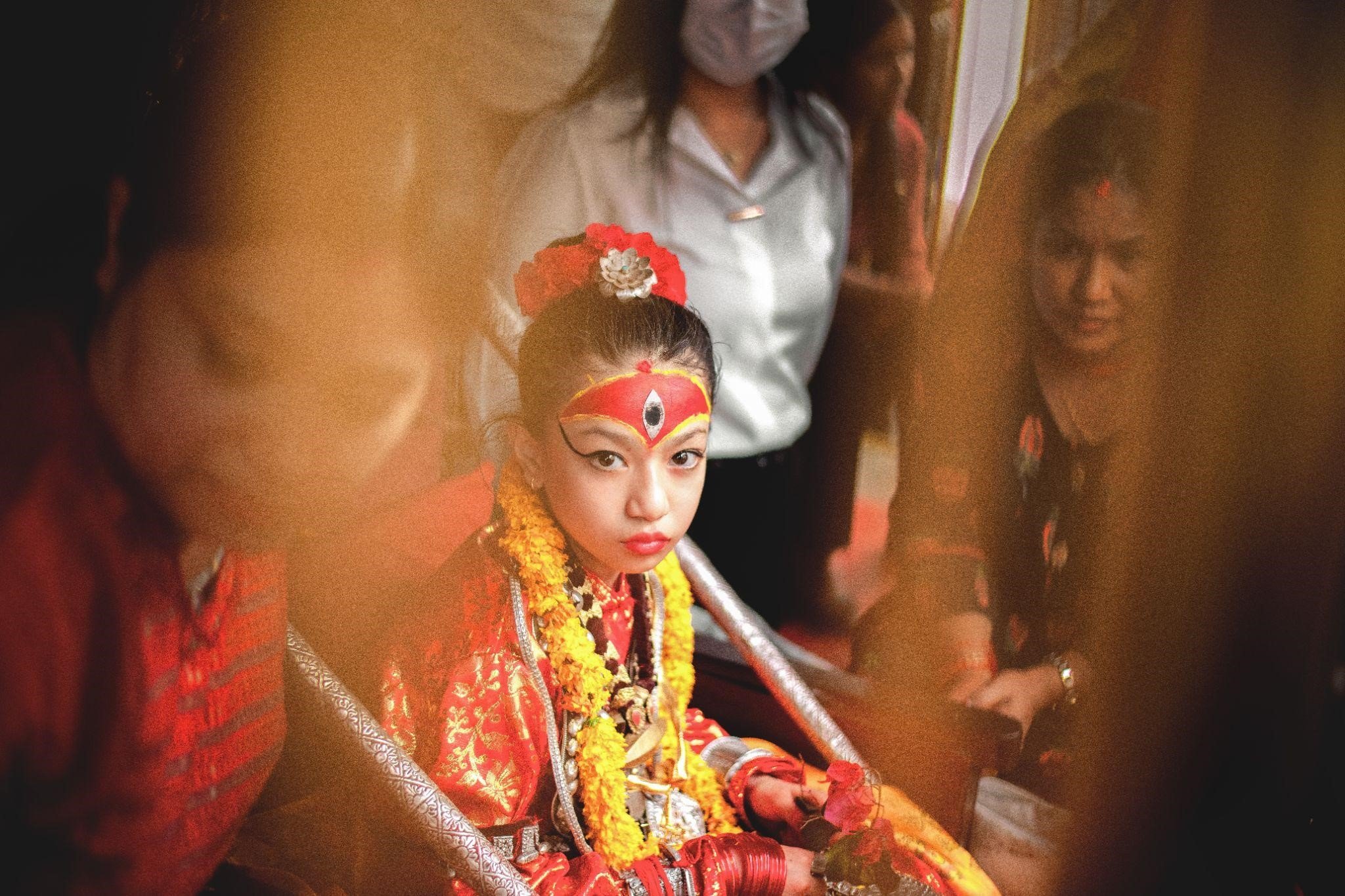
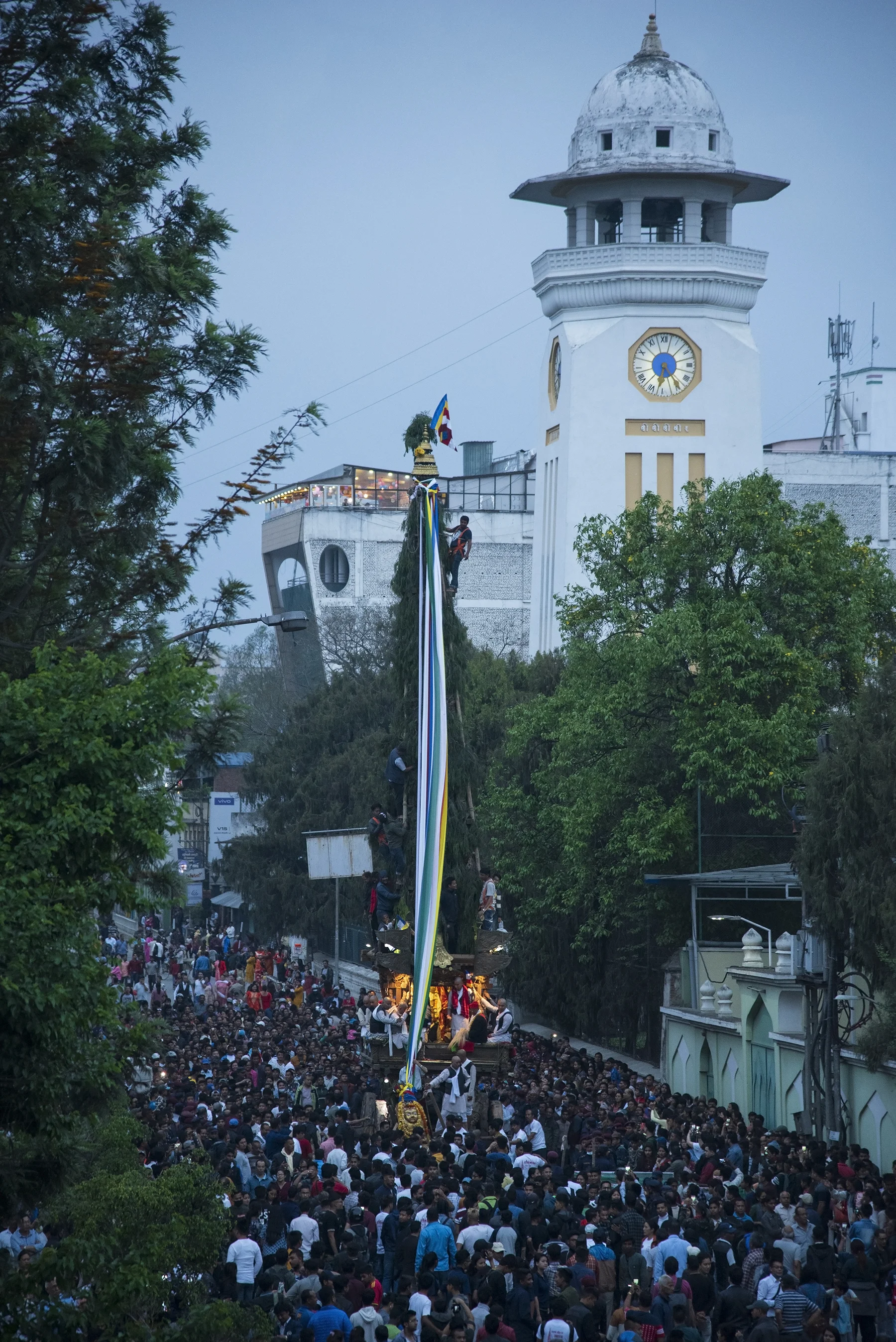
When one thinks of a chariot festival in sure you're thinking of the, Indra Jatra, Bisket Jatra or Rato Matysendranth. These festivals are the biggest in each Kingdom of the then Nepal Valley, but one chariot festival when is as historic as the three is not so known of : The Chariot Festival of Aryavalokiteswara Jana Baha Dyo.
When one thinks of a chariot festival in sure you're thinking of the, Indra Jatra, Biska Jatra or Rato Matysendranth. These festivals are the biggest in each Kingdom of the then Nepal Valley, but one chariot festival when is as historic as the three is not so known of : The Chariot Festival of Aryavalokiteswara Jana Baha Dyo. When the city of Kantipur(Kathmandu) was founded by King Gunakamadeva he arranged two chariot festivals to be held in his new city. "He arranged the procession of Indra Jatra accompanied by the Kumari Group. He also wished to establish the procession of Lokesvara just as in Patana, and therefore made an image of Khasarpalokesvara, performed the rityakl starting with invocation, arranged a procession, and caused it to be celebrated every year." Bajracharya, Micheals (2016: 59) Origin The original site of the monastery Khasarapalokesvara is believed to have been Hamhal Monastery which today is the pond of Rani Pokhari. The chariot festival was which was celebrated every year, is said to have stopped during the end of the Lichhavi Era, it is believed that the temple was destroyed during the raid of Mukunda-sena, the King of Palpa who raided Kathmandu. "The victorious soldiers broke and disfigured the images of the gods, sent the Bhairava placed in front of Machchindranatha to their own country, Palpa and Butawal." Wright (1877:171) Rediscovery After which the temple was lost to time, the chariot festival must have been stopped. During the reign of Yaksha Malla some potters, while digging for clay, found an image of Lokeswara, which had been made by Gunakamadeva Raja, but which had been buried under the ruins of the temple that fell down in the time of the Thakuri Rajas. The image henseforth was named Yamaleswara, and the place where it was dug up was called Yamal (Today called Jamal)." Wright (1877:189) "The king, having seen the image, performed the rituals of renovation; took the image inside the city and established it by building a large temple." Bajracharya, Micheals (2016: 90) After which during the period of King Pratap Malla, he reintroduced the chariot festival of Sena Machchhindra. "Pratapa Malla, then rebuilt the chariot of Lokesvara, the white Matsyendra, according to tradition. He had Lokesvara placed on the chariot and initiated an annual procession that moved the chariot around the city." Bajracharya, Micheals (2016: 106) It is believed that the deity was later shifted from Hambal Monastery, Yamala (Jamal) to Ket Tol (Jana Bahal), during the process of building the Rani Pokhari by King Pratapa Malla in 1670 AD. The Procession The chariot procession is marked for Chaituya Dashain, for which the chariot is building process is commenced a week prior. A group of traditional builders with the help of volunteers build the 4 storied chariot shaped in Shikhara architecture. The chariot is to various parts of the inner city( Old city) of Kathmandu. It is said that the procession must be completed before the full moon, for which the chariot is pulled within 3 days and on the third day a special puja is conducted and the image Jana Baha Dyo is taken back to the temple at Jana Bahal. The chariot is makes it’s way from Durbar Marg to Bhotahity and rests in Asan on the first day. After which it is pulled to Ket Tol, Indra Chowk, and rests in Hanuman Dhoka. On the final day it makes its way through Basantapur Durbar Square, Jasidega and circles the mother tree three times in Lagan. The festival since time and milennia has been a way for the community to come together in merry celebration. Revellers rejoice in pulling the chariot and members of the community place offerings and prayers to Seto Matysendranath as it makes its way to their community. A tradition more than 300 years old still finds a heart in the modern city of Kathmandu, and seeing the next generation take interest in preserving their tradition by participating in the endeavours makes one quaint that it shall be around for more years to come.
The Coming of Spring- Fagu Purnima
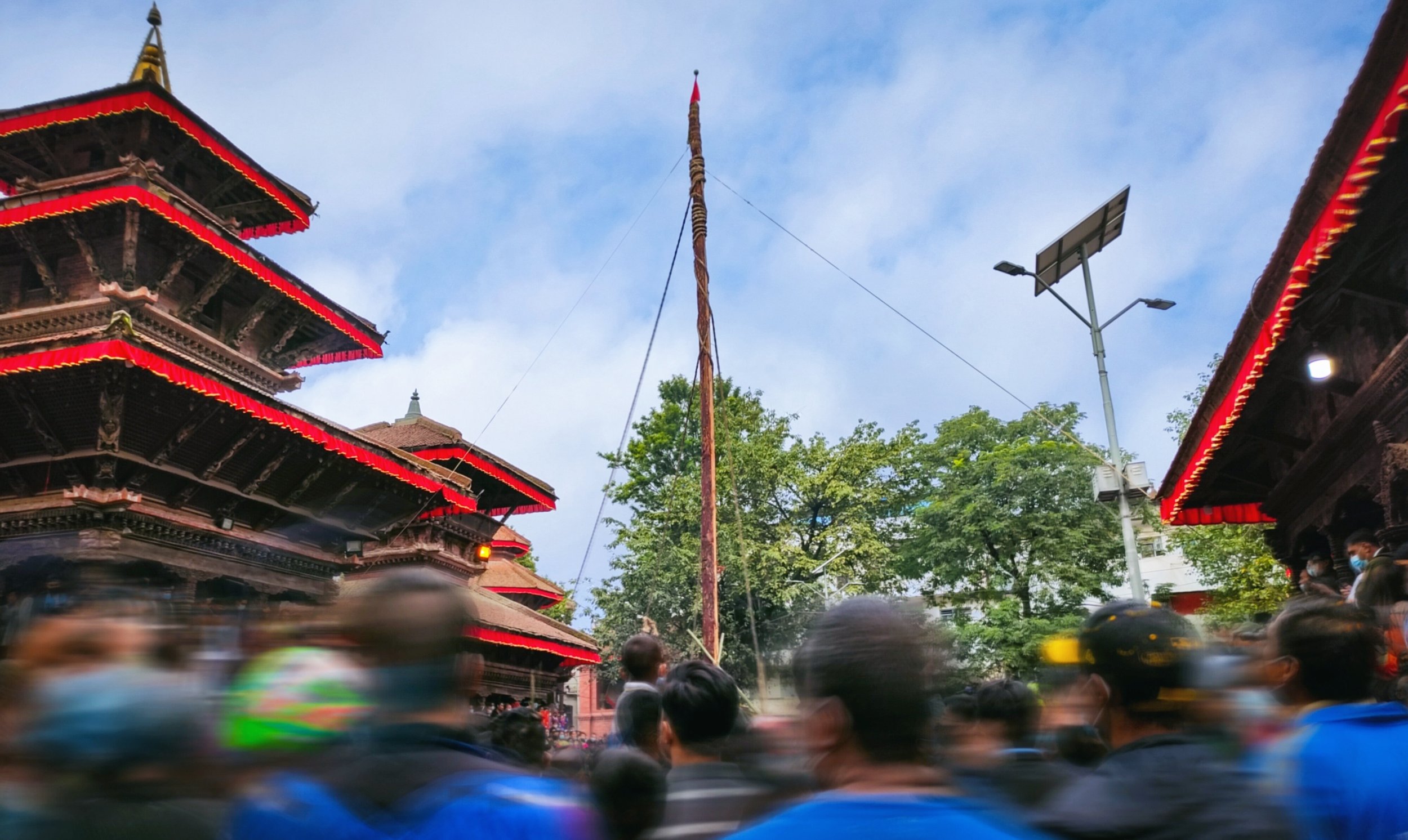
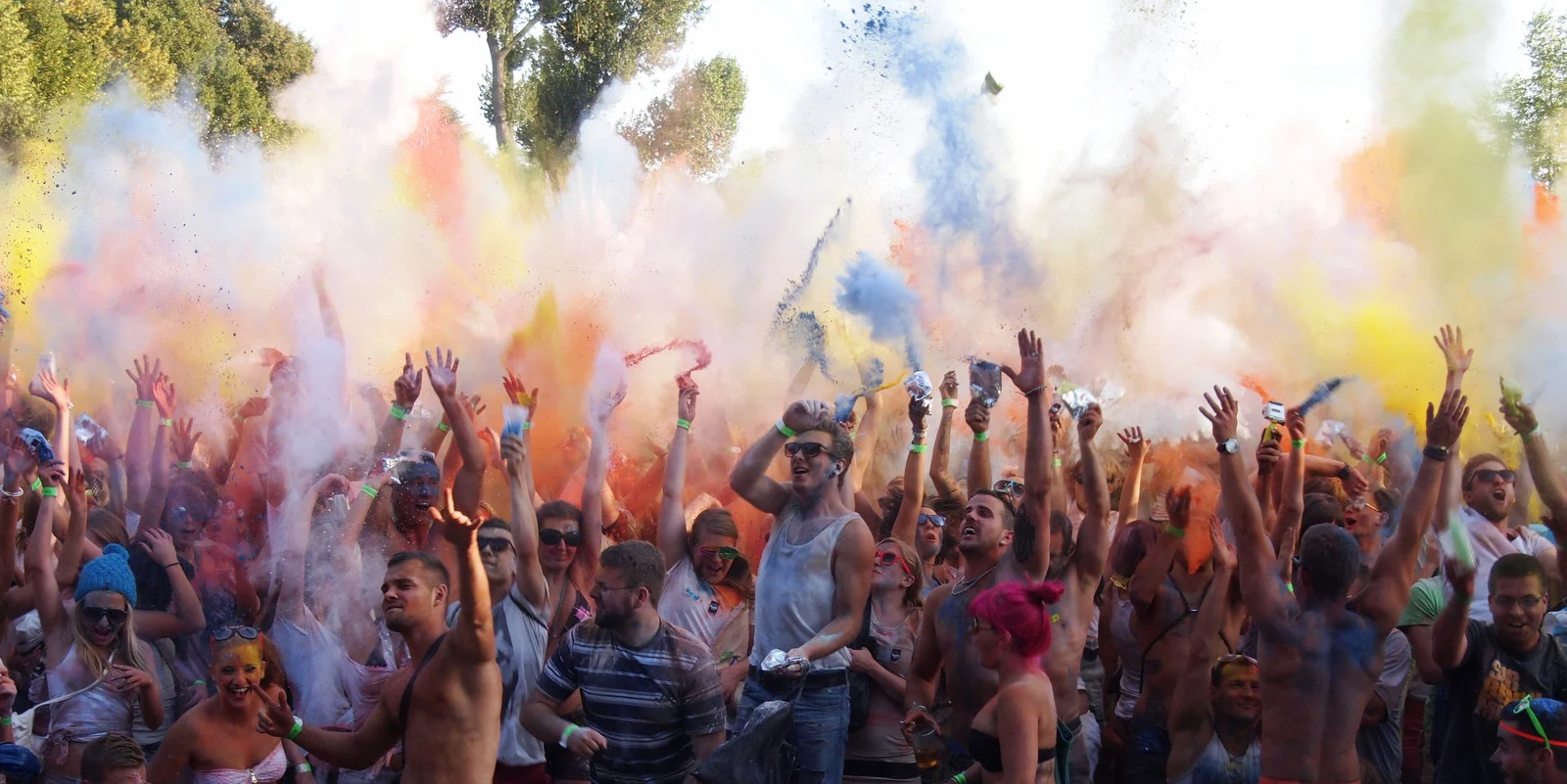
Fagun Purnima also known as Holi is a festival marking the end of winter and coming of spring and summer. Back in the days when phones and the internet didn’t exist, a ling bamboo lingo decorated with clothes of various colors (Chir) is erected a few days before the day of the festival. This tradition is still continued in Basantapur Durbar Square.
Fagun Purnima also known as Holi is a festival marking the end of winter and coming of spring and summer. Back in the days when phones and the internet didn’t exist, a ling bamboo lingo decorated with clothes of various colors (Chir) is erected a few days before the day of the festival. This tradition is still continued in Basantapur Durbar Square.
Mythologically the festival revolves around the legend of the demon king Hiranya Kashyapu who commanded his sister Holika to kill Pralhad who was the son of the demon king and a devout follower of Lord Bishnu. He commanded her to take Pralhad in her lap and sit on a fire, which Hiranya Kashyapu believed would have stopped Pralhad from chanting the name of Lord Vishnu.
Holika had been given a boon by Lord Vishuy that she can never be burnt by fire; and it was thought that she would not be harmed. But as the fire raged, Holika was caught in the flames and she started to burn while Pralhad remained unharmed and came out of the fire chanting the name of Lord Vishnu. The boon given by the Lord didn’t save her because; Lord Vishnu had warned her that if she misused the gift it would not protect her. Thus as a symbol of victory of good over evil, the day Pralhad walked out of the fire is celebrated.
Marking this legend the lingo, erected in Basantapur is pulled down on the after Falgun Purnima and the clothes (Chir) is burned marking the burning of Holika in the fire. There are also numerous other legends associated with the celebration of the festival such as of Lord Krishna and Draupadi, Lord Krishna and Yashodha and the legend of Dhundi and King Raghu.
In Nepal, the festival of Holi is normally celebrated in two consecutive days, where on the first day Holi is celebrated in the Hilly Region and on the second by the people of Terai. Celebrated on the last full moon of the lunar calendar, it is a celebration welcoming the season of spring and a farewell to winter. Holi heartens the brotherhood feeling in society and is an occasion for all members of the family and friends to get together and exchange greetings. The festival of Holi has no religious, ethnic bounds and is celebrated in unity, symbolized by various colors exchanged and greetings of "Happy Holi." The festival has evolved into a day of avid celebrations with essences of the core religious value.
Individuals visiting Nepal can experience the magical colors of Holi throughout Nepal. The most popular mass celebration of Holi is done in Basantapur Durbar Square, which on the day is filled with revelers, music and colors.
POPULAR ITINERARIES
SIMILAR POSTS
The legend of Pashupatinath
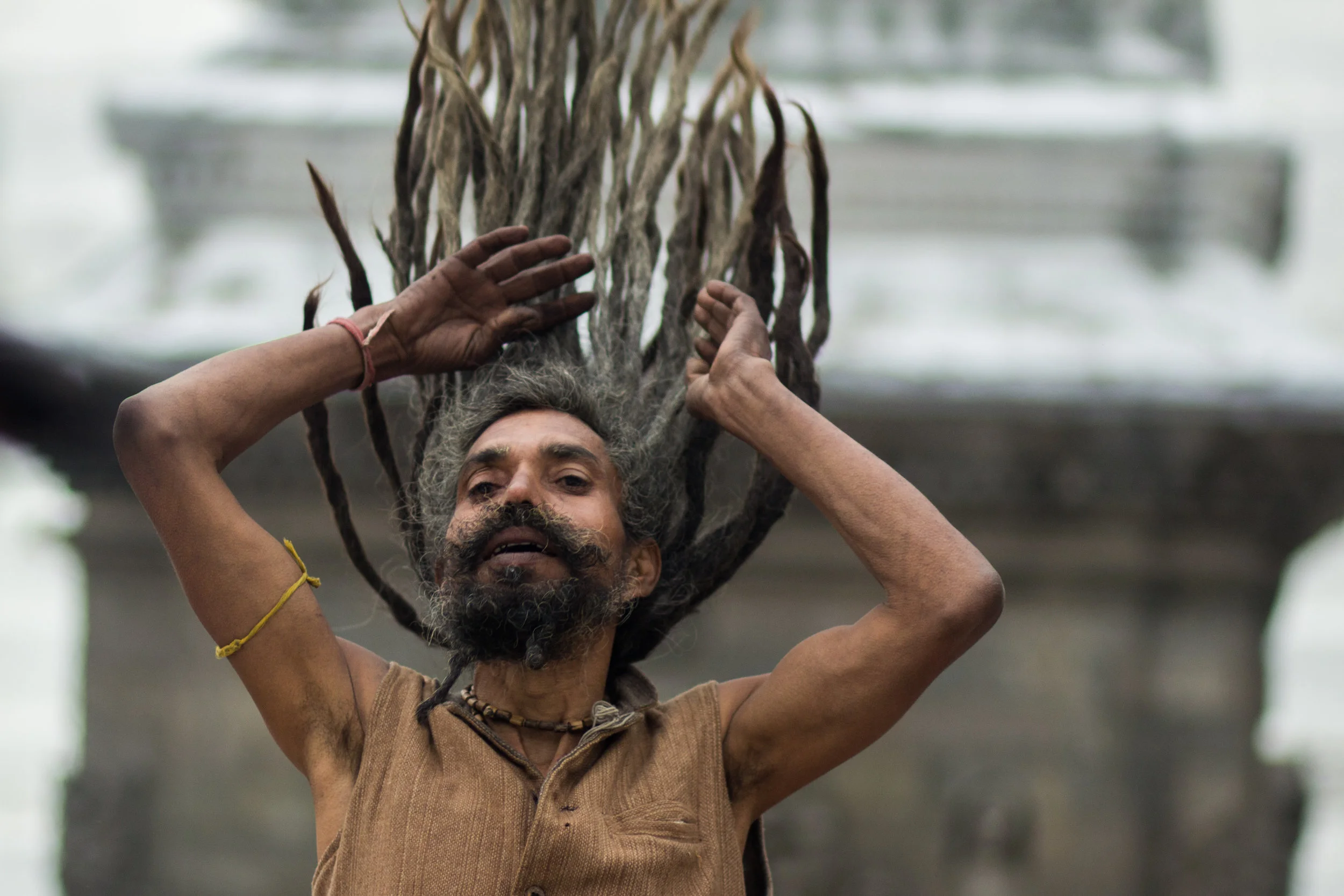
Celebrated as the day of Lord Shiva, Maha Shivaratri is one of the most important celebrations for the devotees of Lord Shiva and Hindus around the world. Maha Shivaratri falls on Mid-February or March in the Gregorian calendar. Also known as the Great Night of Lord Shiva, the biggest hub in Nepal during the night is the Pasupati-Nath Temple in Kathmandu.
Legends state on the day, Lord Shiva is said to have saved the world from annihilation. On the condition that from the day forward people worship him with great pride and enthusiasm. Other legends state how the day marks the wedding day of Lord Shiva and Parvati. Believers also know the auspicious night as the night of "Tandava", the primal dance of creation, preservation and destruction. According to Linga Purana , it is believed during Shivaratri Lord Shiva manifested himself into the form of a Linga.
Thousands of devotees, aesthetics, yogi's visit the Pashupati-Nath Temple in Kathmandu, one of the holiest shrine of the Hindus.
"Maheswara, in the shape of a deer, disclosed himself in the form of light, which pervaded the seven firmaments above Bhulok( The Earth) and also the seven firmaments below Rastal ( Hades). On seeing this, Brahma went upwards to see how far the light extended, and Vishnu went downwards for the same purpose. The place whence Vishnu departed is called Vishnu-Gupt, and the Mahadeva was called Pashupati. ” Wright 1877: 82 "The ancient temple of Pashupati having fallen down, the light was buried under the ruins. Some cowherds came into the country in the train of Sri Krishna, who came from Dwarika to help his grandson in letting out the water from the valley through a passage, which he made at Chaubahal, and in carrying out the daughter of Danasur, who had stopped the outflow of the water. The men settled down at Padmakasthagiri and built a cowshed. One of their cows, by name Ne, was a mulch cow, but gave no milk. Every day at a certain time she went running to a certain place. One day the chief cowherd followed her, and saw milk issuing from her udder, and saturating the spot on which she stood. His curiosity was excited to know what was under the spot, and on removing some earth he discovered the light, which however consumed him." Wright 1877: 107 The first recorded discovery of the ancient shrine and temple of Pashupati-Nath is said to have been in the Gopala Dynasty during the reign of King Bhuktamana. He is said to have discovered the shrine when he was playing Kilatari (A Military Game) in the Sleshmantakban. On the day of Maha Shivaratri, devotees flock in masses at the nearest Shiva Temple to present offerings and prayers. Pashupati-Nath becomes a hub for asthetics, yogis, and devotees. The chants "Om Namah Shivay" and "Maharitunjaya", charge the atmosphere and devotees can be found meditating in the temple premises. Tourists visit the temple to view the naked sadhus, the ambience and indulge in the energy of the eastern believes. "The occasion of Maha Shivaratri, the Pashupati Area Development Trust (PADT) is expecting a crowd of 1.3 million people from across the world. For the successful celebration of the festival, the management units in Pashupatinath start cleaning the area. Also, this year more importance has been given for figuring out an easier way to manage crowd so that devotees can carry out their Puja and Darshan faster and more conveniently. Spring is one of the best times to visit Nepal, and Indian tourists enjoy visiting during the most auspicious occasion of Maha Shivaratri. Special provisions are made to ease Darshan for Indian pilgrims at Pashupatinath during Maha Shivaratri, which falls on Feb 13 this year, according to officials at the Pashupati Area Development Trust (PADT). The PADT will also make available Pashupati Darshan passes at easy outlets near Pashupati area to facilitate pilgrims from India. "– Nepal Tourism Board
Losar: The Festival of Reunion
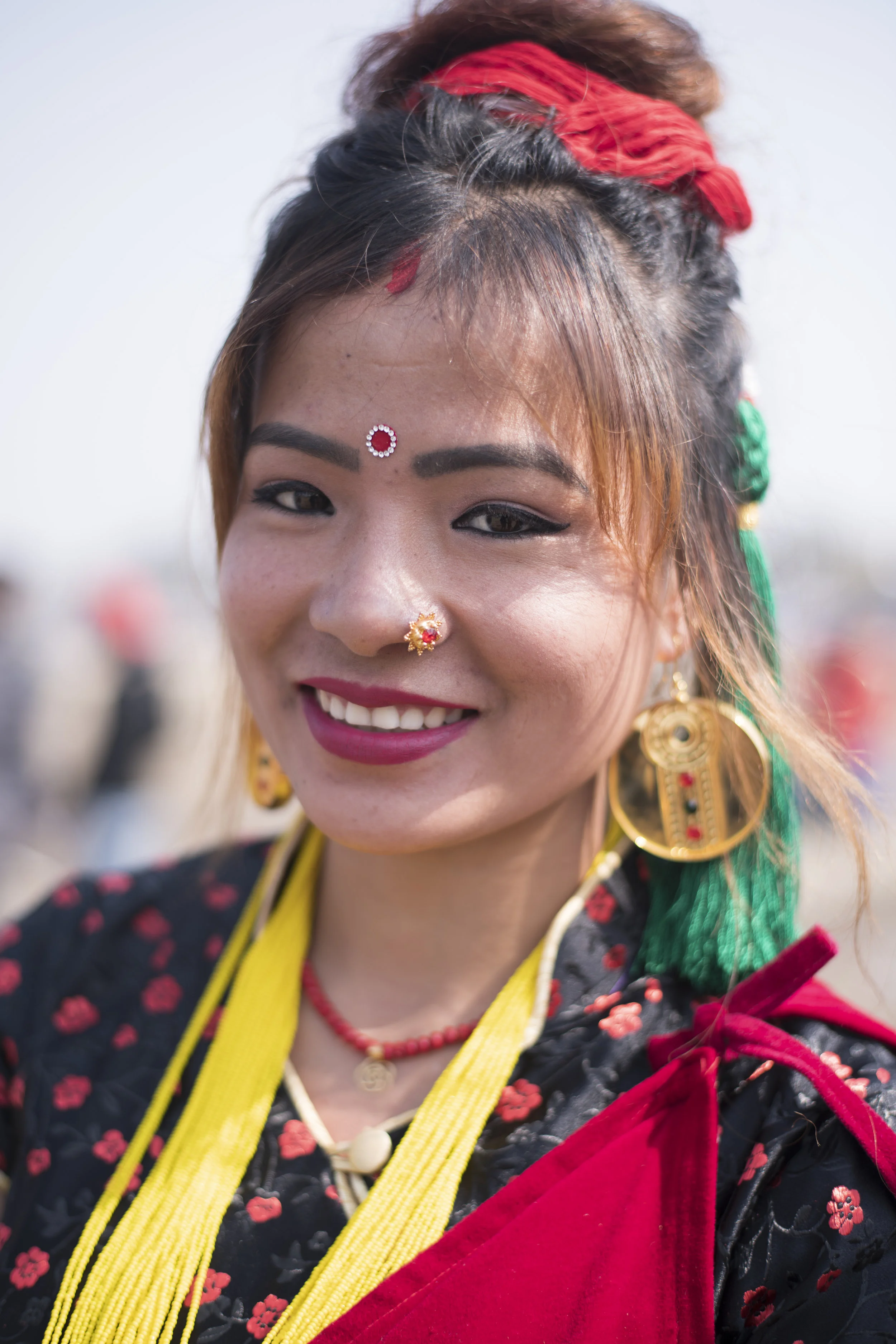
Losar is one of the main festivals celebrated by the ethnic communities of Tamang, Sherpa, Gurung and Thakali. Losar means new year according to the unisolar calendar followed by the communities, it is also known as the Tibetan Calendar which follows the cycle of 12 years called Lohokor.
Losar is one of the main festivals celebrated by the ethnic communities of Tamang, Sherpa, Gurung and Thakali. Losar means new year according to the unisolar calendar followed by the communities, it is also known as the Tibetan Calendar which follows the cycle of 12 years called Lohokor.
Losar is celebrated for 15 days during which the people visit the stupas and monasteries to offer pray, and receive blessings from monks for prosperity and wellbeing. The ethnic people adorn themselves their traditional dresses and rejoice the coming of the new year with their friends and family. Losar is a communal event where all members of the community gather in a venue and celebrate through numerous cultural dances, songs and prayer.
Losar is a single festival celebrated in different days according by different communities. Among the numerous Losar celebrations, the major ones are Tamu Losar celebrated by the Gurung community, Gyalpo Losar by the Sherpa Community and Sonam Losar celebrated by the Tamang community.
Tamu Losar:– Celebrated by the Gurungs community they are the indigenous people from Nepal and called Tamu, another name of Gurungs. They are native to the mountainous region but have settled all over Nepal. Gurungs are among the famous soldiers who share the title of “Gorkhas” who participated in the 1st and the 2nd World War.
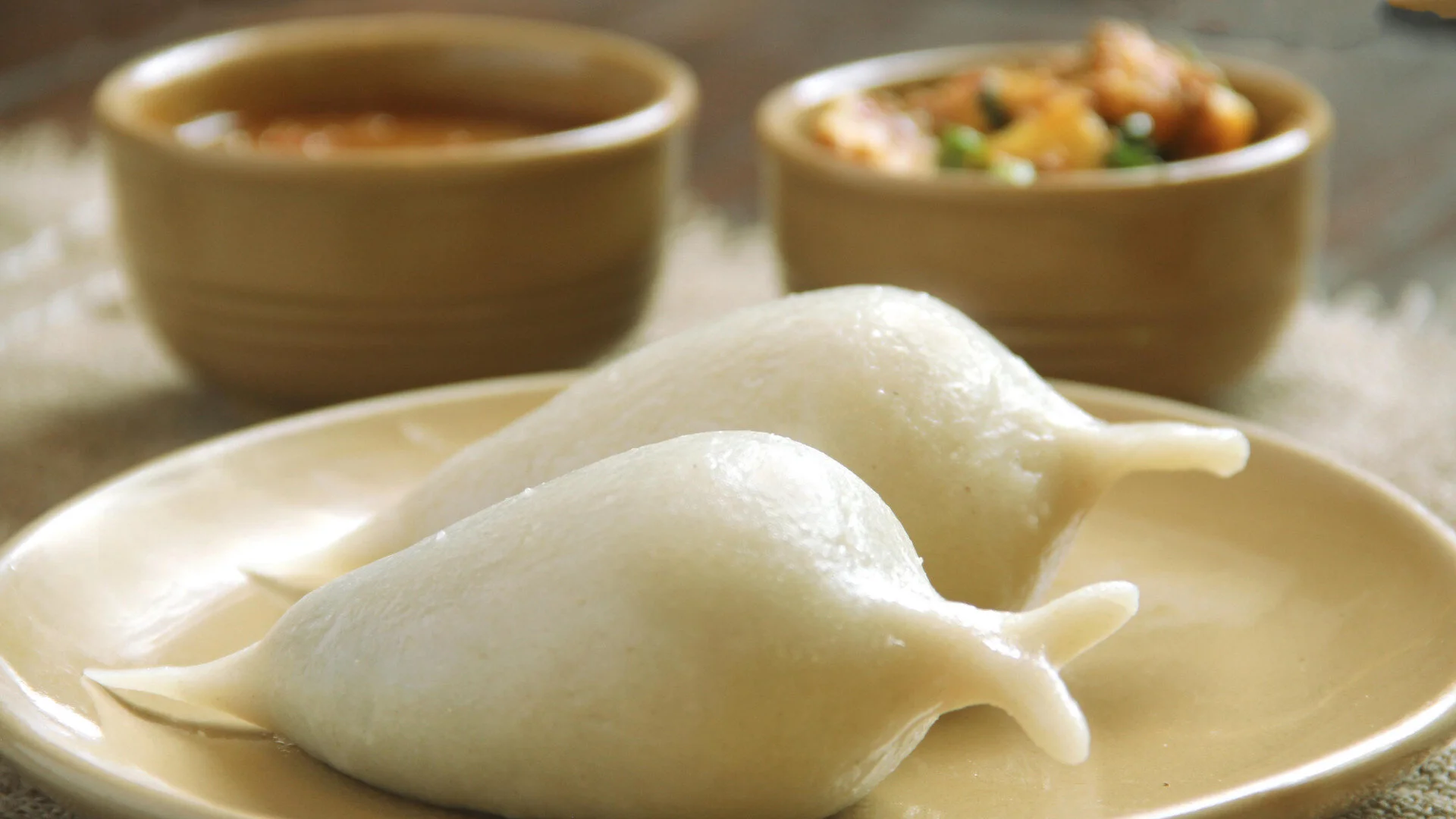
Tamu Loshar falls in the month of December/January. The date signifies the end of the shorter days and the start of the longer days bringing warmness and charm. At the eve of the festival the lama, the traditional priests of the community called Lamas burn incense and offer prayers. Various delicacies such as Sel roti (Rice circle bread), Achar ( Pickle), Meat, homemade rice Beer and Wine are served. Members gather in the communal spaces and rejoice in the festivities and cultural processions marking the New Year. Sonam Losar:- Celebrated by the Tamangs community native to the central highlands of Nepal. Tamang’s have their dialects and unique culture that distinguishes them from other ethnic groups. The Tamang’s ethic profession during earlier times was horse trading. Sonam Loshar falls in the early January to mid February. Sonam Losar is all together celebrated for 15 days but the first three days are the major of the festival. They clean and decorate their homes to welcome the coming year and visit monasteries and stupas in their traditional costumes. Pork, duck, chicken and sweet desert along with rice beer and wine are served in communal and family gatherings.
Gyalpo Losar:- Celebrated by the Sherpa community native to the Himalayan region. Sherpas are renowned for having extreme endurance as they are born and raised in the one the high Himalayas. Their native profession is trade, husbandry and highland farming but in todays modern times. Most earn their living through transporting goods for trekkers and mountaineers who come to climb the high mountains. The trekkers and travelers have a deep respect for the Sherpa community as their work is involves high risk. They are world famous mountain climbers and the first one to scale Mount Everest in Nepal, the highest mountain in the world.
It is the celebration of Tibetan New Year falls that in the month of February in English Calendar. The community marks the beginning of the festivities by preparing their traditional dish Khapsee. The houses are cleaned, specially the kitchen has to be cleaned properly because it is place where the family prepares the food. Among the many dishes served one is a soup served with dumplings called Guthuk. The soup incorporates meat, rice, sweet potatoes, wheat, yak cheese, peas, green peppers, vermicelli and radishes. During the festival, the communities recall the struggle between the good and the evil in their ceremonial dance and as the Lama chants mantras and passes the fire torches through the crowds. People perform the traditional dance battle encounter between the king and the deer and amuse the spectators.
All three Losars have one commonality they are celebrated to not just mark the new year but to bring the community together. Especially in the modern times where many have migrated away from their native land and cultural values are being overrun by the modern routines. Festivals such as Losar help bring together the community and keep the traditional culture, lores and the sprit of a community alive.
Swasthani Bratakatha Festival in Nepal
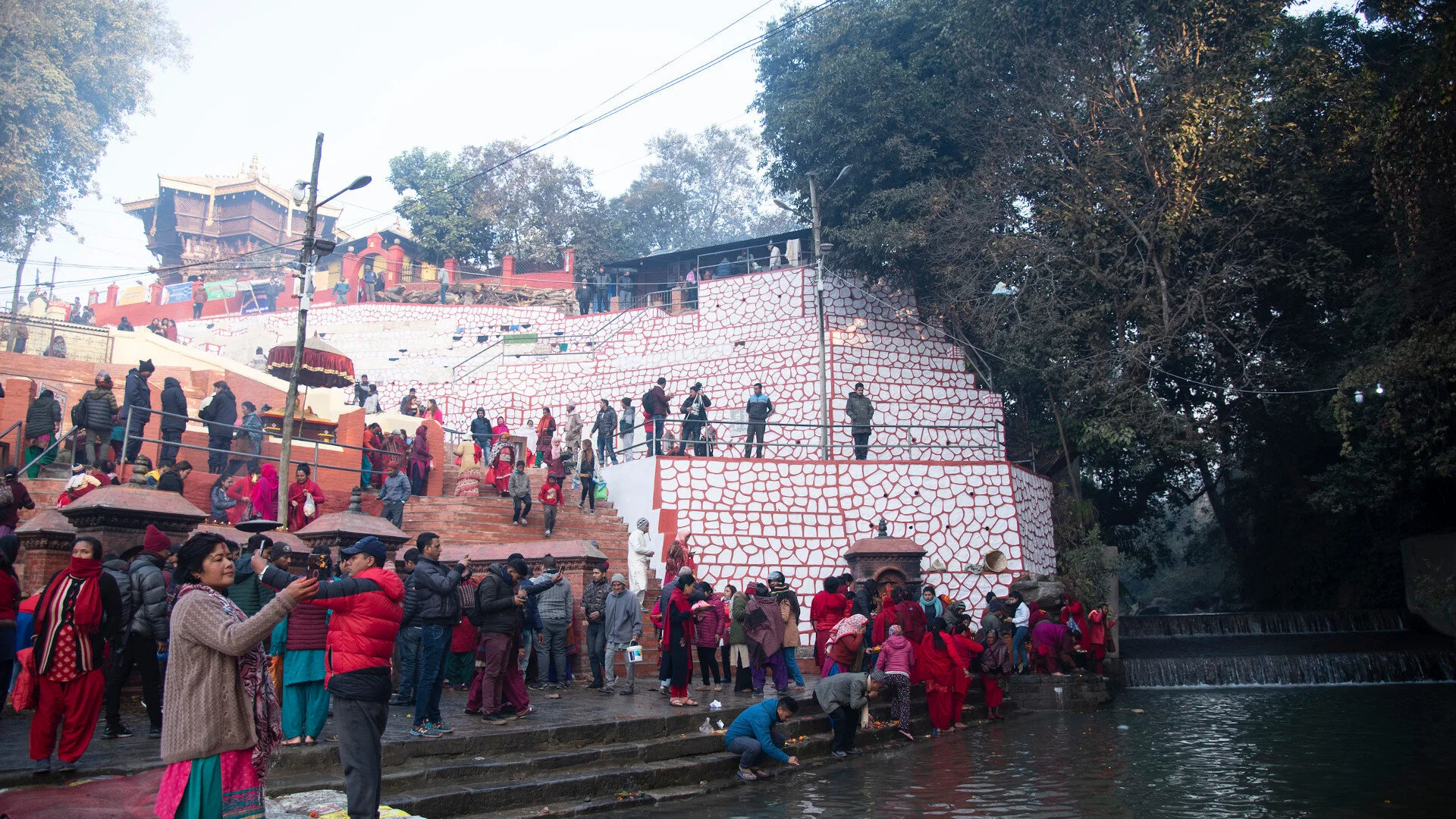
Every year during the full moon of Poush Shukla, devotees flock to the holy river of Shali Nadi in Sankhu to offer their prayers to Goddess Swasthani and God Madhav Narayan. Devotees fast for their family’s prosperity till the next full moon. During the month family members read the book of Swasthani.
Every year during the full moon of Poush Shukla, devotees flock to the holy river of Shali Nadi in Sankhu to offer their prayers to Goddess Swasthani and God Madhav Narayan. Devotees fast for their family’s prosperity till the next full moon. During the month family members read the book of Swasthani.
The month includes various rites and rituals performed for prosperity and well being, devotees arrive at the holy river before the crack of dawn. Offer their prayers at the Madhav Narayan temple, take a holy dip in the river and perform various rituals. The Swasthani Brata Katha believed to be first written in Newari is a sacred text based on the Goddess Swasthani. Goddess Swasthani is believed to be a four handed goddess placed in the centre of the Asta Matrika’s. The Asta Matrika’s ( Brahmayani, Maheswori, Kumari, Vaishnavi, Indrayani, Barahi, Chamunda and Mahalaksmi), are protective deities worshipped in the Newar pantheon who are the feminine energy (Shakti) of Brahma,Vishnu,Shiva, and Indra. The ancient cities of Kathmandul, Lalitpur and Bhaktapur are protected by a ring of Asta Matrika temples.
Swasthani Brata Katha is a tale narrated by Lord Kumar also known as Kartikay, the elder son of Loed Shiva and goddess Parvati, to Shanta Muni Agasthi about the formation of the universe. The tale begins with ‘Kumar Ji Agya Garnu Huncha Hey Agasthi Muni‘ which means ‘Lord Kumar Shall Ask Agasthi Muni’. The chapters in the book is mainly about the devotees who performed sins due to their ignorance and were rescued by goddess Swasthani after they performed fasting and puja to please her. Some of the scriptures are focused on goddess Parvati and some about Sati Devi, (Lord Shiva’s first wife) and goddess Swasthani recuing her from her dismay.
The mention of Sali River (Nadi), situated in Sankhu, in the Swasthani Brata Katha makes it a major holy place for the revellers to visit during the month of Swasthani.
POPULAR ITINERARIES
SIMILAR POSTS
Boisterous Festivals of Spring
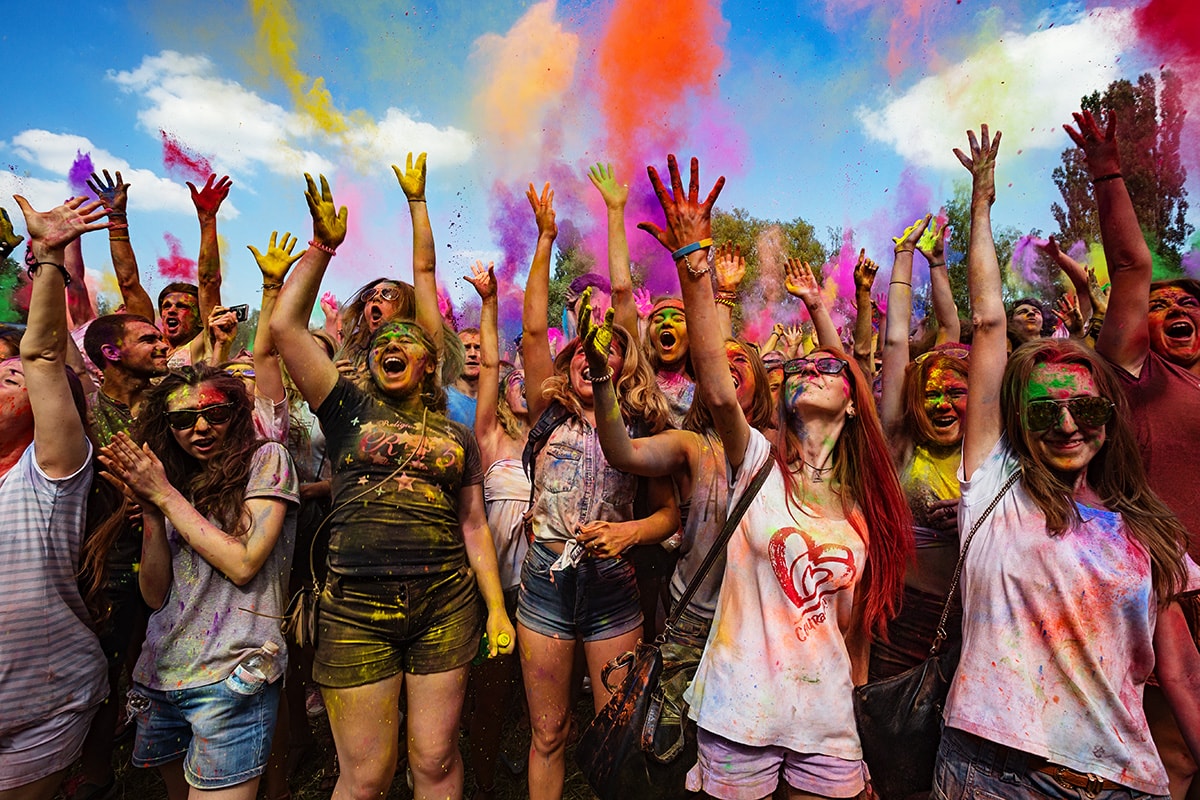
Holi, the festival of colors, is celebrated with great enthusiasm all over the country, and it is a time when one forgets and forgives.
With the waning of winter, arrives many enjoyable festivals. one will witness people of all ages and walks of life throwing color at each other, and friends and acquaintances, sometimes even strangers, exuberantly rubbing color powder on one another’s face. Many young men are likely to be high on the day from drinking ‘bhang’ and eating ‘bhang-ko-laddu’ (drink and sweet containing marijuana). Much ahead of the festival, government authorities put out notices through various media warning that unruly behavior will not be condoned on the day of Holi. Security will be high, since brawls often break out between groups of intoxicated revelers.
Till recently (not so much now), you could deduce that Holi was around the corner due to kids throwing small water-filled balloons (lolas) at passersby, particularly young girls, almost a week before the festival day. ‘Anything goes,’ seems to be the watchword of Holi, and in fact, the favorite cry on the day is in Hindi, “Bura na mano, Holi hai!” especially in the Terai, where Holi is celebrated one day after the one in the hills. The phrase means, “Don’t mind, it’s after all Holi!” In other words, it is a festival that permits you to let out steam, within limits, of course.
The story of a female demon “Holika”
Here is the story behind the festival of colors: It is to celebrate the death of a female demon named Holika, who had been ordered by her brother Hiranyakashyapu to kill his son Prahalad. Hiranyakashyapu, through severe meditation, had won the gods’ blessings that he couldn’t be killed by anybody on earth, water, or sky, using whatsoever means, and thus he considered himself to be immortal, above all beings.
So, when he discovers his son worshipping Lord Vishnu, he gets enraged. He orders his sister Holika, who herself has won a blessing to be immune from fire, to grasp Prahalad and jump into an inferno. However, somehow or the other, it is Holika who gets immolated, while the boy remains unharmed. There’s another reason for Holi. It is to celebrate Lord Rama’s return to Ayodhaya after his epic victory over the 10-headed King Ravana of Ceylon, who had abducted his wife Sita, thus starting a war.
Raising ceremonial bamboo
The beginning of the festival, in Kathmandu, is marked by raising the Chir pole (a ceremonial bamboo pole having cloth strips of various colors) at Kathmandu Durbar Square. The story behind this is pretty interesting. Lord Krishna, in his heydays, had a flock of adoring women always around him. They were known as Gopinis (Krishna is also known as Gopi). One day, while the women are taking a bath in a river, he steals their clothes and hangs them on a tree. Well, the chirs (cloth strips) represent the Gopinis’ clothes. The naughty Krishna then declares that he won’t be returning the clothes until they remain submerged for some time, offering prayers to the Sun god.
Oil wicks on a cow dung base are kept lighted at the bottom of the Chir, and ceremonial threads tied around it. The setting up of the Chir heralds the start of the Holi festival. In the same way, its lowering announces the end of Holi. Once lowered, the waiting crowd rushes forward to grab the cloth strips, which are regarded as lucky charms. The Chir pole is then dragged to Tundikhel and burnt. Women throw coconut shells into the bonfire, and people collect the glowing coals and ash, which will be used for purifying their homes. In the Terai, Holi is celebrated as boisterously as in the hills, and in many areas, more so. People invite friends to their homes to enjoy special delicacies. All said and done, Holi is the most colorful festival of all festivals in Nepal, and a time when old grievances are forgotten and forgiven.
POPULAR ITINERARIES
SIMILAR POSTS
The Many Abodes of Lord Shiva
Lord Shiva, one of the three main deities of Hinduism, has numerous devotees all over Nepal and the Indian subcontinent. He also has many temples all over the country.
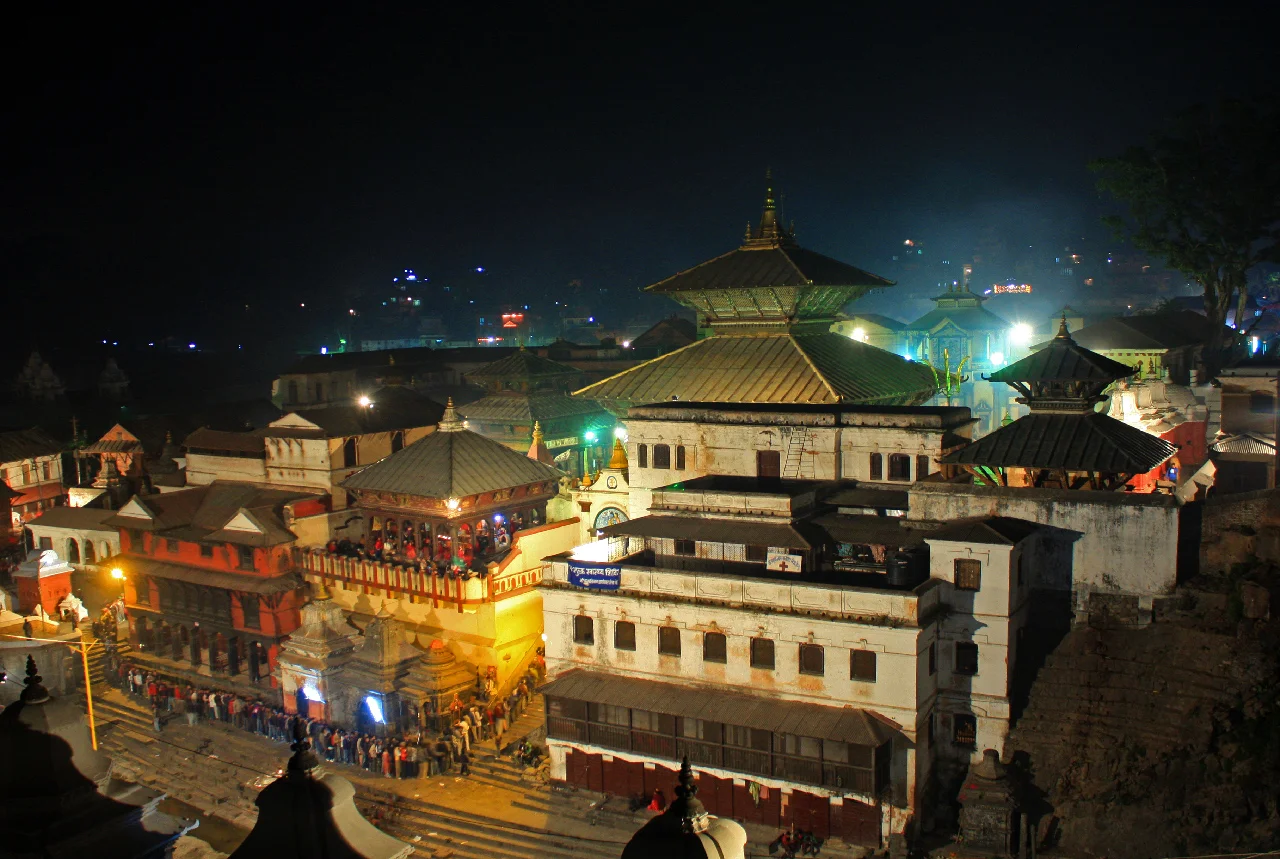
Come February 24 this coming year, Pashupatinath Temple in Kathmandu will be crowded with throngs of devotees lining up in long queues to pay homage to the Lord of Creation and Destruction, Shiva, on the occasion of Maha Shivaratri, one of the biggest festivals in Nepal. Shiva, ‘The Auspicious One’ who goes by more than one thousand names, Pashupatinath (Lord of the Animals) being one such name. He is also known as Omkara (creator of ‘Om’ the sacred Hindu chant), Trilokpati (supreme ruler of the three realms), and Mahadev (greatest among the gods).
Pashupatinath Temple is a World Heritage Site monument zone, and exemplary of the pagoda style temples in the country. The complex, located on the banks of the holy Bagmati River, has numerous smaller temples as well as the cremation ghats, where all Hindus wish to have their last rites done. The main temple has silver-embossed doors, two gilded roofs, and a magnificent gold-plated bull facing the main entrance. The bull, Nandi, is the vehicle of Lord Shiva. Although it is believed that a temple stood at the site as far back as the 5th century, the present day temple dates to A.D. 1653.
Shiva is worshipped in his aniconic form of the Lingam (a phallic symbol representing divine generative energy), and inside the temple is six-foot-tall lingam with four faces. Besides Maha Shivaratri (the night of Shiva), Pashupatinath Temple is the focal point of religious occasions such as Teej, Sankranti, Ekadasi, Rakshabandhan, etc. Maha Shivartri is obviously the biggest occasion, and during this time, one will find a large contingent of ash-covered and dreadlocked sadhus who congregate from within and outside the country, especially India, to celebrate the night dedicated to the veneration of their lord, Shiva.
Similar will be the scenario, of course on a smaller scale, in the many Shiva temples throughout the land, of which there are some that are more famous than the others. One is Haleshi Mahadev in Khotang of eastern Nepal, which is popular as the Pashupatinath of the east. It is located within a cave in which Shiva is said to have hidden once during a battle with the demon Bhasmashur.
Nearer the capital, in Sipadol of Bhaktapur, is Doleshwor Mahadev, the deity of which is believed to be the head of the divine bull, a subterfuge Shiva had taken recourse to, to avoid the Pandavas who had come to him to seek his forgiveness for the large number of killings during the epic Kurukshetra War (as described in the Mahabharata). The Pandavas, on recognizing the bull as Shiva, had tried to stop him by pulling his tail, upon which the head had been severed, and lost for the next 4,000 years.
Further up in Panauti, some 32 km from Kathmandu, is located one of the tallest and largest of Nepal’s pagoda temples, the Indreshwor Mahadev Temple, dedicated to Shiva. It is situated in a large brick paved courtyard that also has some other temples. In addition to its magnificent three-story roof, the temple has fine woodcraft on its doors, windows, doors, and struts. The lingum inside the temple is said to have been created by the Lord himself.
Similarly, in Kirtipur, is another splendid shrine of Shiva called the Uma Maheshwor Temple. It is dedicated to both Shiva and his wife Parvati, and is also called Bhawani Shanker Temple. Two massive stone elephants with spiked backs stand guard on two sides of the stairway leading up to the three-roofed 17th century temple.
About 10 km from Kathmandu city center is a newly formed municipality called Gokarneswor, wherein is located the Gokarna Mahadev Temple, said to have been built in the 16th century. The temple has a beautiful golden torana above the main doorway, with Uma-Maheswor as the central figure. A large number of pilgrims make their way to the temple in late August or early September on the occasion of Gokarna Aunsi to honor their fathers, either deceased or living.
Up on Chandragiri Hill (2,251 m), some kilometers from Thankot of Kathmandu, is located the Bhaleshwor Mahadev Temple. Behind its founding, as is the case with many other temples, lies an interesting piece of mythology. Shiva’s favorite consort, Sati Devi, commits suicide by jumping into the sacred ritual fire of the yagna being conducted by her father, because he insults Shiva in the presence of those present, which includes many kings and princes. Shiva, in his wrath, embarks on a journey of destruction, carrying Sati’s corpse on his back. Where parts of her corpse falls, become venerated as ‘shakti-piths’ (power centers), and the place where her forehead falls, Chandragiri Hill, the Bhaleswor Temple is built.
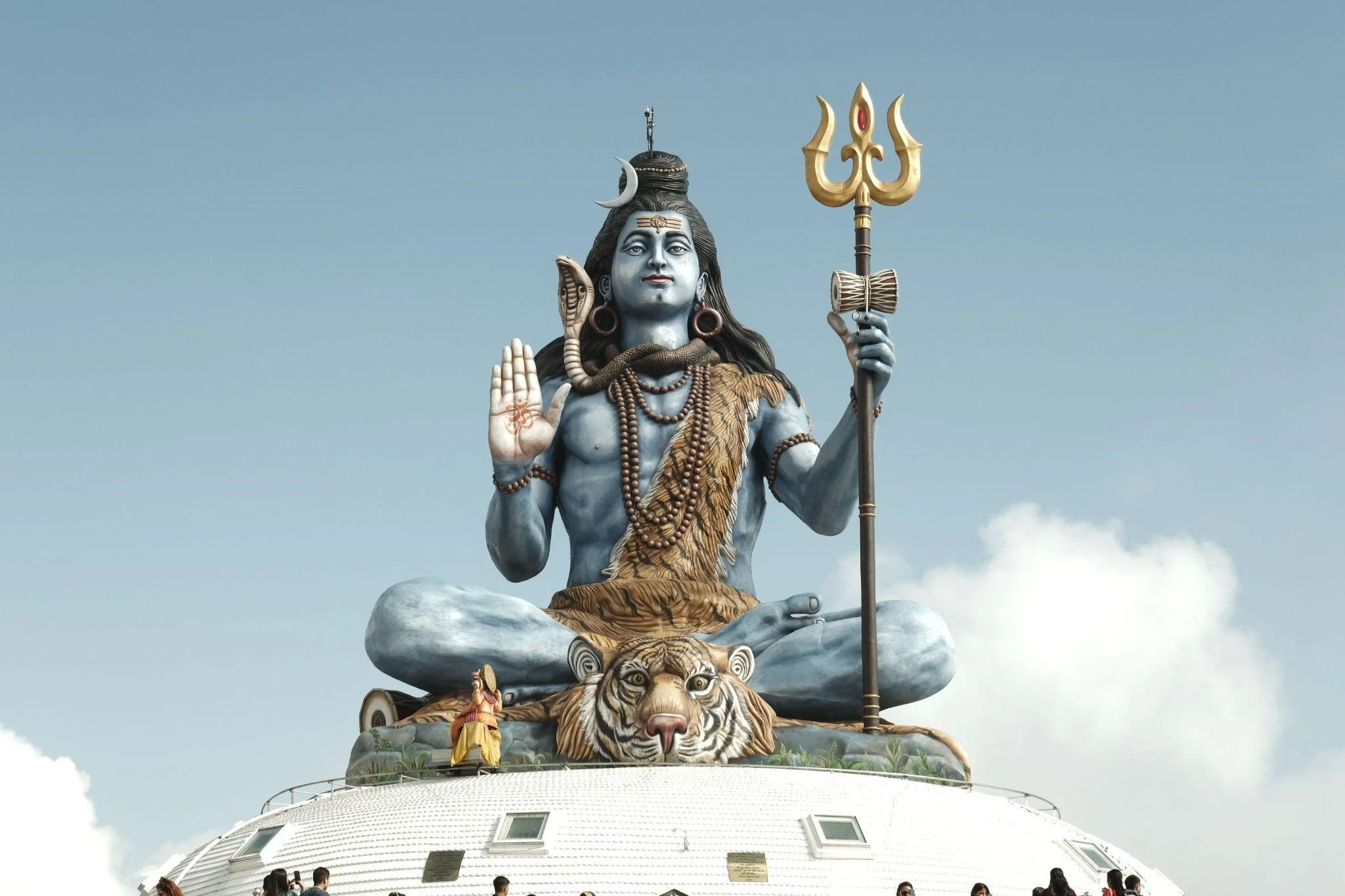
One of the most recent additions to Shiva centers is the Kailashnath Mahadev statue at Sanga, some 20 km from the capital. This is no ordinary statue, being 144 ft in height, making it among the tallest statues in the world, and probably the tallest Shiva statue anywhere. Finished in 2014, it’s quite a tourist attraction today.
Nepal’s Most Popular Festival, Tihar
Tihar is the most popular festival for many Nepalis, and this is because of the many fun activities that take place during all of its five days.
Ask any Nepali what their favorite festival is, and chances are that most of them will say, Tihar. Also known as Deepawali (festival of lights), it’s a really fun festival lasting five days, during whichtime, dogs, crows, cows, Goddess Laxmi (goddess of wealth), oxens, and brothers are worshipped on different days. And, yes, in the order mentioned above.
November 9, the first day of Tihar, is known as Kag (Crow) Tihar. Now, if you are wondering why crows, of all birds, should be so honored, know that they are the messengers of Lord Yamaraj, the god of death. So, people try and ensure that these deadly messengers don’t carry the wrong message to their master, by feeding them delicious tidbits on at least one day of the year. A plate full of such delicacies is kept outside in the courtyard or the terrace of every Hindu household.
November 10 is Kukur (Dog) Tihar. Dogs get their deserved due on this day, and you’ll see all sorts of dogs, even some of the X-breeds on the streets, with a garland of marigold around their necks, and with bright red tikas on their furry heads. They are treated to teeth gnashing, lip smacking morsels especially prepared for them. Most people feed them a couple of boiled eggs along with other delicacies. Now, you might be thinking that it’s a day to show one’s gratitude towards dogs for being such loyal friends, but there’s more to it than that. Dogs are believed to guard the gates to the netherworld, and their master is yes, the lord of death, Yamaraj himself! So, it’s a good idea to ingratiate oneself with animals so well connected with death. Everybody dies. Remember?
November 11 is Gai (Cow) Tihar. The cow, a most sacred animal for Hindus, has always been the national animal of Nepal (a Hindu kingdom for ages), yet, there were some who believed that this would change in the newly promulgated constitution of the now secular Nepal. However, it has retained its honored position as the nation’s national animal, and so you can imagine that Gai Tihar is a very important day. The cow is a fantastic animal, giver of so many provisions, from nourishing milk to holy manure to soul purifying urine.
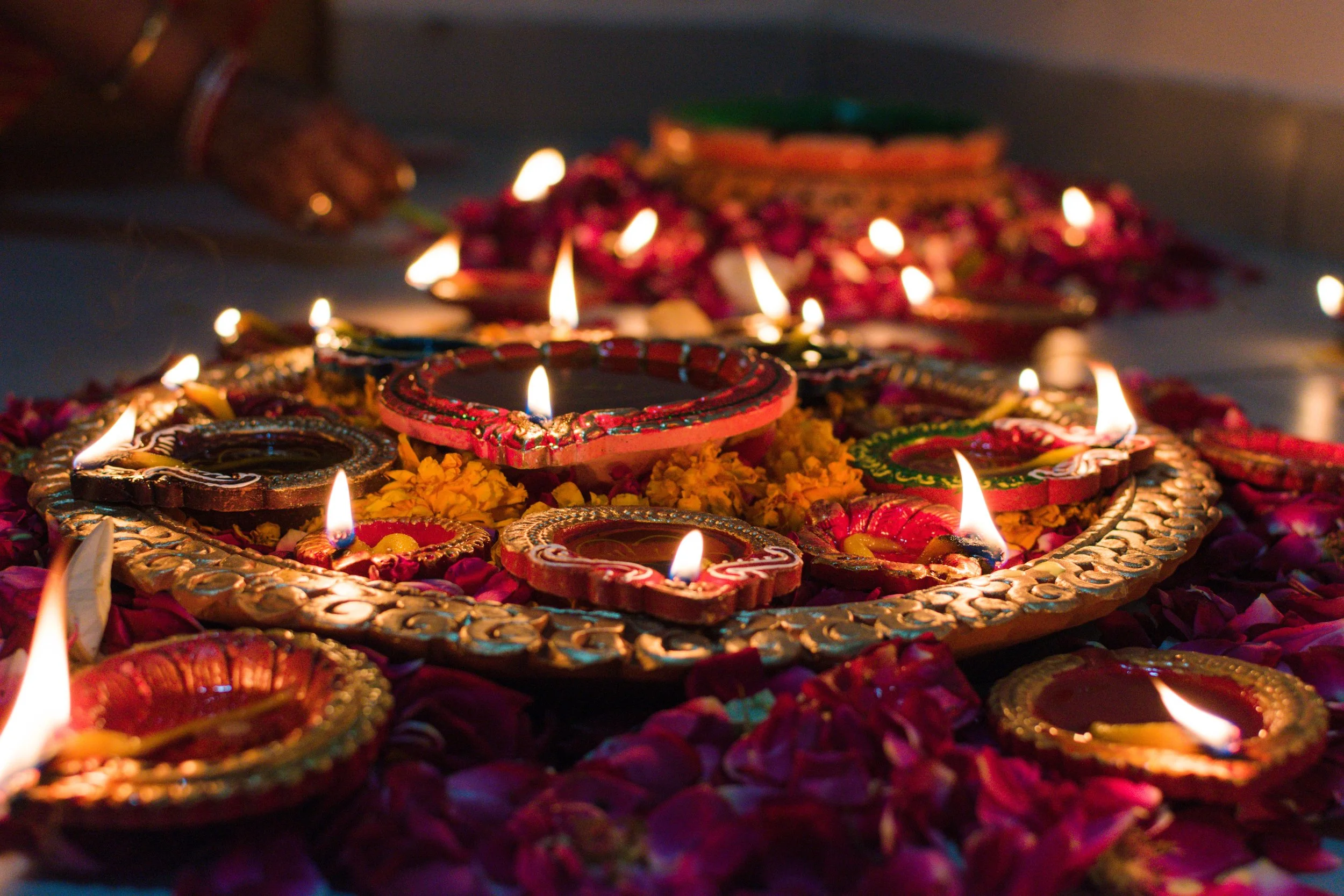
November 11 is also Laxmi Puja, simply the most important day in the lives of all Hindus, for this is the when you get to invite the goddess of wealth, Laxmi, into your humble, or not-so-humble, abode. This is the day when villages and towns and cities twinkle and sparkle with brightly colored lights, and all houses are decorated with strands of marigold garlands over doorways, windows, etc. In the golden days of simpler times, people illuminated their houses with rows and rows of diyos (small earthen vessels with cotton wicks dipped in oil), and it was a tremendously satisfying sight to behold. Nowadays, most houses are illuminated with twinkling strands of electric lights. Still, that is not to say that diyos are not used, they are, but to a lesser degree. Oil has become pretty expensive, don’t you know?
Anyway, the main thing to know is that all homes undergo a thorough cleaning, new curtains are put up, as are new bedsheets, and so forth, and those who can, have their houses repainted. The purpose of all this hard work is to make sure that Goddess Laxmi finds your home up to her standards to pay a visit. To double make sure, she is worshipped with much pomp and fanfare in the evening, with lots of sweetmeats and cash offerings. A female member of the household dips her hands in red mud and imprints them in front of the main doorway, making a trail leading to the puja room. People are expected to try out their luck on this day, and so there’s a fair bit of gambling in many homes, with card games like flush, paplu, and marriage being the favored card games.
November 12 is Goru (Oxen) Tihar, also known as Govardhan (literally, cowdung wealth) Puja. Cow dung has many significant uses: as manure, fuel, and biogas, and for cleansing the courtyards and other surroundings of houses, and plastering mud walls of village houses, etc.
November 13 is Bhai (Brother) Tika, a day when brothers are invited to their sisters’ homes to be worshipped. The symbolism is clear: brothers are supposed to be their sisters’ protectors, and they are therefore duly appreciated for this on Bhai Tika. This day is the last day of Tihar, so everybody takes it a bit easy. The puja of the brother is a long drawn out affair, with a lot of merrymaking. Lots of foodstuffs are offered to the brother, plenty of fruits and dry fruits, sweetmeats, homemade traditional bread (sel roti) and other sweets, fried fish and meat, yogurt, alcohol, etc. The sister gets cash or other gifts in return.
There are other asides of this fun festival, with song and dance being the highlights. Girls go to homes in their neighborhood in groups, and dance to the singing of songs known as bhailo. Boys, similarly, go around singing songs known as deusi while some of them dance. They receive cash and foodstuff for their efforts. Another highlight is the setting off of firecrackers on Laxmi Puja day; literally, millions of rupees go up in fire, smoke, and thunder on this day! Dancing, singing, gambling, feasting, firecrackers…indeed, there’s a lot of reasons why Tihar is the most popular festival of Nepal.
There’s a Festive Air in Nepal
The weather is changing, and along with it, there’s a definite festive air around the country; yes, some of the country’s biggest festivals are here.
As I write this, all the factories and workshops and wherever mechanical implements are used in Nepal are festooned with colorful pennants. Owners and workers alike are enjoying a holiday to commemorate Viswakarma, the divine architect and carpenter, one of whose major achievements was the creation of Dwarka city, the birthplace of Lord Krishna, and who is credited with designing and making numerous weapons for the gods of the Hindu pantheon. A statue of the god is installed in the above-mentioned establishments and homage is paid with worship and offerings. This festival is known as Viswakarma Puja.
This day, too, women are flocking to temples to cleanse themselves of any sins committed, consciously or unconsciously, during the year, by worshipping the Sapta Rishis (seven powerful sages; namely, Atri, Bharadvaja, Gautama, Jamadagni, Kasyapa, Vashishta, and Vishwamitra), whose figures are made using cow dung. This day is known as Rishi Panchami, and it is the culmination of the Teej festival that was observed with great joy over the last three days. The women take a purification bath before sunrise in a sacred river such as the Bagmati. In Kathmandu, the focal point is a particular temple in Teku, where a fair is also held on the day. According to tradition, the women are supposed to scrub themselves with mud from beneath an elephant’s foot, along with roots of the tulsi and amala plants. Teeth are brushed vigorously with the stem of an herbal tree (datiyon), and leaves of this tree are also part of the offerings to the sages.
Now, to add to the festive air, the powers-that-be have requested all the countrymen and women to observe the promulgation of the new Constitution on September 20 by lighting lamps in their homes. It’s also a holiday, as perhaps September 21 is too, when the government has planned all sorts of celebratory events. Only thing is, they might be limited to only some parts of the country, the Terai and many other parts having declared September 20 as a ‘Black Day’, and calling for the people to observe a total blackout in their homes. All in all, the following week will be a very interesting week indeed!
Whatever happens in the coming days, no matter who lights lamps and who observes a blackout, all this will probably not dampen the expectancy of all towards the coming month, when the biggest festival of the country, Dashain, will be celebrated from Oct 13 to Oct 27. In fact, most people will have already started planning for it, beginning this month itself, since for many there’s a lot of travel involved. The major highlight of Dashain is that it brings families together, even if it’s just for a few days. People, no matter where they are, make it a point to visit their ancestral homes to celebrate this great festival with their families.
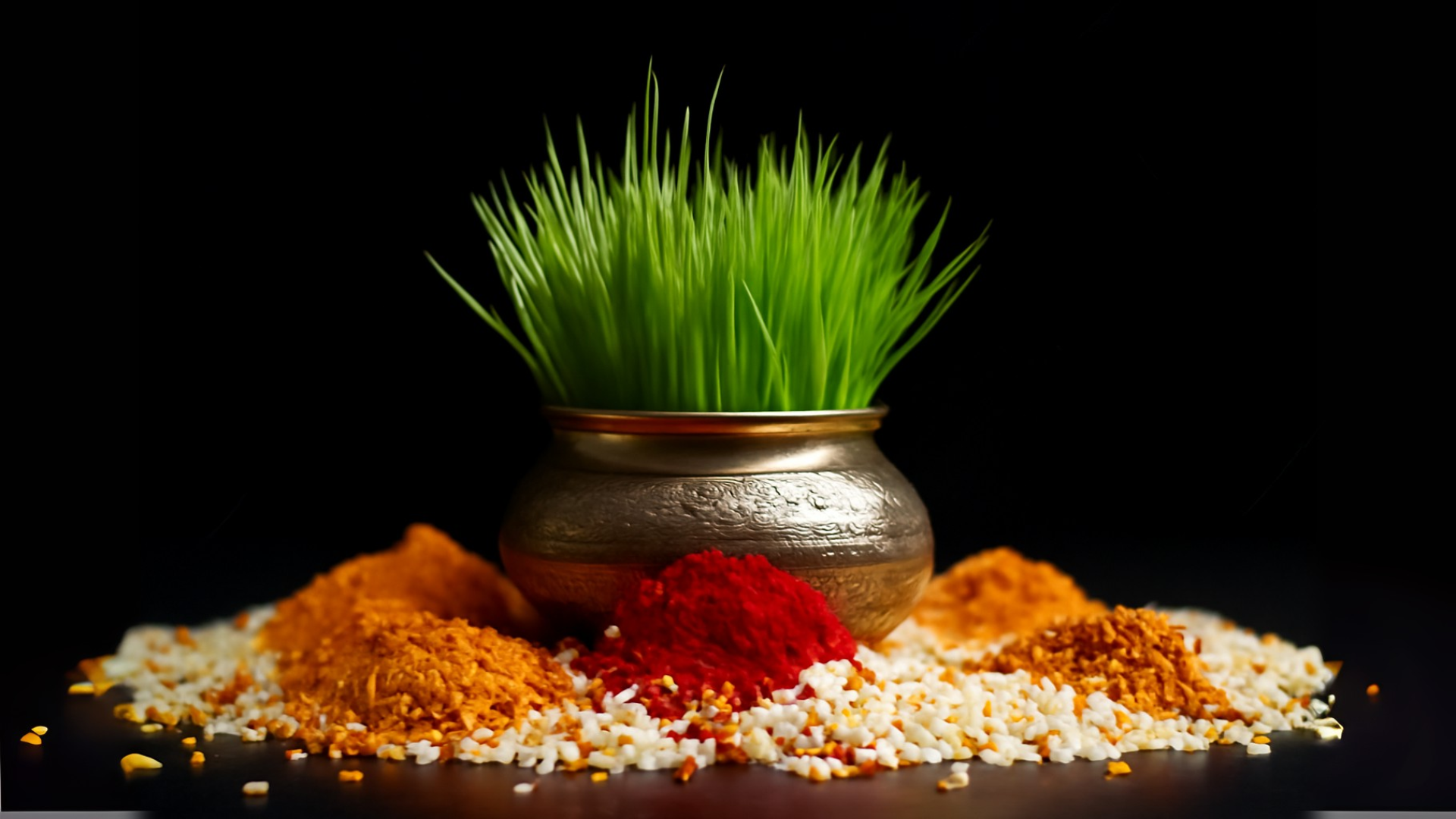
Dashain lasts for 14 days, beginning with Ghatasthapna on Oct 13, when barley seeds are sown in sand-filled earthen pots in all Hindu household puja rooms. The sand will be brought from nearby riverbanks. A thick-wicked lamp is lighted, as well, and the lamp holder is filled with oil continuously to ensure that it remains lighted for the duration of the lengthy festival. Unlike at other times, when women do the daily puja, during Dashain, a male member does the needful for the period. The barley seeds will sprout into lovely yellow leaves (jamara), which have a significant role on the main day of Dashain, that is, Viajaya Dashami on the tenth day.
The first nine days are known as Navaratri (nava: nine and ratri: night). People wake up early all nine days to visit all the temples dedicated to Goddess Durga and her various incarnations. In all homes, families have hearty meals that include plenty of meat dishes. The seventh day is called Phulpati; it is when jamara is brought in from Gorkha to Kathmandu in a palanquin, escorted by -musket carrying soldiers. This ritual apparently has royal tones, since Gorkha is from where its king, Prithvi Narayan Shah, set out to unify the country. The eighth day (Oct 21) is Maha Asthami, when hundreds of thousands of buffaloes, goats, ducks, and pigeons are sacrificed in Durga temples throughout the country. Young men vie to test their mettle by slicing the necks of buffaloes and goats with a single slice of the khukuri. The night is called Kal Ratri (black night).
The next days is Maha Nawami. It is when soldiers of the Nepal Army perform their own sacrifices at the Hanuman Dhoka courtyard, with officers and foreign dignitaries in full regalia in attendance. The scene is all the livelier with the military band belting out vigorous tunes, and cannons blasting off salutary shots. The Taleju Temple nearby is also a focal point on this day, because its doors will be opened to the public on this particular day only. A lot of devotees will line up patiently for hours to get a rare darshan of Goddess Taleju.
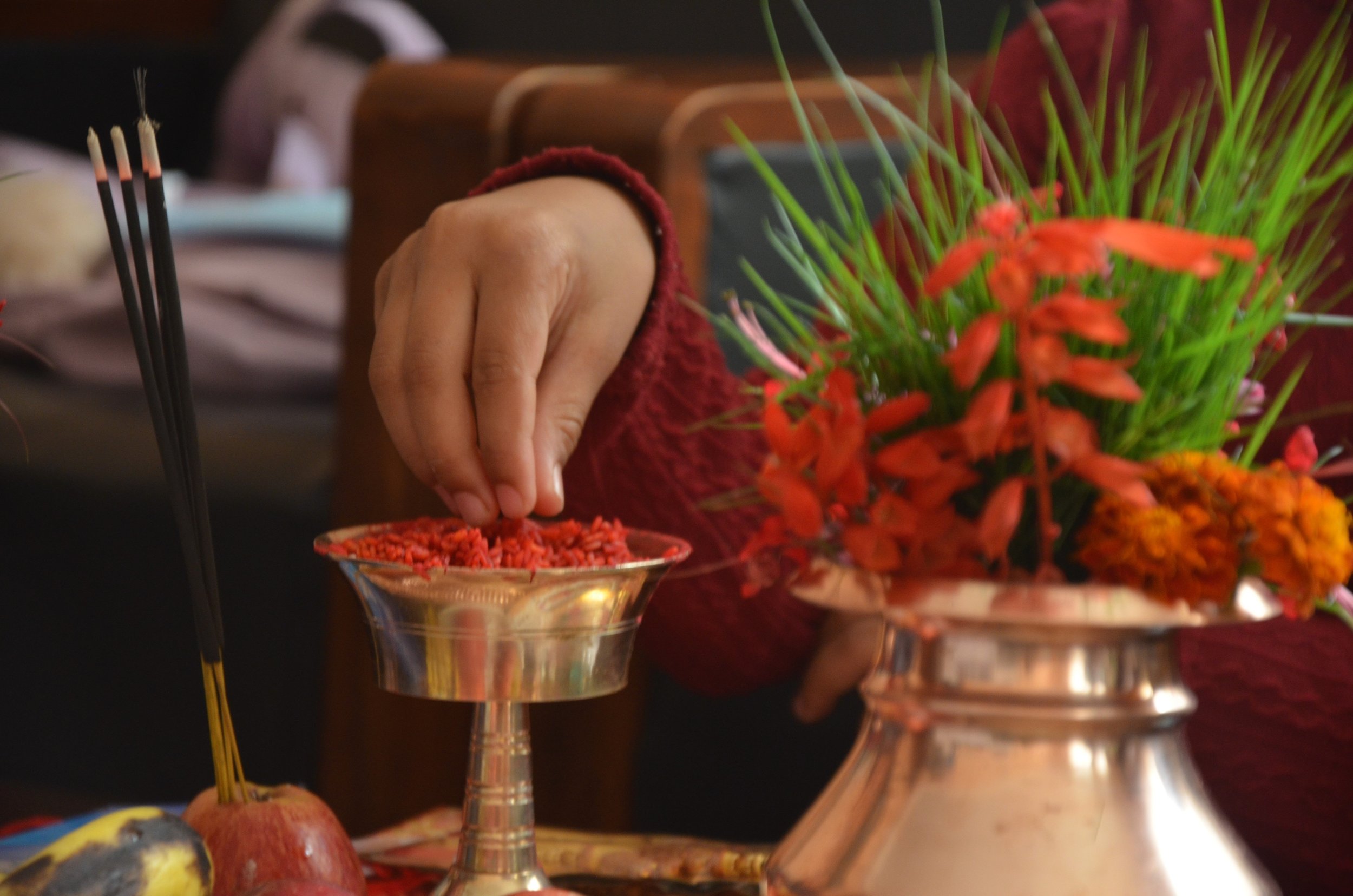
The tenth day is the main day of Dashain. It is called Vijaya Dashami, as well as Tika. Family seniors will put tika (mix of vermillion powder, rice, and curd) on juniors’ foreheads, and offer sweets, fruits, and money, along with some jamara, which will be either put on the head, or behind the ear. After tika is over in their home, people will go visit all their relatives to put on tika and get blessings from elders. It is quite a hectic day, even if it is full of joy. Though it’s the last festival day, the coming four days are also observed as part of Dashain, these four days being used to complete visits to more relatives. The final two days are known as Kojagrat Brata (Oct 26), and Purnima (Oct 27), which is a full moon day, and the end of the greatest festival of Nepal.
Oh yes, there certainly is a festive air around the country, and people are certainly going to have a great time, regardless of the political shenanigans and the aftermath effects of the great earthquake of April 25, 2015.
POPULAR ITINERARIES
SIMILAR POSTS
Bisket Jatra, Boisterous to the Extreme
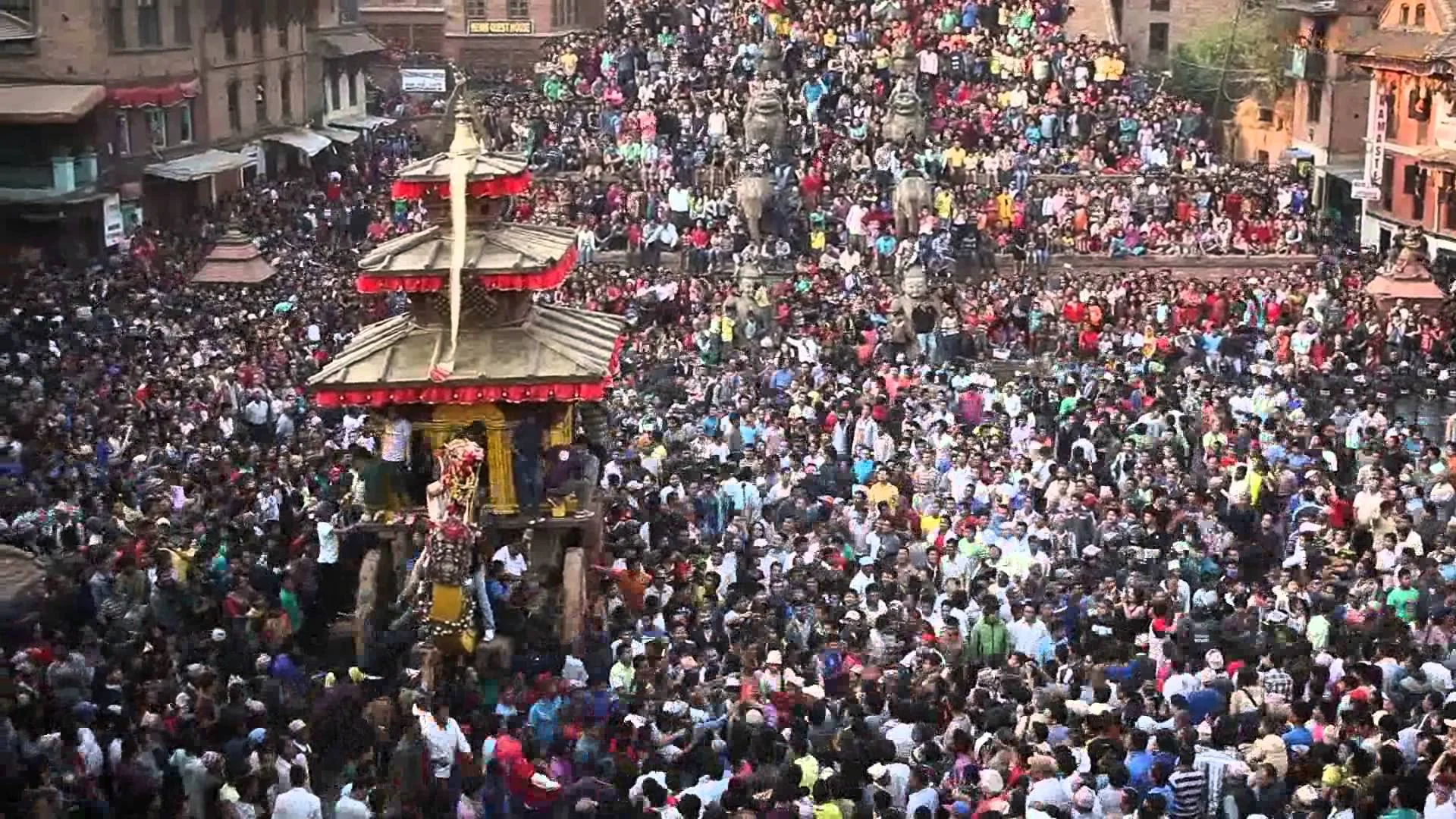
Here’s a chance to participate in a festival that’s pretty boisterous, a festival in which two huge wooden chariots are pulled by hundreds of enthusiastic folks — in all directions!
Bhaktapur’s Bisket Jatra is one spectacle that’s hard to get out of the mind once you have been part of it. And, it will be a fortunate thing if there are no fatalities due to accidents during this festival. Yes, it has claimed quite a few victims in the past, some of whom have been crushed under the chariots’ mammoth wheels, while some have been unlucky to be at the wrong spot when the chariot itself overturns (yes, this happens sometimes). You see, it’s not a simple matter of tugging the chariots along a specific path; more often, different groups try to pull the chariots in different directions. The groups concerned are factions of various localities of the historical city, and to add to the bedlam, many of them are high on strong local liquor. Certainly, saying that the Bisket Jatra is a lively festival would be somewhat of an understatement.
Celebrated for a week before, during, and after the Nepali New Year (April 14) in Bhaktapur, the festival’s origin is quite interesting. King Jagajyoti Malla (1613 to 1637) was much enamored by a legend about a cursed princess, which went like this: whoever married her died the day after the first night, and there was no consummation of the marriage, either. Several young men thus lost their lives, quite unfulfilled! Then, along came one more brave young man who was willing to take the risk of marrying the cursed princess. He, however, came with a definite plan. No matter what happened, he was determined to stay awake the whole night of the honeymoon. And so, on the fateful night, he witnessed a sight that scared the living daylights out of him. As the princess slept, a fearsome-looking serpent slithered out of one of her nostrils. Terrified as he was, the new groom did not hesitate, and with a single stroke of his sword, cut off the serpent’s head. This was the legend King Malla wished to be remembered through the Biket Jatra festival every year (originally known as Bisyau Jatra).
During the festival, two massive wooden chariots (raths) carrying the gods Bhairab and Bhadrakali, along with various other gods on palanquins, are taken in a procession through the different localities of the ancient city. Hundreds of young men pull on strong ropes to move the chariots. The chariots are rested at certain places, where the people of that locality come to pay their respects to the deities. Around the same time, two tall wooden poles (lingos) are installed in separate places around the city. On the day of the New Year, the bigger one is brought down, and the two raths are crashed against each other. The bringing down of the pole symbolizes the slaying of the serpent, while the clashing of the raths symbolizes successful consummation of the marriage.
All these activities of bringing down the pole and crashing the chariots against each other is when things turn really active, and the atmosphere becomes rowdy and boisterous. And, this is also when accidents can happen. The pulling and pushing of the massive chariots becomes somewhat like a tug of war between groups of hundreds, and the bringing down of the pole is also a very contentious affair, with different groups vying for the honor to do so.
A typical Bisket Jatra program goes like this:
Day 1: The two chariots (carrying Bhairab and Bhadrakali) start off from Taumadhi square
Day 2: Palanquins with statues of other gods and goddesses are taken in a procession
Day 3: Same as Day 2, that is, palanquin procession of different deities
Day 4: The day before New Year; pillars are erected in pottery square and Yosinkhel
Day 5: New Year; people have feasts in the morning. The pillar in Yosinkhel is brought down, while the two chariots are crashed against each other near Taumadhi square.
Day 6: Festivals in nearby Thimi and Bode; Balkumari Yatra and Sindure Jatra in the former and tongue-piercing ceremony in the latter.
Day 7: Worship at temples of the eight mother goddesses (Astamatrikas)
Day 8: Bringing down of wooden pole in pottery square.
Well, here’s wishing you a memorable outing during the Bisket Jatra, and hope you take good care of yourself. Safety first, is what we say!