
Nepal Today, Bargain of a Lifetime
Visit Nepal now to take advantage of some really fabulous bargains, and in some really exciting places.
“People have been traumatized, but you can’t cry all the time. People are united to work together to overcome the national crisis…Things are getting better...Schools have opened. People are quite positive, they have started laughing and partying…There is a strong sense of unity to rebuild Nepal.” So says the owner of a travel agency in a feature titled, “Nepal prays for return of tourists after earthquakes” by Natalie Paris (http://goo.gl/lvpzIl).
Indeed he is right. Kathmandu has gained backed much of its vibrancy. There is optimism in the air. The making of a “New Nepal” is the mantra that’s very much in vogue today. Even the official bodies, which have more or less been criticized in the past as being laggardly in their duties, appear to be galvanized. The World Heritage Sites are being opened to the public very soon. Most of the popular trekking routes are in operation, and tourist destinations are offering fantastic discounts on lodging, boarding, and many adventure activities.
For instance, Pokhara hotels are offering a hefty 50% discount on their rooms, and attractive rebates on transport fares and adventure activities. Pokhara Tourism Revival Committee Coordinator Ganesh Bahadur Bhattarai has been reported as saying, “We have offered 50 per cent discount on hotels, zip flight and bungee jump, 20 per cent discount on bus fare, 30 per cent in paragliding and 15 per cent on ultra light flights.” (http://goo.gl/ls8ctC).
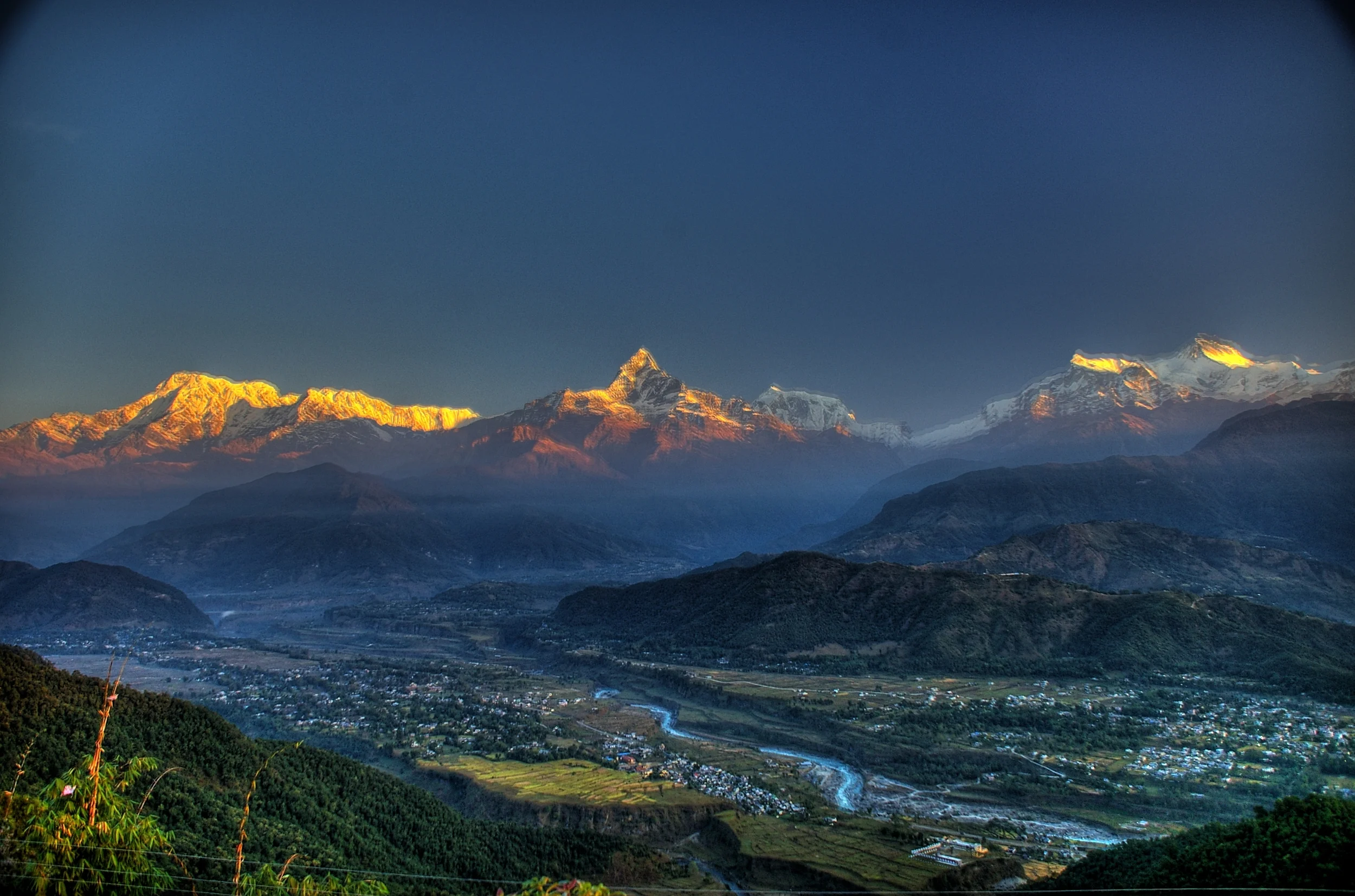
Lying about 200 km west of Kathmandu, by air, it’s a short flight of just 30 minutes. Driving down from Kathmandu can also be a most pleasant trip, taking around 5-6 hours. Also known as the ‘Lake City’, Pokhara has a number of lovely lakes, with Phewa Tal, the second largest lake in Nepal, being the most famous. The richness of its natural beauty has to be seen to be believed, and the reflection of the magnificent Machhapuchchhre Himal (6,993 m), on Phewa’s serene surface is an unforgettable sight.
Pokhara is also one of the best places to go to for some adrenaline rushing activities. It is reportedly one of the top five destinations worldwide for paragliding. You take off from Sarangkot (1,592 m) that is a little over two kilometers from the tourist hub of Pokhara’s Lakeside. Another activity that has become a must-do is flying high on an ultra-light aircraft, which flies up to 5,000 ft for a 15 min-flight over scenic Pokhara. If you wish, 30-min and 60-min flights can also be availed of. The former takes you near to Machhapuchchhre, while the latter takes you up to 12,000 ft for a fantastic bird’s eye view of the entire Annapurna Range. There are other exciting activities, as well, such as white water rafting, ziplining, bungee jumping, and so on.
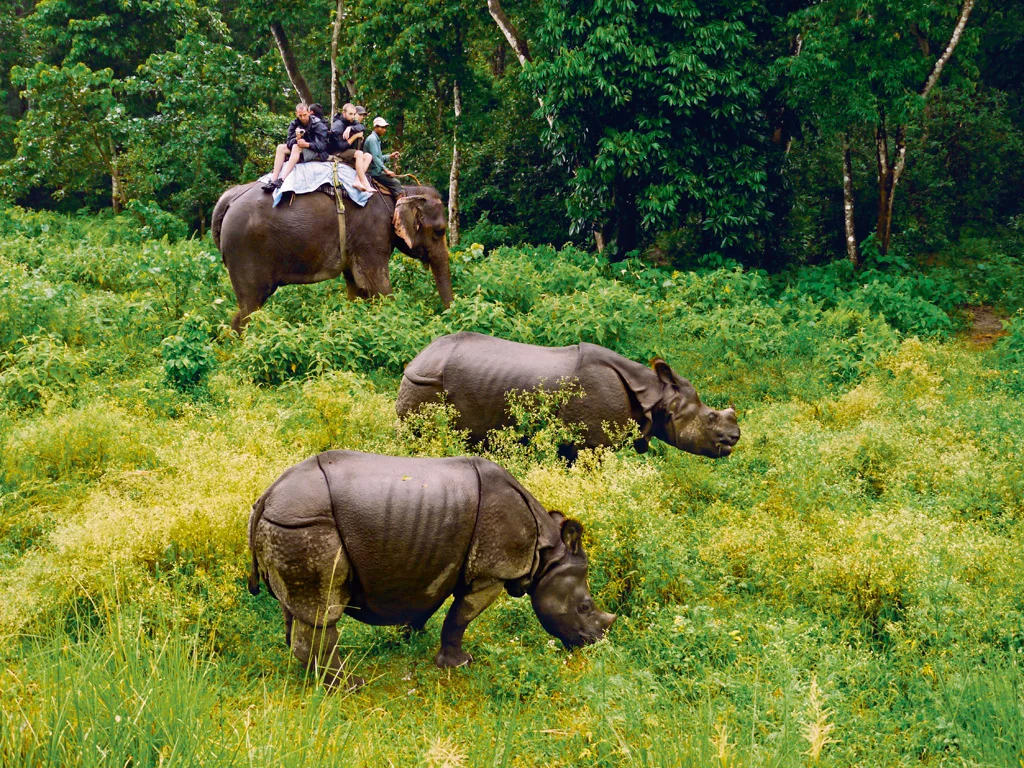
Similarly, Chitwan hospitality entrepreneurs are offering massive rebates to visitors coming to Sauraha, where the Chitwan National Park, another World Heritage Site, is situated. The Regional Hotel Association, Chitwan, has decided to offer 50 per cent discount to both domestic and international tourists on all accommodation, which include about 100 hotels and some of the finest resorts in the world. Elephant safaris, jungle walks, canoeing, wildlife watching, and bird watching, etc. are extremely popular activities in the world famous park. Of the around 2000 remaining one-horned rhinos in the wild today, Chitwan National Park has about 500 of them. It also has many royal Bengal tigers, another rare animal, as well as the endangered snout-nosed gharial, besides numerous other mammal, bird, reptile, and amphibian species.
Doubtless, visiting Nepal now could be one of the wisest decisions you make—easy on the pocket, and rich in exciting activities.
Now’s a Good Time to Visit Nepal
The devastating April 25 earthquake caused many deaths and much destruction, but Nepal is rapidly rising out of the rubble to create a ‘Naya(New) Nepal’.
June 15 is when all the seven world heritage monument zones that go to make Kathmandu Valley a World Heritage Site are again open to tourists. The April 25 earthquake reduced some of the relics inside these seven zones to dust, or caused partial damage to some others. Restoration plans are well underway, and this will of course be a prolonged affair, since it is quite an intricate process. And, because Kathmandu has some of the best restorers in the world—restorers who are well versed in their highly specialized craft—one can rest assured that something beautiful is sure to come out of their efforts.
No doubt, even with the destruction caused by the Great April 25 Earthquake, Kathmandu Valley still overflows with such sights and experiences as does justice to its claim to be one of the most interesting places to visit in the world. June 2 was when the highest temperature, 34 degrees Centigrade, was recorded in the valley. A pittance, compared to the near-50s sweeping over neighboring India. Most times, the valley enjoys mild temperate climate, and with the onset of the pre monsoon season, weather-wise, the valley will revert back to its lovely climate again. Just as, with the back-to-business sense of urgency that is very much evident now, Kathmandu is once again open for business, and waits with wide open arms to welcome visitors from around the globe.
While the quake caused untold suffering and many tragic deaths, it also resulted in world media attention on Nepal, leading to millions of viewers becoming witness to the never-say-die-spirit of the Nepali people. It is true that, in addition to its rich culture and heritage and its fantastic natural beauty, Nepal is also known equally as a land of the brave, the hardy, and the hospitable. All this have been on world view for the past month or so. The resolute villagers of the quake affected areas have already begun the process of rehabilitating themselves, and the government and international organization are lending the much needed helping hand with vigor.
The quake has brought people together in a very symbolic way that will hopefully transform into something concrete in the future. The mantra is now of rising from the rubble with strengthened resolve to create a ‘New Nepal’. This is not to mean that ancient heritage will be kept in the backseat. Not at all. Heritage will continue to be part and parcel of whatever route the country’s development takes now, because its proud heritage is what gives Nepal its unique identity. An identity that is synonymous with a high degree of artistic and cultural finesse, a sumptuous richness of natural beauty, and a well established reputation as a country with some of the happiest and most hospitable people on planet Earth.
No wonder then that so many visitors are so deeply impressed when they come here. The wealth of art, craft, culture, and heritage everywhere is impressive, the fabulous scenery all around is breathtaking, and the welcoming smiles of the people is heartwarming. Right now, with the country at the crossroads between the old and the new, could well be one of the most interesting times to visit this interesting country.
Similar Posts
Flying High, the Unique Flag of Nepal
The flags of all countries have a similar shape, except for Nepal’s, which is unique and thus stands alone. Not only that, the Nepali flag is also the most mathematically constructed.
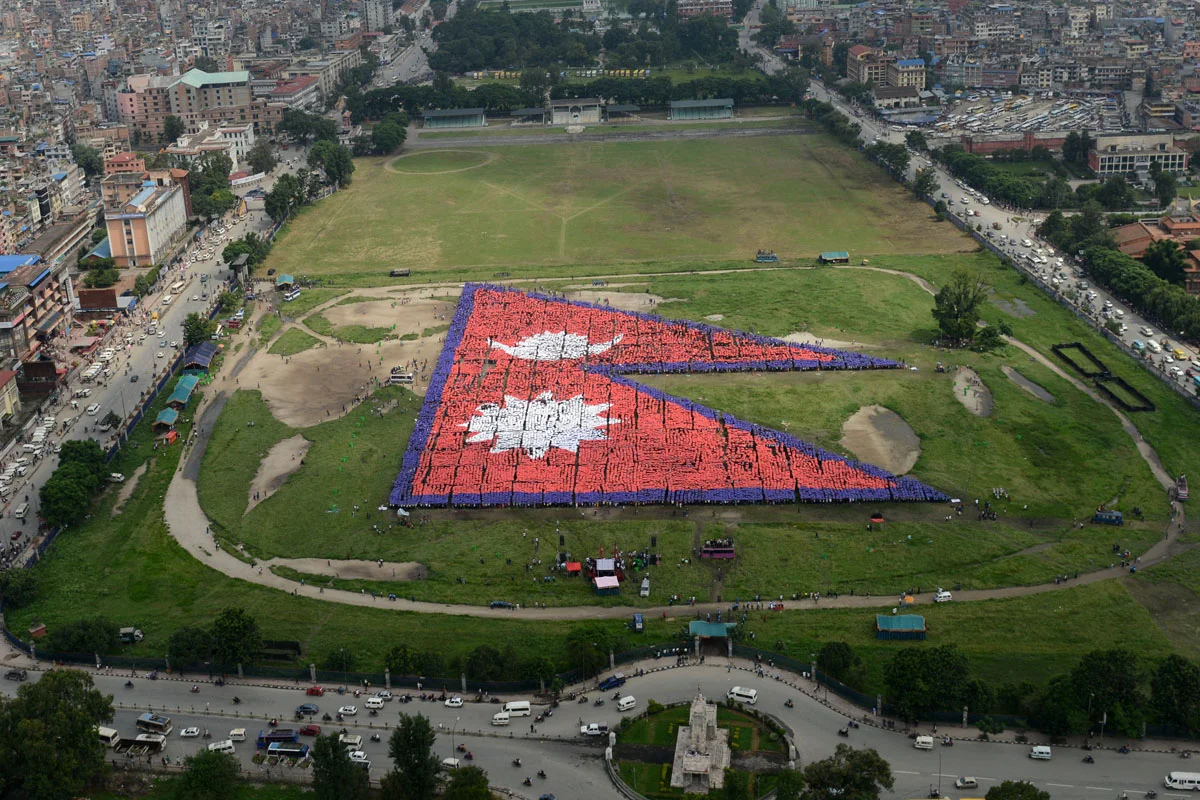
As if Nepal’s flag wasn’t unique enough (it being the only national non-quadrilateral flag in the world), 35,000 people gathered in the center of Kathmandu at the Tundikhel ground on August 23, 2014, to create the world’s largest national flag. The previous world record was made six months previously by 28,957 Pakistanis coming together to create their national flag. However, Nepal’s achievement was a short-lived one, because on December 7, 2014, it was overshadowed by 43, 830 Indians uniting in Chennai to make their flag the world’s largest yet.
But, there is no reason for Nepalis to despair, at least not in the matter of its flag having a unique and prominent place in any chart or list of the world’s flags. In fact, one could say that Nepal’s flag will garner the attention of anyone interested in the science of vexillologv (study of the history, symbolism, and usage of flags). One such person is Dr. James Grime. Well, actually he is not a vexillogist, but a mathematician and a faculty member of the Applied Mathematics and Theoretical Physics Department at the University of Cambridge. He has declared Nepal’s flag to be the most mathematical of all the world’s flags. Coming from such an authoritative person, that is really saying something!
You can watch him on http://goo.gl/gZcaQJ as he draws the Nepali flag, following step-by-step instructions as given in Schedule 1, Article 5 of the Nepal Constitution. The given measurements are exact, and include everything from the outline of the two triangles to the sun and moon emblems to the border. On the video, there’s a clock that times his work, and as far as can be seen, it takes him just half-an-hour to complete the drawing. However, if somebody of a lesser breed than a mathematician were to duplicate his effort, then it goes without saying that it will take a whole lot longer, so intricate are the steps.
As a matter of fact, there are 23 steps in all; precise instructions are given in detail in three sections. The first deals with the measurement of different lines, while the second is about the exact placements and measurements of the two emblems—the sun and the half moon—as also about how many triangles are to be drawn to represent the sun’s rays. The third section gives you instructions on how to draw the border. Finally, the sun and the moon have to be in white color, while the border has to be blue. The rest of the flag is to be in crimson color. There are plenty of instructions such as: draw a line ‘CD’ parallel to “AB”, “RS” should be half of “PQ”, and so forth, with almost all the alphabets being used, except for ‘X’, ‘Y’, and ‘Z’. From this, one can decipher how detailed are the instructions that go into the making of Nepal’s flag. Imagine a procedure consisting of 23 steps and using a total of 27 alphabets to make one flag!
It is generally assumed that the Nepali flag is derived from the pennants of two regimes: one, the bonafide regime of the Shah dynasty, and the other, that of the Ranas, who as prime ministers virtually ruled the country for more than one hundred years (1846 to 1951). Some people assume that the moon emblem on the upper triangle represents the royal house of the Shahs, and the sun on the lower triangle represents the Rana dynasty. According to others, the sun and the moon are said to be representative of the country’s two major religions, namely, Hinduism and Buddhism. Still others believe that the sun depicts the bravery of the Nepali people, while the moon depicts their serenity and peace loving nature. As far as the colors are concerned, most people agree that red stands for bravery and victory, while blue stands for peace.
However you look at it, the Nepali flag, which was officially adopted in its present form on December 16, 1962 (before that, the sun and the moon were portrayed as faces), carries a lot of symbolism, and various facets may have different meanings for different individuals. At the same time, the Nepali flag, like other flags, is a symbol of unity. That it has a distinctive identity all its own makes it all the more significant. In a field of mostly colorful rectangles, the two-triangled flag of Nepal stands out prominently. Now, we also know that it is the most mathematically constructed, and this is a record in itself. So what if we couldn’t keep our record for making the world’s largest flag?
Nepali Woman Power on Everest
Nepali women have had quite a number of successes in conquering the highest peak in the world; some have even set new records
I had the opportunity of once meeting Junko Tabei, the Japanese woman who, on May 16, 1975, at the age of 35, inscribed her name in the history books as the first woman to conquer Everest (8,848 m), the highest mountain in the world. From her, I came to know that on June 28, 1992, she also became the first lady to successfully achieve the ‘seven summit’ feat by climbing seven of the highest peaks in all the seven continents. That aside, she also disclosed that she had already climbed the highest peaks of 61 countries, and that her lifelong goal was to climb the tallest mountains of all the countries around the globe!
Around the same time, I also had the opportunity of meeting Churrim Sherpa, a courageous Nepali lady who was awarded the Guinness World Record Certificate on February 25, 2013, for becoming the first woman to summit Everest twice within a single season (May 12 and 19, 2012). Born in Gusan village of Taplejung district in eastern Nepal, her feat gains even more significance when one realizes that, in 2012, 12 climbers perished while attempting to climb the highest point on earth. As for her getting the certificate only a year later, she admits that it was due to her own ignorance in not having the faintest idea about how to go about laying her claim to one. Anyway, this year too, despite the large number of expeditions attempting Everest, she is again in the limelight for being chosen to carry some equipment of recently deceased Australian cricketer Paul Hughes to the summit. It is a high honor, indeed.
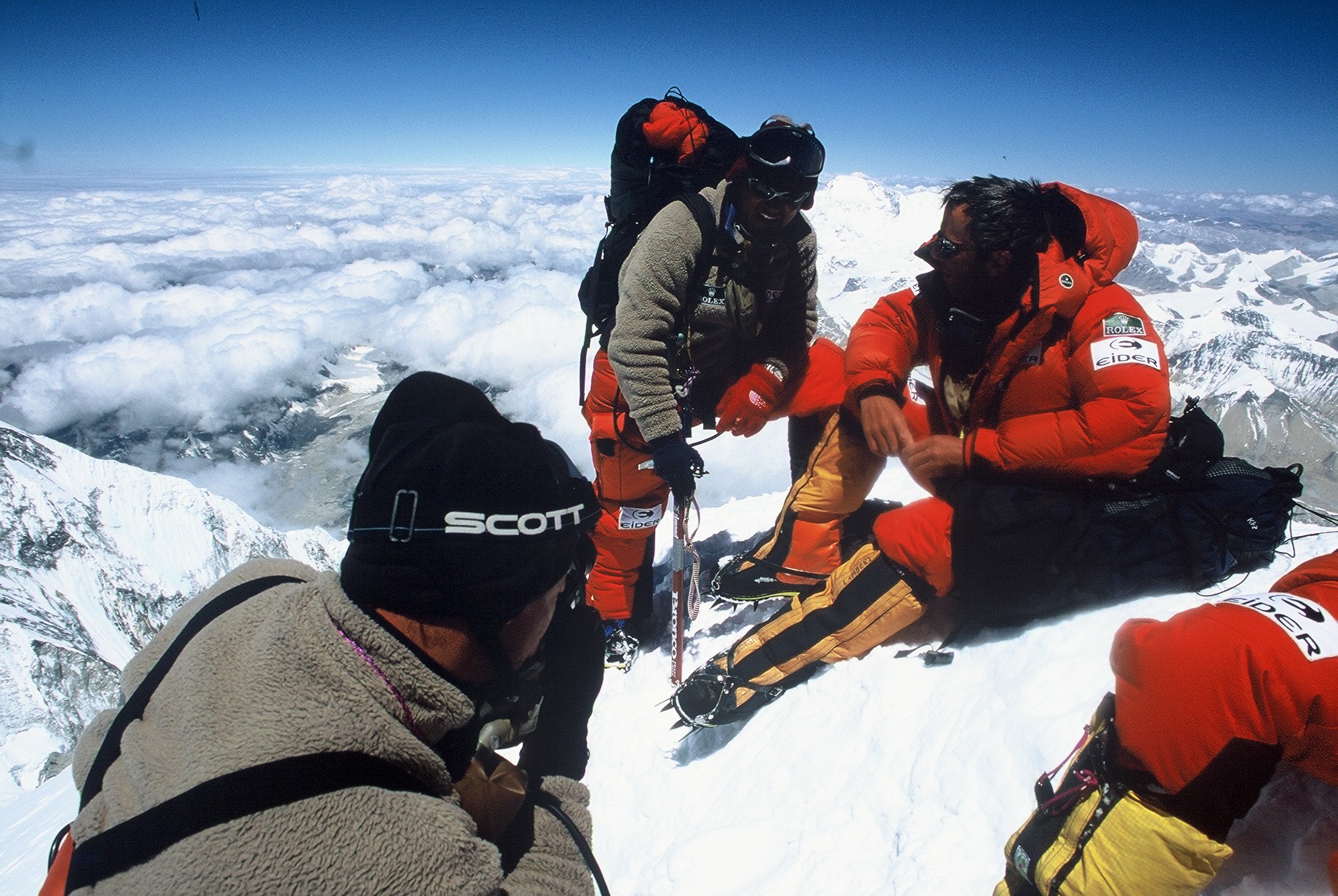
Reminiscing on her double feat in May 2012, she revealed that the first summit had been more difficult due to the bad weather; still, she managed to reach the top at 7:00 a.m. after starting out at 9:00 p.m. from camp 4, despite the “traffic jams” on the route (there were some 150 climbers crowding it at one point!). Concerned about the eager-beaver hordes, and the resulting accidents, she advises that they acclimatize themselves really well before attempting Everest, because even though the so-called “death zone” starts at 8,000 m, the effects of high altitude begin to be felt acutely even after 7,000 meters. She readily confessed that her plan had been to do two climbs, as she wanted to do something different. After the first summit, she returned to base camp for some rest before starting off once more on May 17 for the top.
While Churrim is again earning accolades today, a certain Nepali lady named Pemba Doma Sherpa earned her place in the sun in 2000 for becoming the first Nepali woman to climb Everest via its north face. Her historic climb was as the leader of the Millennium Everest Expedition, and later on, having climbed to the top again via the south face, she became only the second woman to summit via both the faces. She went on to achieve her sixth ascent in 2007, which makes her the record-holder for most successful attempts on Everest by a woman anywhere in the world. Sadly, while climbing the world’s fourth highest peak, Lhotse, she fell from a height of 8,000 m and perished in the mountains she so loved.
Fifteen-year-old Ming Kipa Sherpa became the world’s youngest woman to conquer Everest when she made a successful ascent on May 24, 2003. She had to climb from the Tibetan side since the Nepal government didn’t allow those under 16 years of age to attempt Everest! Ming had company during the attempt in the form of her sister Lhakpa Chiri, 31, and brother Mingma Gyalu. Lhakpa had already conquered Everest in 2001, and she later went on to climb Everest once more from the Tibetan side.
On May 30, 2005, Moni Mulepati, 24, laid her claim to fame by becoming the first non-Sherpa Nepali woman to climb Everest. She was part of the Rotary Centennial Everest Expedition. While at the summit, she achieved another feat by exchanging marriage vows with her climbing partner and beau, 23-year-old Pemba Dorje Sherpa! Although Moni holds the distinction of being the first non-Sherpa Nepali woman to summit Everest, she is no more the only one. In 2008, a group of Nepali women from different ethnicities were assembled to make a team for the ‘First Inclusive Women Sagarmatha Expedition 2008 Spring’ (FIWSE). Its members, ranging in age from 17 to 30, were Sushmita Maskey (team leader), Chunu Shrestha, Asha Kumari Singh Chaudhary, Shailee Basnet, Maya Gurung, Usha Bisht, Pemadiki Sherpa, Nawang Phutti Sherpa, and Nimdoma Sherpa. All of them succeeded in reaching the summit in May, 2008.
However, as expected, it is the Sherpa women climbers who are the achievers of remarkable feats of climbing. For example, Maya Sherpa, who has conquered Everest from both the north and south faces, has also climbed Ama Dablam 6,812 m, Pumori 7,112 m, Cho Oyu 8,211 m, and Khan Tengri 7,010 m, all very challenging peaks, and all for the first time by any Nepali woman climber. Having said all this, it’s now time to recall the most historic day of all in the annals of mountaineering and Nepali women climbers.
Yes, the very first summit of Everest by any Nepali woman. Yes, I am referring to the redoubtable Pasang Lhamu Sherpa (born Dec 10, 1961) and her remarkable achievement on April 22, 1993, the date when this brave lady reached the pinnacle of Everest to become the 17th woman in the world, and the very first Nepali woman, to do so. Her story did not have a happy ending. A nasty turn in the weather on the way down resulted in her death on the south summit. It was only 21 days later that her frozen body was found just 72 meters below the summit—a tragic ending, but not one that was for nothing. Her momentous accomplishment provided the groundwork for more Nepali women climbers to attempt Everest, and she will forever remain an inspiration to all.